Many English learners, writers, and even native speakers regularly search for “affect or effect” because these two words look similar, sound related, and often appear in the same situations. The confusion is so common that affect vs effect is considered one of the most
frequently misunderstood word pairs in English. People struggle with it while writing emails, exams, academic papers, news articles, and social media posts. Choosing the wrong word can make your writing look unprofessional or unclear.
The main reason for this confusion is that affect and effect are closely connected in meaning. In many situations, one word describes an action, while the other describes a result. However, English also allows exceptions where affect can be a noun and effect can
be a verb, which increases uncertainty for learners. This leads people to ask questions like: Is it affect or effect on me? Does this affect the result or effect the result?
This article solves that confusion completely. You will get a quick answer, simple explanations, word origins, British vs American usage, common mistakes, everyday
examples, Google Trends insights, FAQs, and expert advice. By the end, you will clearly know when to use affect and when to use effect with confidence and accuracy.
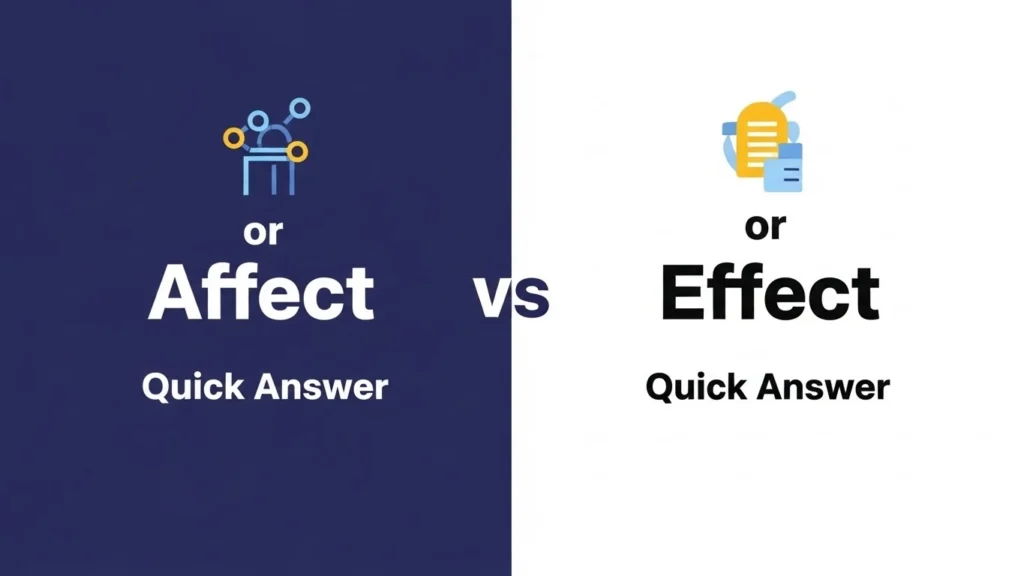
Affect or Effect:Quick Answer
In most cases:
- Affect is a verb meaning to influence or change something.
- Effect is a noun meaning the result or outcome of a change.
Examples:
- Lack of sleep can affect your health. ✅
- Lack of sleep has a bad effect on your health. ✅
❌ Lack of sleep can effect your health. (Usually incorrect) ❌ The affect was serious. (Usually incorrect)
Easy rule:
Affect = Action | Effect = End result
The Origin of Affect or Effect
Understanding the origin of these words helps explain why they are so closely linked.
Origin of “Affect”
The word affect comes from the Latin verb afficere, meaning to influence, act upon, or move emotionally. Over time, it entered English through Old French and Middle English. From the beginning, affect was mainly used as a verb, showing an action that causes change.
Origin of “Effect”
The word effect comes from the Latin noun effectus, meaning result, accomplishment, or outcome. It also entered English through Old French. Historically, effect was used mainly as a noun, describing the outcome produced by an action.
The spelling difference exists because English borrowed both words separately from Latin, keeping their related meanings but assigning them different grammatical roles. This shared origin is the main reason people still confuse affect and effect today.
British English vs American English Spelling
There is no spelling difference between British English and American English for affect or effect. Both varieties use the same spellings, meanings, and grammar rules.
However, frequency and context may differ slightly in academic, legal, or psychological writing.
Examples
- British English: Climate change affects global weather patterns.
- American English: New laws may affect small businesses.
Comparison Table
| Aspect | British English | American English |
| Verb form | affect | affect |
| Noun form | effect | effect |
| Meaning | Same | Same |
| Grammar rules | Same | Same |
Which Spelling Should You Use?
The choice between affect and effect depends on grammar and meaning, not geography.
- US audience: Use affect for influence, effect for result.
- UK/Commonwealth audience: Follow the same rule.
- Global audience: Keep writing simple and clear using the standard rule.
Professional advice: If you can replace the word with influence, use affect. If you can replace it with result, use effect.
Affect or Effect in Everyday Examples
Emails
- This delay may affect the project deadline.
- The changes had a positive effect on sales.
News
- Inflation continues to affect household budgets.
- The new policy had a major effect on the economy.
Social Media
- Stress really affects mental health.
- Exercise has an amazing effect on mood 💪
Formal Writing
- Environmental factors affect human behavior.
- The long term effect of pollution is severe.
Affect or Effect:Google Trends & Usage Data
Search data shows that “affect or effect” is one of the most searched grammar questions worldwide. It is especially popular in:
- United States
- United Kingdom
- India
- Pakistan
- ESL learning countries
The keyword spikes during exam seasons, content writing deadlines, and academic submissions. Affect is more common in scientific and social discussions, while effect appears frequently in results, conclusions, and reports.
This confirms strong user intent for quick clarification with reliable rules.
Comparison Table:Affect vs Effect
| Word | Part of Speech | Meaning | Example |
| Affect | Verb | Influence | Stress affects sleep |
| Effect | Noun | Result | Stress has a bad effect |
FAQs
Is “affect” always a verb?
Usually yes, but rarely it can be a noun in psychology.
Is “effect” always a noun?
Mostly yes, but sometimes it can be a verb meaning to bring about.
Which one means result?
Effect means result.
Which one means influence?
Affect means influence.
Can I say “effect on”?
Yes, effect on is correct.
Can I say “affect on”?
No, it should be affect something, not affect on.
Why is affect or effect so confusing?
Because they sound related and share similar meanings.
Read more about!
Conclusion
The difference between affect or effect may seem confusing at first, but it becomes simple when you focus on grammar and meaning. In everyday English, affect is usually a verb that
shows influence or change, while effect is a noun that shows the result of that change. Remembering this basic rule will help you avoid most mistakes instantly.
There is no British or American spelling difference to worry about, which makes learning easier.
If you are writing emails, academic papers, news articles, or social media posts, choosing the correct word improves clarity and professionalism.
If you are ever unsure, replace the word with influence or result and see which one fits better.
With clear rules, real life examples, tables, FAQs, and usage advice, you now have a complete understanding of affect vs effect.
Use this knowledge confidently, and your English writing will become clearer, more accurate, and more professional.
Related posts!
Me Either or Me Neither: Quick Answer

**Emily R. Dawson** I am a English language writer and editor i specializes in grammar clarity, sentence structure, and common writing mistakes.I focuses on helping readers write correct, natural-sounding English through simple explanations and practical examples. Emily mainly creates beginner-friendly and intermediate-level language guidesmy writing style is clear, supportive, and easy to follow.