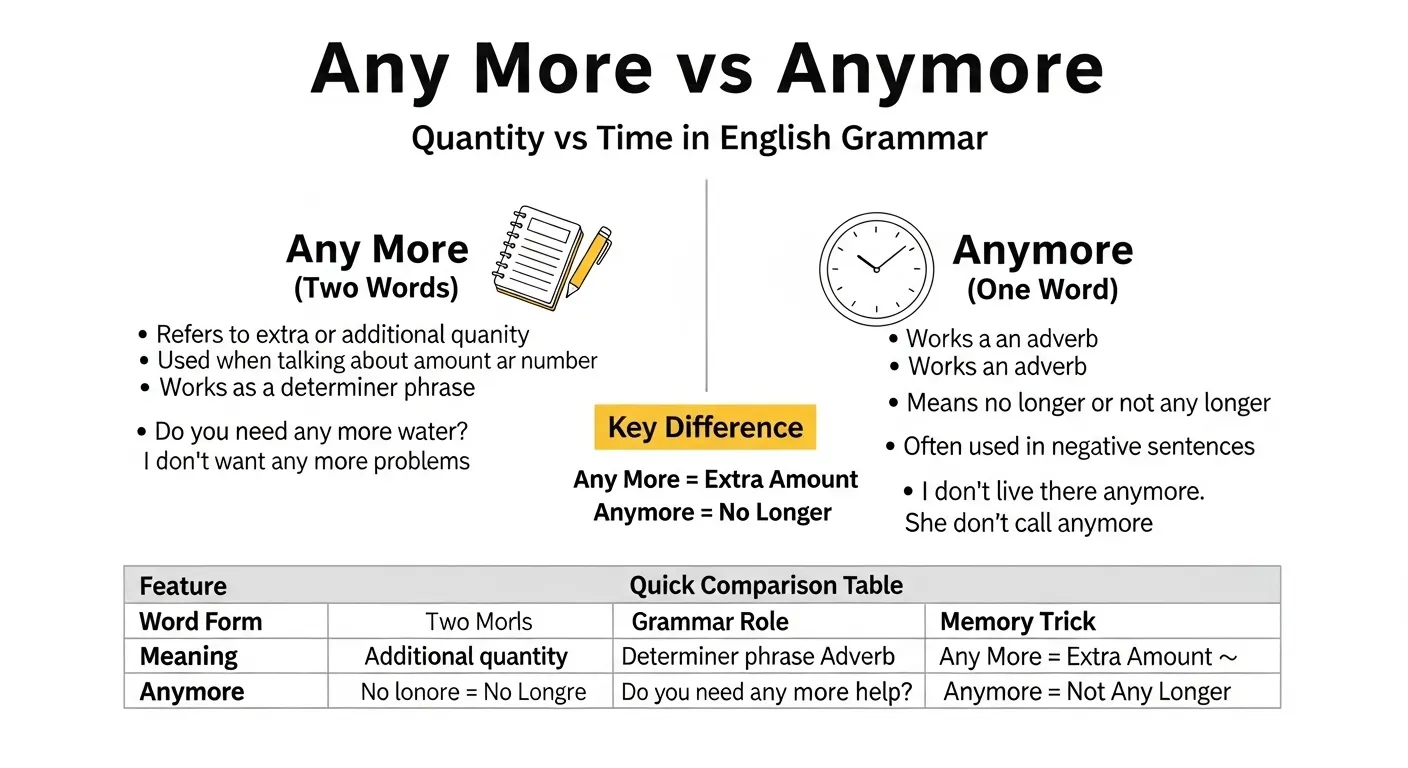
“Any more” is usually used as two words, while “anymore” is one word used mainly as an adverb in negative sentences.
Many English learners and writers get confused because both forms look similar but work differently in grammar.
People often search this topic when writing emails, posts, or professional content and want to avoid mistakes.
The confusion grows because both versions appear in daily English, and regional usage can change how people write them.
This guide explains the difference in a clear and simple way. You will learn mistakes, and real examples so you can use each form with confidence and clarity in everyday writing.
Any More or Anymore: Quick Answer
The difference between any more and anymore depends on grammar and meaning.
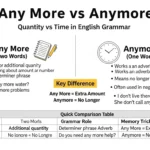
👉 Any more (two words) refers to quantity or amount. It means “additional” or “extra.”
Examples:
- Do you need any more water?
- I don’t want any more problems.
- She bought some apples but did not buy any more.
👉 Anymore (one word) works as an adverb. It usually means “any longer” or “no longer.” It appears often in negative sentences.
Examples:
- I don’t live there anymore.
- He doesn’t play football anymore.
- They don’t talk anymore.
Quick Tip
- Use any more when talking about extra amount.
- Use anymore when talking about time or continuation.
The Origin of Any More or Anymore
The history of these forms helps explain why confusion exists.
The phrase comes from Old English roots. The word “any” meant “one or some,” and “more” meant “greater quantity.” Early English writers used “any more” as two separate words because it described quantity.
Over time, English speakers began using the phrase in a different way. When people wanted to say something stopped happening, they used “any more” at the end of negative sentences. Gradually, the words joined together to form “anymore.” This new form acted like an adverb.
Language change often happens through speech patterns. Writers started joining the words because it felt natural and faster to say. Dictionaries later accepted both forms but assigned different grammatical roles.
Today:
- “Any more” keeps its original meaning related to quantity.
- “Anymore” evolved into an adverb linked to time or continuation.
Understanding this history makes the difference easier to remember.
British English vs American English Spelling
Both British and American English recognize “any more” and “anymore,” but usage habits can differ.
In American English:
- “Anymore” is widely accepted as one word when used as an adverb.
- It commonly appears in negative statements.
Examples:
- I don’t watch TV anymore.
- She doesn’t call anymore.
In British English:
- Writers often prefer “any more” even when used adverbially.
- Some British style guides still favor the two word form.
Examples:
- I don’t live here any more.
- He doesn’t visit us any more.
However, modern British usage is changing. Many writers now accept “anymore,” especially in informal writing.
Comparison Table
| Usage Type | American English | British English | Example |
| Quantity meaning | any more | any more | Do you need any more help? |
| Adverb meaning | anymore | often any more | I don’t go there anymore / any more. |
| Formal writing | anymore accepted | two word often preferred | She doesn’t work here any more. |
| Informal writing | anymore common | both appear | We don’t talk anymore. |
Which Spelling Should You Use?
Choosing the right form depends on audience and writing style.
For US Audience
Use anymore as one word when it works as an adverb. This is normal in American English. Readers expect this form.
Example:
- I don’t eat fast food anymore.
Use any more when referring to extra quantity.
Example:
- Do you want any more tea?
For UK and Commonwealth Audience
Many readers prefer “any more” in both situations. This keeps writing consistent with traditional style.
Example:
- I don’t work there any more.
For Global Audience
If your readers come from different regions:
- Use “any more” for quantity always.
- Choose based on tone for adverb use. Formal writing may use two words. Casual writing can use one word.
Consistency is key. Pick a style and follow it throughout your content.
Common Mistakes with Any More or Anymore
Many writers mix these forms because they sound the same. Below are common errors and corrections.
Mistake 1: Using “anymore” for quantity
❌ Do you need anymore sugar?
✅ Do you need any more sugar?
Explanation: Quantity needs two words.
Mistake 2: Using “any more” when meaning “no longer” (American style)
❌ I don’t live there any more. (Not wrong, but less common in US style)
✅ I don’t live there anymore.
Mistake 3: Forgetting negative context
“Anymore” often appears with negative verbs.
Correct examples:
- She doesn’t drive anymore.
- We can’t stay anymore.
Mistake 4: Confusing meaning
Sentence meaning can change:
- I don’t want any more cake. (No extra quantity)
- I don’t eat cake anymore. (Stopped eating cake)
Always check if the sentence refers to quantity or time.
Any More or Anymore in Everyday Examples
Understanding real life usage helps memory.
Emails
- Please let me know if you need any more details.
- I don’t manage that project anymore.
News Writing
- The company does not produce that model anymore.
- Customers do not want any more delays.
Social Media
- I don’t use that app anymore.
- Do you have any more recommendations?
Formal Writing
- The organization does not operate in that region anymore.
- Additional funding is not required any more. (UK style)
Academic Writing
- Researchers do not follow that theory anymore.
- The study did not find any more evidence.
Any More or Anymore: Google Trends & Usage Data
Usage varies by region and context.
In the United States:
- “Anymore” is very common as an adverb.
- Search interest shows strong usage in daily language and casual writing.
- The United Kingdom:
- “Any more” still appears frequently, even when used at the end of negative sentences.
- Formal publications often prefer the two word form.
In Canada, Australia, and other English speaking regions:
- Both forms exist.
- Writers may follow either British or American style depending on audience.
Online search behavior shows that many people look for this topic because of grammar uncertainty. Writers want clarity for professional writing, school assignments, and digital content.
Context also affects usage:
- Business communication often uses clear grammar rules.
- Social media allows more flexibility.
Comparison Table: Keyword Variations
| Form | Word Type | Meaning | Example Sentence |
| any more | determiner phrase | additional amount | Do you need any more help? |
| anymore | adverb | no longer | I don’t go there anymore. |
| any more (UK adverb use) | adverb phrase | no longer | He doesn’t work here any more. |
| any more (negative quantity) | quantity phrase | extra amount denied | We don’t need any more chairs. |
FAQs
1. Is “anymore” one word or two words?
Both exist. One word works as an adverb. Two words refer to quantity.
2. Can I use “any more” at the end of a sentence?
Yes. Many British writers use it this way. Example: I don’t live there any more.
3. Is “anymore” informal?
No. It is accepted in standard American English, even in formal writing.
4. How do I remember the difference?
Think: quantity equals two words. Time or continuation equals one word.
5. Are both forms correct worldwide?
Yes. Style preference may change based on region and audience.
6. Does punctuation affect the choice?
No. Grammar meaning decides which form to use.
7. Can positive sentences use “anymore”?
Sometimes in certain dialects, but standard usage often places it in negative or limiting contexts.
Conclusion
Understanding the difference between these two forms becomes easy once you focus on meaning. The two word version refers to extra quantity or additional amount.
The single word form functions as an adverb that shows something has stopped happening. Regional preferences also influence spelling.
American writers commonly use the single word form for adverb use, while British writers may prefer two words in many situations. Always think about audience and writing context before choosing.
Short sentences help clarity. Ask yourself a simple question: Are you talking about extra quantity, or about something that no longer happens? This quick check will guide your choice every time.
Consistency matters in professional writing, so follow one style throughout your content. With practice, selecting the correct form becomes natural.
Clear grammar improves readability and makes your writing look more polished and confident across emails, articles, and everyday communication.
Related More Posts!
Too Late or To Late: Meaning and Examples With In 30 Seconds
📚Defense or Defence: Which Spelling Is Correct?
📚Up to Date or Up-to-Date: When Should You Use Each?

englifiy.com is my English grammar comparison website where I simplify confusing words, spelling differences, and usage rules through clear explanations and examples. My goal is to help learners, writers, and students understand English easily and use correct grammar with confidence.