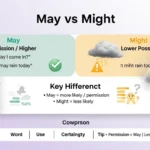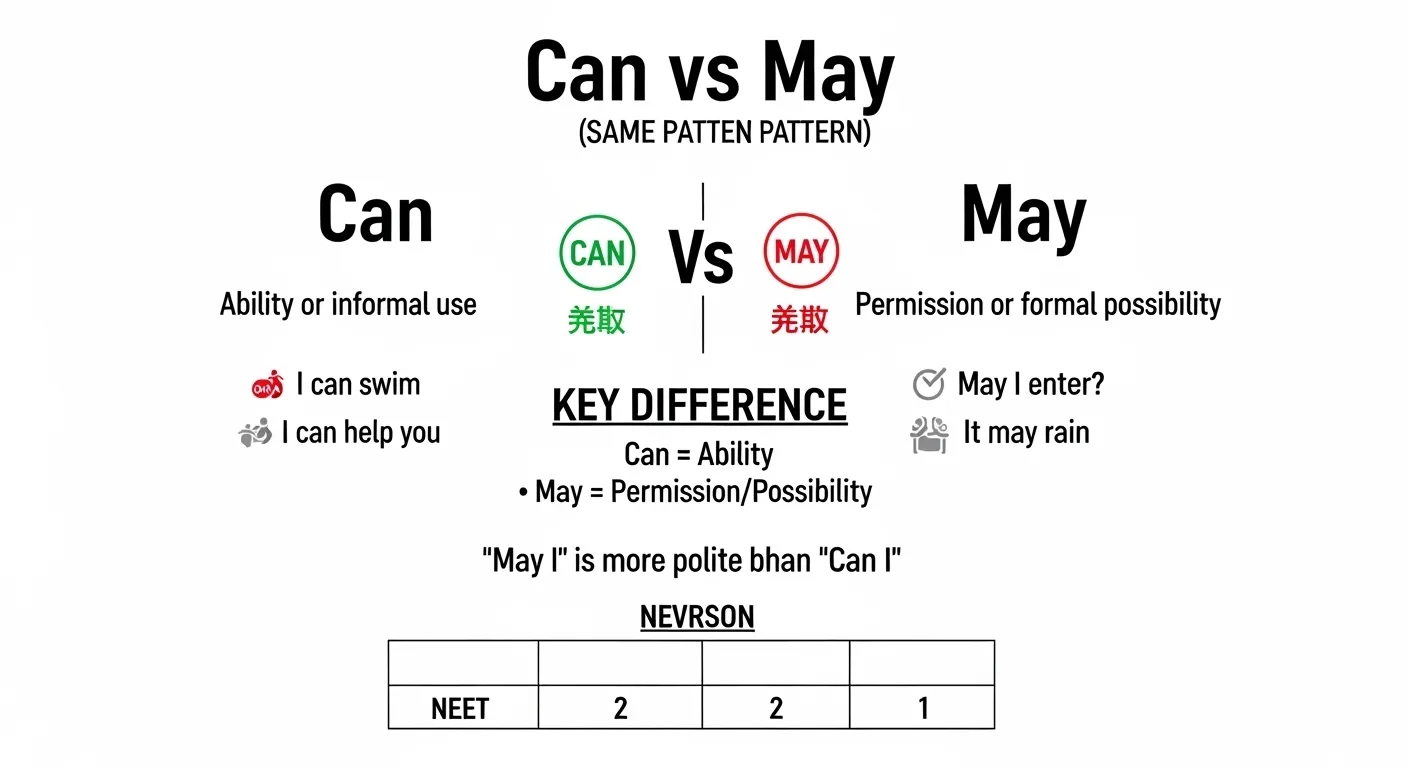
Can shows ability, while may shows permission.
Many people search for can vs may because both words are used to ask for something or talk about possibility.
They look similar, but their meanings are not the same in formal English. Students often get confused in exams, and many people use “can I” instead of “may I” in polite situations.
The confusion happens because everyday speech mixes these words, but grammar rules still keep them separate.
This guide explains the quick answer, origin, grammar rules, common mistakes, examples, usage patterns, and memory tricks so you can clearly understand and use both words correctly.
⚡ Can and May: Quick Answer
The main rule is:
- Can = ability or possibility
- May = permission or formal possibility
Examples
- I can swim. (ability)
- May I come in? (permission)
Simple Explanation
- Use can for what you are able to do.
- Use may for asking or giving permission.
📜 The Origin of Can and May
Both words come from Old English.
Origin of Can
“Can” comes from Old English cunnan, meaning to know or be able to do something.
Example:
- She can drive.
Origin of May
“May” comes from Old English mæg, meaning to have permission or possibility.
Example:
- You may leave now.
Over time, their meanings became more specific.
🇬🇧🇺🇸 British English vs American English Usage
There is no spelling difference, but usage may vary in formality.
| Word | British English | American English | Usage |
| Can | Can | Can | Ability, informal permission |
| May | May | May | Formal permission |
In casual speech, “can” is often used instead of “may.”
🌍 Which Word Should You Use?
Your choice depends on context.
Use Can for Ability
Examples:
- I can run fast.
- She can speak English.
- They can solve the problem.
Use May for Permission
Examples:
- May I go outside?
- You may sit here.
- Students may leave early.
Use May for Possibility
Examples:
- It may rain today.
- He may come later.
- This may help you.
❌ Common Mistakes with Can vs May
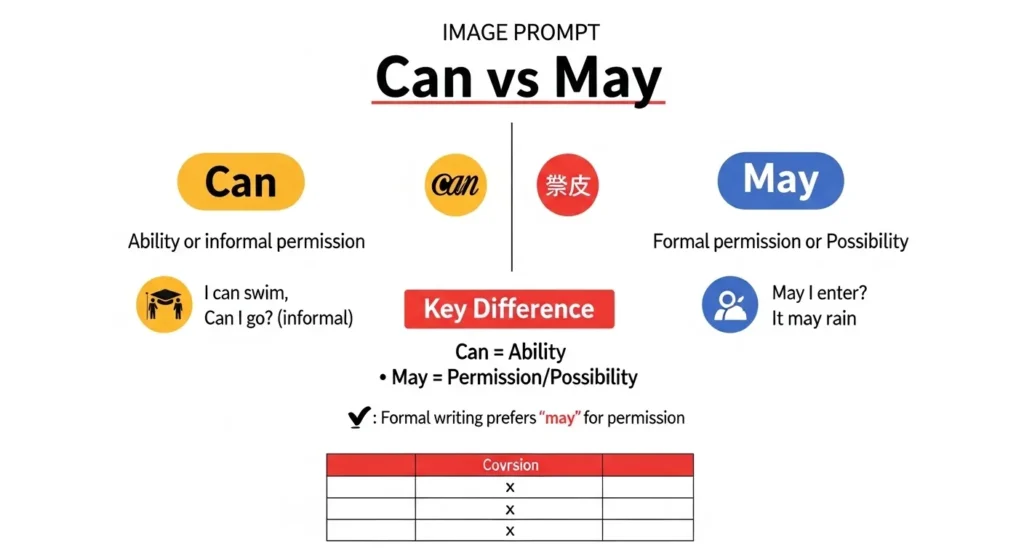
These mistakes are very common.
1. Using Can for Permission (Formal Context)
Incorrect:
- Can I enter the room? (formal situation)
Correct:
- May I enter the room?
2. Using May for Ability
Incorrect:
- I may swim.
Correct:
- I can swim.
3. Confusing Possibility and Ability
Incorrect:
- It can rain tomorrow (less formal, not wrong but less precise)
Better:
- It may rain tomorrow.
📘 Understanding the Grammar Rule
Here is a clear comparison.
| Word | Meaning | Usage | Example |
| Can | Ability | Informal | I can drive |
| May | Permission | Formal | May I come in |
✍️ Can vs May in Everyday Examples
📧 Email Example
“May I request a meeting tomorrow?”
📰 News Example
“The storm may affect the area.”
📱 Social Media Example
“I can’t believe this!”
📄 Formal Writing Example
“Participants may submit their applications online.”
These show real-life usage.
📊 Can or May: Google Trends & Usage Data
Search data shows that can vs may is a common grammar query.
Popular related searches include:
- can vs may difference
- when to use can or may
- can vs may examples
- can vs may permission
- can vs may grammar rule
Countries where this query is common:
- United States
- United Kingdom
- India
- Pakistan
Students often search this topic for exams.
📋 Comparison Table: Can vs May
| Feature | Can | May |
| Meaning | Ability | Permission |
| Formality | Informal | Formal |
| Use | Skills, ability | Permission, possibility |
| Example | I can swim | May I go? |
🧠 Easy Memory Tricks
Simple tricks help you remember.
Trick 1: Can = Ability
Think “can = capable.”
Example:
- I can run.
Trick 2: May = Permission
Think “may = allowed.”
Example:
- May I enter?
Trick 3: Situation Test
Ask:
- Talking about skill? → Use can
- Asking permission? → Use may
📖 Advanced Usage Examples
Using Can
- She can solve complex problems.
- I can help you later.
Using May
- You may begin the test.
- He may not agree.
- This may cause issues.
Politeness Tip
“May I” is more polite than “Can I.”
🧾 Can vs May in Professional Writing
Right usage improves professionalism.
Correct:
- May I ask a question?
Correct:
- The system may fail under pressure.
Incorrect:
- Can I ask a question? (less formal)
Using “may” sounds more polite in formal contexts.
🌎 Why This Confusion Happens
This confusion happens because:
- Both words are used in questions.
- Casual speech often ignores the rule.
- People learn “can I” first.
Understanding context solves the problem.
❓ FAQs About Can vs May
1. What is the difference between can and may?
Can shows ability. May shows permission or possibility.
2. Can I use can for permission?
Yes, in informal situations.
3. Is “may I” more polite?
Yes, it is more formal and polite.
4. Can may be used for ability?
No. Use “can” for ability.
5. Is this mistake common?
Yes. Many people use “can” instead of “may.”
6. Are spellings different in UK and US English?
No. Both use the same spelling.
7. What is the easiest rule?
Ability = can
Permission = may
🏁 Conclusion:
The difference between can and may becomes clear when you understand their purpose. “Can” is used to talk about ability, skills, or what someone is capable of doing. “May,” on the other hand, is used to ask for or give permission and to express possibility.
While everyday speech often uses “can” in place of “may,” especially in casual conversations, formal English still follows the traditional rule.
Using the correct word helps improve clarity and politeness, especially in professional or academic writing.
Remember the simple idea: use “can” when talking about ability and “may” when asking for permission or describing something that might happen. With practice, choosing between these two words becomes natural and easy.
Discover More Articals!
Among vs Between: What Is the Difference?
Period Before or After Quotes: Simple Guide for Correct Usage📝
Tweeking or Tweaking: Which Spelling Is Correct?📝

englifiy.com is my English grammar comparison website where I simplify confusing words, spelling differences, and usage rules through clear explanations and examples. My goal is to help learners, writers, and students understand English easily and use correct grammar with confidence.