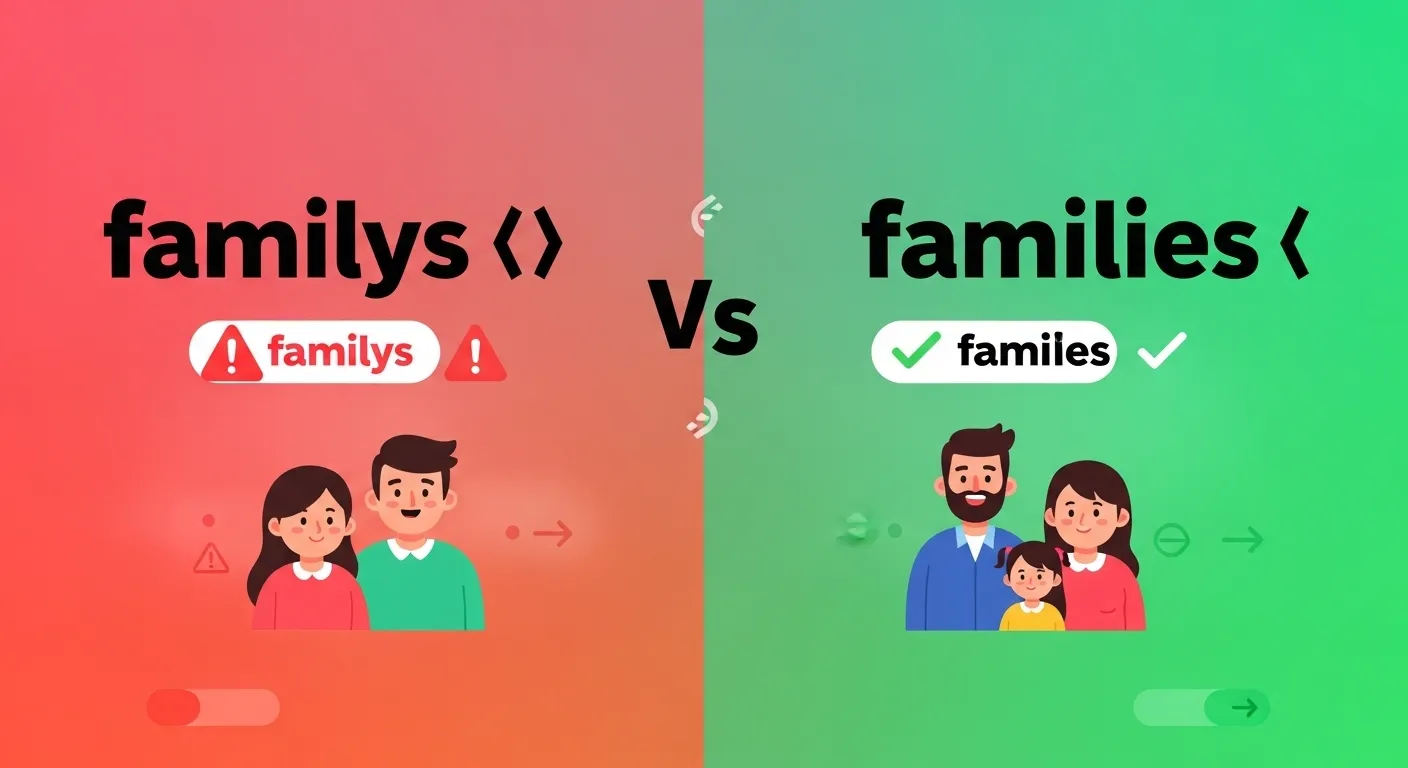
“Family’s” shows possession, while “families” is the plural form of family. Many writers confuse these two words because they look similar but serve different grammar roles.
People often search for this topic when writing emails,professional documents and want to avoid simple grammar errors.
One small apostrophe can change the meaning of a sentence completely, so understanding the difference matters. This guide explains the rules in simple steps.
You will learn when to use each form, why the difference exists, and how to avoid common mistakes.
By the end, you will feel confident choosing the correct word every time without second-guessing your writing.
Family’s vs Families: Quick Answer ✅
Here is the short and simple explanation:
- Family’s = possessive form (something belongs to one family).
- Families = plural form (more than one family).
Examples:
✔ The family’s car is parked outside.
(One family owns the car.)
✔ Many families attended the event.
(More than one family.)
Easy Rule:
- Apostrophe + s → shows ownership.
- No apostrophe → shows plural.
Think like this:
👉 If you can replace it with “belonging to a family,” use family’s.
👉 If you mean many groups of relatives, use families.
The Origin of Families or Family’s 📚
To understand the difference, it helps to know how English forms plurals and possessives.
The word “family” comes from Latin familia, meaning household or group living together. Over time, English adopted rules for plural and possessive forms.
Plural Formation
English nouns usually form plurals by adding -s or -es:
- book → books
- class → classes
- family → families
Since “family” ends in a consonant + y, the “y” changes to “ies.”
Possessive Formation
Possessive forms show ownership or relationship.
Standard rule:
- Add apostrophe + s to singular nouns.
Example:
- family → family’s
The apostrophe developed from older English writing practices where possession needed clear marking. It helps readers understand relationships between words.
Why Confusion Exists
People mix these forms because:
- Both words sound similar in speech.
- Apostrophes are often misunderstood.
- Typing quickly leads to missing punctuation.
Learning the core rule makes the difference easy.
British English vs American English Spelling 🌍
Good news: both British and American English follow the same rules for family’s and families. The difference is not about regional spelling but about grammar function.
Shared Rules
- Plural nouns drop apostrophes.
- Possessive nouns use apostrophes.
Examples
| Context | British English | American English |
| One family owns a house | The family’s house | The family’s house |
| Many groups attend | Many families attended | Many families attended |
| Family traditions | The family’s traditions | The family’s traditions |
Both styles follow identical structure. There is no regional variation here.
Extra Note
Some punctuation styles differ in longer phrases, but basic plural and possessive rules stay the same across English-speaking regions.
Which Spelling Should You Use? 🎯
Choosing between family’s and families depends on meaning, not location.
For US Readers
Follow standard possessive rules:
- Use family’s for ownership.
- Use families for plural.
For UK and Commonwealth Readers
Same guidance applies. No spelling change.
For Global Writing
When writing for an international audience:
- Keep sentences clear.
- Avoid overusing apostrophes.
- Double-check meaning before typing.
Quick Decision Checklist
Ask yourself:
- Am I talking about one family or many?
- Is something owned or described as belonging to them?
If ownership exists → use family’s.
If multiple groups exist → use families.
Common Mistakes with Family’s or Families ❌

Many errors come from misunderstanding apostrophes.
Mistake 1: Using apostrophe for plural
❌ The family’s are arriving soon.
✔ The families are arriving soon.
Apostrophes do not make words plural.
Mistake 2: Missing apostrophe in possessive
❌ The families car is red.
✔ The family’s car is red.
Ownership needs apostrophe + s.
Mistake 3: Confusing plural possessive
When multiple families own something:
✔ The families’ picnic area is full.
Notice:
- families = plural
- families’ = plural possessive
Mistake 4: Adding extra apostrophes
❌ familie’s
Correct plural spelling changes y → ies.
Mistake 5: Relying only on pronunciation
Speech often hides apostrophe differences. Writing must follow grammar rules.
Family’s or Families in Everyday Examples ✍️
Seeing real-life examples helps learning.
Emails
- The family’s schedule has changed.
- Several families joined the mailing list.
News Writing
- The family’s statement was released today.
- Local families requested more parks.
Social Media
- Our family’s vacation photos are online.
- Many families shared similar experiences.
Formal Writing
- The family’s financial history shows stability.
- Multiple families participated in the study.
Education Context
- The family’s involvement improves learning outcomes.
- Different families bring unique perspectives.
Notice how meaning changes clearly depending on apostrophe use.
Family’s or Families: Google Trends & Usage Data 📊
Language usage varies depending on context and search behavior.
Popular Search Reasons
People often search this topic because:
- Apostrophes confuse many learners.
- Writing tools do not always explain grammar rules.
- Students want quick clarity.
Geographic Interest
Higher search activity appears in:
- United States
- United Kingdom
- India
- Pakistan
- Australia
These regions have large English-learning communities and active online writing.
Context of Usage
- Education platforms
- Blogging and content writing
- Academic assignments
- Social media posts
Plural vs possessive confusion remains common, which explains consistent search demand.
Comparison Table: Keyword Variations Side by Side
| Word | Type | Meaning | Example |
| family | singular noun | one group | The family is here. |
| families | plural noun | many groups | Many families attended. |
| family’s | singular possessive | belonging to one family | The family’s car broke down. |
| families’ | plural possessive | belonging to many families | The families’ plans changed. |
This table helps you see differences quickly.
FAQs About Family’s or Families ❓
1. Is family’s always possessive?
Yes. The apostrophe shows ownership or relationship with something.
2. Can families ever show ownership?
Not by itself. Add an apostrophe after the s to show plural possession: families’.
3. Which form is more common?
Both appear often. It depends on context. Writing about groups uses “families.” Ownership uses “family’s.”
4. How do I remember the difference fast?
Check for ownership. If something belongs to a family, use apostrophe.
5. Is pronunciation different?
Usually not. That is why many people confuse them in writing.
6. Can grammar tools fix this automatically?
Some tools help, but understanding rules prevents mistakes.
7. What about collective noun usage?
“Family” can act as singular or collective depending on sentence style, but possessive rules stay the same.
Conclusion
Understanding the difference between family’s and families becomes simple once you focus on meaning. One word shows possession.
The other shows plural groups. The apostrophe acts like a signal that something belongs to someone or something.
Without it, the word simply refers to more than one group. Many writers make mistakes because both forms sound similar in speech.
Clear grammar rules solve this problem quickly. Always pause and ask If ownership exists or if you are talking about many groups.
This small check prevents errors in emails, academic writing, business communication, and everyday messages.
Practice using examples from real life. Read your sentences aloud and confirm the meaning matches your intention.
Over time, choosing the correct form will feel natural. Strong grammar builds trust with readers and improves clarity.
By mastering this small detail, your writing becomes more professional, accurate, and easy to understand for audiences everywhere.
Related Posts!
Each Other or Eachother: Which One Is Correct?
Is vs Are: Understanding Singular and Plural Verbs ✍️
Affect vs Effect: What Is the Difference?

**Emily R. Dawson** I am a English language writer and editor i specializes in grammar clarity, sentence structure, and common writing mistakes.I focuses on helping readers write correct, natural-sounding English through simple explanations and practical examples. Emily mainly creates beginner-friendly and intermediate-level language guidesmy writing style is clear, supportive, and easy to follow.