Fewer is used for countable things, while less is used for uncountable things.
Many people search for fewer vs less because both words relate to quantity, but they are not used in the same way.
This confusion often appears in exams, emails, advertisements, and even public signs like “10 items or less.”
The mistake happens because both words mean a smaller amount, yet English grammar separates them based on If the noun can be counted.
Understanding this rule helps improve accuracy in both casual and formal writing. This guide explains the quick answer, origin, grammar rules, common mistakes, examples, usage patterns, and helpful memory tricks.
⚡ Fewer vs Less: Quick Answer
The basic rule is simple:
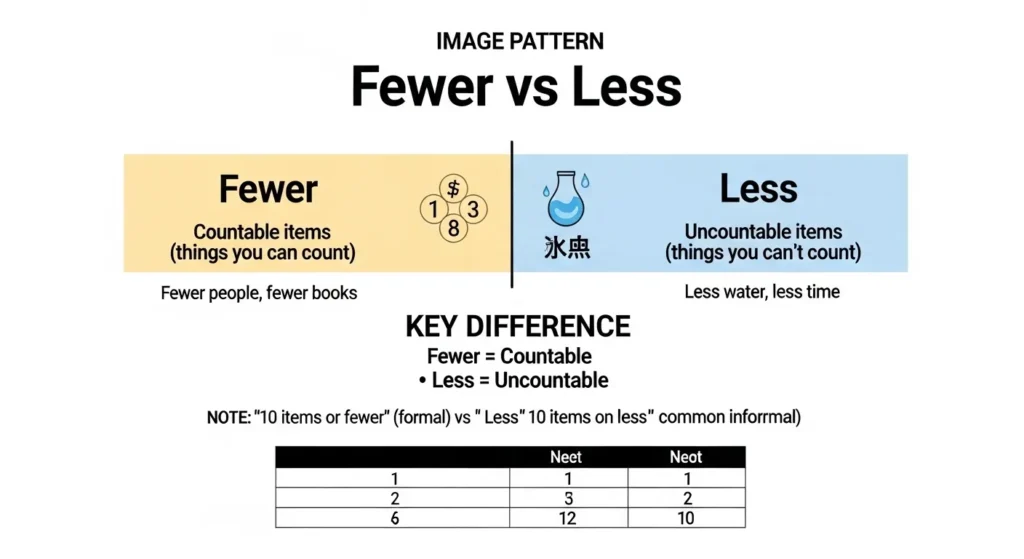
- Fewer = countable nouns
- Less = uncountable nouns
Examples
- I have fewer books than before.
- I have less water in my bottle.
Simple Explanation
- Use fewer for things you can count (books, apples, cars).
- Use less for things you cannot count (water, time, money).
📜 The Origin of Fewer and Less
Both words come from Old English but developed different uses.
Origin of Fewer
“Fewer” comes from Old English fēawerra, meaning a smaller number of items.
Example:
- Fewer people attended the meeting.
Origin of Less
“Less” comes from Old English lǣssa, meaning a smaller amount.
Example:
- There is less sugar in this drink.
Over time, English grammar assigned different roles to each word.
🇬🇧🇺🇸 British English vs American English Spelling
There is no spelling difference between British and American English.
| Word | British English | American English | Usage |
| Fewer | Fewer | Fewer | Countable nouns |
| Less | Less | Less | Uncountable nouns |
However, informal usage sometimes breaks the rule in both regions.
🌍 Which Word Should You Use?
Your choice depends on If the noun is countable.
Use Fewer for Countable Nouns
Examples:
- Fewer students attended class.
- I made fewer mistakes today.
- There are fewer cars on the road.
You can count these items individually.
Use Less for Uncountable Nouns
Examples:
- I need less time to finish this.
- She drinks less coffee now.
- There is less traffic today.
These things cannot be counted one by one.
❌ Common Mistakes with Fewer vs Less
These errors are very common in everyday English.
1. Using Less for Countable Items
Incorrect:
- Less people came to the event.
Correct:
- Fewer people came to the event.
2. Using Fewer for Uncountable Items
Incorrect:
- I need fewer water.
Correct:
- I need less water.
3. Ignoring the Rule in Signs
Example:
- “10 items or less” (common but informal)
Correct form:
- “10 items or fewer”
📘 Understanding the Grammar Rule
Here is a clear comparison.
| Word | Type of Noun | Meaning | Example |
| Fewer | Countable | Smaller number | Fewer books |
| Less | Uncountable | Smaller amount | Less water |
Key Idea
- Countable → fewer
- Uncountable → less
✍️ Fewer vs Less in Everyday Examples
📧 Email Example
“We received fewer applications this year.”
📰 News Example
“There is less rainfall compared to last year.”
📱 Social Media Example
“I am spending less time on my phone.”
📄 Formal Writing Example
“The company reported fewer errors in production.”
These words are used in daily communication.
📊 Fewer vs Less: Google Trends & Usage Data
Search data shows that fewer vs less is a frequently searched grammar topic.
Popular related searches include:
- fewer vs less difference
- when to use fewer or less
- fewer vs less examples
- less vs fewer grammar rule
- is it fewer or less items
Countries where this query is common:
- United States
- United Kingdom
- India
- Pakistan
Even native speakers often check this rule.
📋 Comparison Table: Fewer vs Less
| Feature | Fewer | Less |
| Noun type | Countable | Uncountable |
| Meaning | Smaller number | Smaller amount |
| Example | Fewer apples | Less juice |
| Usage | Numbers | Quantity |
This table makes the difference clear.
🧠 Easy Memory Tricks
Simple tricks help you remember.
Trick 1: Fewer = Few = Count
Both fewer and few relate to countable things.
Example:
- Fewer books
Trick 2: Less = Mass
“Less” is used for mass nouns (things you cannot count).
Example:
- Less water
Trick 3: Count Test
Ask yourself:
Can I count it?
- Yes → Use fewer
- No → Use less
📖 Advanced Usage Examples
Using Fewer
- There are fewer chairs in the room.
- Fewer employees attended the meeting.
Using Less
- She has less energy today.
- We need less time to complete the task.
Exception (Time, Money, Distance)
Sometimes “less” is used with countable ideas treated as a whole.
Examples:
- Less than 10 minutes
- Less than 5 kilometers
- Less than 100 dollars
These are accepted in modern English.
🧾 Fewer vs Less in Professional Writing
Right usage improves clarity and professionalism.
Correct:
- The company made fewer mistakes this year.
Correct:
- The project required less time.
Incorrect:
- The company made less mistakes this year.
Mistakes can affect credibility in formal documents.
🌎 Why This Confusion Happens
This confusion occurs because:
- Both words relate to quantity.
- They are often used interchangeably in speech.
- Many people are not taught the rule clearly.
Even advertisements sometimes ignore the rule.
❓ FAQs About Fewer vs Less
1. What is the difference between fewer and less?
Fewer is used for countable nouns. Less is used for uncountable nouns.
2. Can I say “less people”?
No. The correct form is “fewer people.”
3. Why do signs say “10 items or less”?
It is common but grammatically incorrect in formal English.
4. When can less be used with numbers?
With time, money, and distance.
5. Is this mistake common?
Yes. Even native speakers make this mistake.
6. Are there spelling differences in UK and US English?
No. Both use the same spelling.
7. What is the easiest rule?
Countable = fewer
Uncountable = less
🏁 Conclusion:
The difference between fewer and less becomes simple once you understand the type of noun being used.
“Fewer” is used for countable items such as books, people, and cars, where each item can be counted individually. “Less” is used for uncountable quantities like water, time, and money, where the focus is on the amount rather than individual units.
This distinction is important in formal writing because it improves clarity and correctness. Although everyday speech and advertisements sometimes ignore the rule, using the correct form shows strong language skills and attention to detail. Remember the simple test: if you can count it, use “fewer.” If you cannot count it, use “less.”
With practice, choosing the correct word becomes natural. Mastering this rule will help you write more clearly and confidently in both casual and professional communication.
Discover More Articals!
Which vs That: What Is the Difference?
Their vs There vs They’re: What Is the Difference?
Family’s or Families: What’s the Difference 👨👩👧👦

**Emily R. Dawson** I am a English language writer and editor i specializes in grammar clarity, sentence structure, and common writing mistakes.I focuses on helping readers write correct, natural-sounding English through simple explanations and practical examples. Emily mainly creates beginner-friendly and intermediate-level language guidesmy writing style is clear, supportive, and easy to follow.