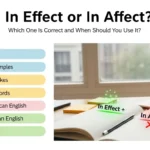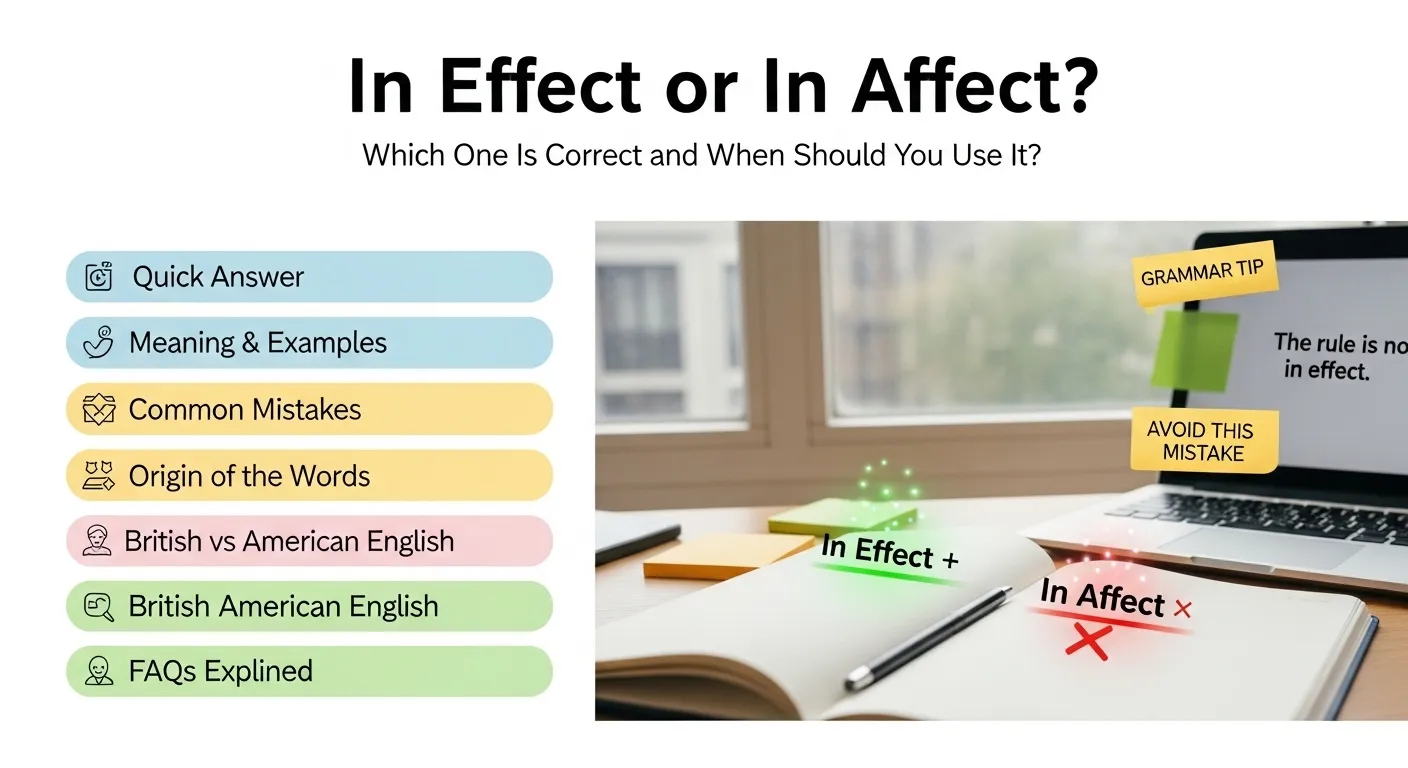
“In effect” is correct; “in affect” is almost always wrong.
Many people search for in effect or in affect because the two phrases look similar. The spelling difference is small. The meaning difference is big. One letter can change your sentence.
It can also make your writing look weak. Students, bloggers, and even professionals get confused.
They mix up effect and affect. Both words sound close. Both are common in English. But only one works in this phrase.
This article clears the confusion. You will learn the quick answer, the origin, spelling rules, common mistakes, and real examples. After reading, you will use the correct phrase with confidence.
In Affect or In Effect: Quick Answer
The correct phrase is “in effect.”
“In affect” is incorrect in standard English.
What does “in effect” mean?
“In effect” means:
- Currently active
- Operating
- Basically
- In reality
Examples:
- The new law is in effect from Monday.
- The rule is now in effect across the country.
- His words were, in effect, a warning.
- The system has been in effect for years.
Why “in affect” is wrong
“Affect” is usually a verb. It means to influence something.
Example:
- Lack of sleep can affect your mood.
Because “affect” is a verb, it does not fit after “in.” The phrase “in affect” does not make sense in normal writing.
The Origin of In Effect or In Affect
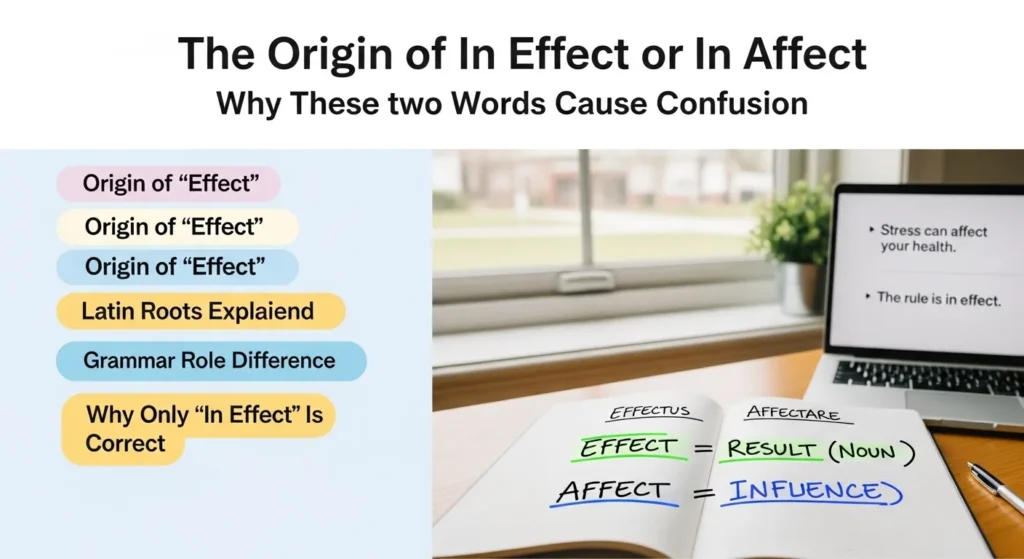
To understand the confusion, we need to look at the words effect and affect.
Origin of “effect”
The word effect comes from Latin effectus. It means result or outcome. Over time, English adopted it as a noun.
Example:
- The effect of rain was flooding.
The phrase “in effect” developed to mean “in operation” or “in force.” It became common in legal and official language.
Origin of “affect”
The word affect comes from Latin affectare. It means to influence or act upon. In English, it became mostly a verb.
Example:
- Stress can affect your health.
Because both words come from Latin and sound similar, confusion started. But their grammar roles are different.
- Effect = usually a noun
- Affect = usually a verb
That difference explains why only “in effect” is correct.
British English vs American English Spelling
There is no spelling difference between British and American English for this phrase.
Both use:
- In effect ✅
- In affect ❌
Unlike words such as:
| American English | British English |
| Color | Colour |
| Organize | Organise |
| Center | Centre |
The phrase “in effect” stays the same in both systems.
Comparison Table
| Phrase | American English | British English | Correct? |
| In effect | Yes | Yes | ✅ Correct |
| In affect | No | No | ❌ Incorrect |
So no matter where you write US, UK, Canada, Australia the correct form remains the same.
Which Spelling Should You Use?
The answer depends on grammar, not location.
If you write for a US audience:
Use in effect.
If you write for a UK or Commonwealth audience:
Use in effect.
If you write for a global audience:
Still use in effect.
There is no regional variation here. The rule is universal.
Professional writers, journalists, lawyers, and teachers all use “in effect.”
Using “in affect” can hurt your credibility.
Common Mistakes with In Effect or In Affect
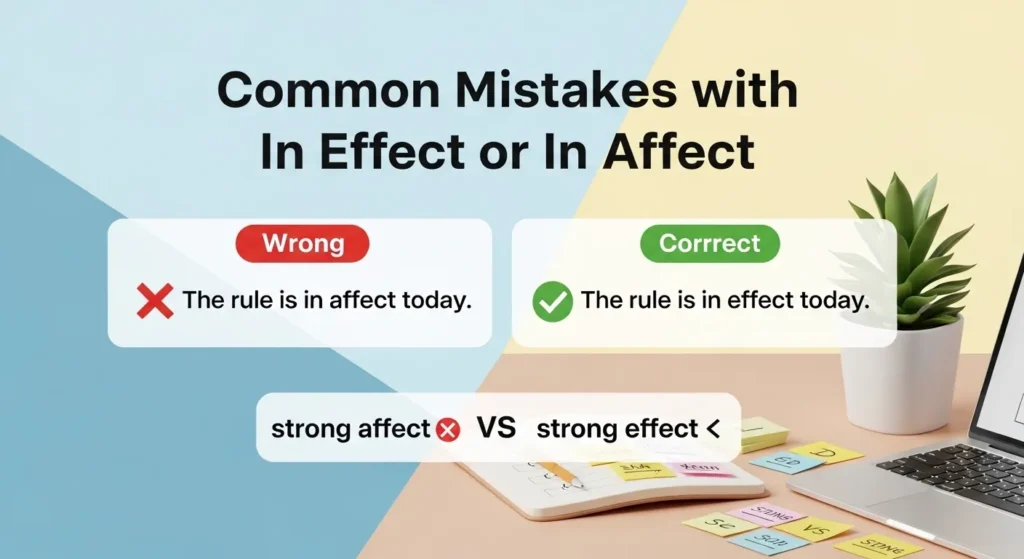
Here are frequent errors people make:
1. Mixing up affect and effect
Wrong:
- The rule is in affect today.
Correct:
- The rule is in effect today.
2. Using affect as a noun by mistake
Wrong:
- The law had a strong affect.
Correct:
- The law had a strong effect.
3. Forgetting grammar roles
Remember:
- Affect = action (verb)
- Effect = result (noun)
Simple trick:
RAVEN rule
- Remember
- Affect = Verb
- Effect = Noun
4. Overthinking the phrase
Some writers think both forms are acceptable. They are not. Standard grammar guides confirm only “in effect” is correct.
In Effect vs In Affect in Everyday Examples
Let’s see how it appears in real life.
1. In Emails
- The new schedule is in effect starting tomorrow.
- The changes are now in effect.
2. In News Reports
- The travel ban is in effect across the region.
- Emergency rules remain in effect.
3. On Social Media
- New privacy rules are in effect.
- The update is finally in effect.
4. In Formal Writing
- The agreement shall remain in effect for five years.
- The policy is in effect until further notice.
In all cases, “in effect” shows something is active or functioning.
In Effect and In Affect: Google Trends & Usage Data
Search data shows that “in effect” is far more common worldwide.
People in the United States, United Kingdom, Canada, and Australia search for:
- in effect meaning
- in effect definition
- affect vs effect
Searches for “in affect” are usually mistake-based queries. Users want to confirm the correct form.
The correct phrase appears in:
- Legal documents
- Government websites
- News articles
- Academic papers
“In affect” rarely appears in trusted publications.
This shows that professional writing strongly supports “in effect.”
Comparison Table: In Effect vs In Affect
| Feature | In Effect | In Affect |
| Grammar Role | Prepositional phrase | Grammatically incorrect |
| Meaning | In operation / Basically | No standard meaning |
| Used in formal writing | Yes | No |
| Used in legal documents | Yes | No |
| Accepted globally | Yes | No |
| Common mistake? | No | Yes |
FAQs About In Effect or In Affect
1. Is “in affect” ever correct?
No. It is almost always incorrect in standard English.
2. What does “in effect” mean in simple words?
It means something is active, working, or basically true.
3. Why do people confuse these phrases?
Because affect and effect sound similar.
4. Is this mistake common among native speakers?
Yes. Even native speakers mix them up sometimes.
5. Can “affect” ever be a noun?
Yes, but rarely. In psychology, “affect” can describe emotion. But that usage does not apply here.
6. How can I remember the difference?
Use the RAVEN trick:
Affect = Verb
Effect = Noun
7. Is “in effect” formal or informal?
It works in both. It appears often in legal and official writing.
Conclusion
“In effect” is the only correct phrase. “In affect” is a common spelling mistake. The confusion comes from the similarity between affect and effect.
One is usually a verb. The other is usually a noun. That grammar rule explains everything. The phrase “in effect” means active, operating, or basically true.
It works in emails, news writing, academic papers, and legal documents. There is no regional difference between British and American English. The spelling stays the same worldwide.
If you want clear and professional writing, always choose “in effect.” When in doubt, remember the RAVEN rule. Affect is a verb. Effect is a noun. That simple reminder will help you avoid errors every time.
Discover More Posts!
Colon or Semicolon:How to Use Them Punctually ✍️
Person, Place, or Thing: Understanding the “Host” in Grammar 📝
Liason vs Liaison: What Is the Difference?

**Emily R. Dawson** I am a English language writer and editor i specializes in grammar clarity, sentence structure, and common writing mistakes.I focuses on helping readers write correct, natural-sounding English through simple explanations and practical examples. Emily mainly creates beginner-friendly and intermediate-level language guidesmy writing style is clear, supportive, and easy to follow.