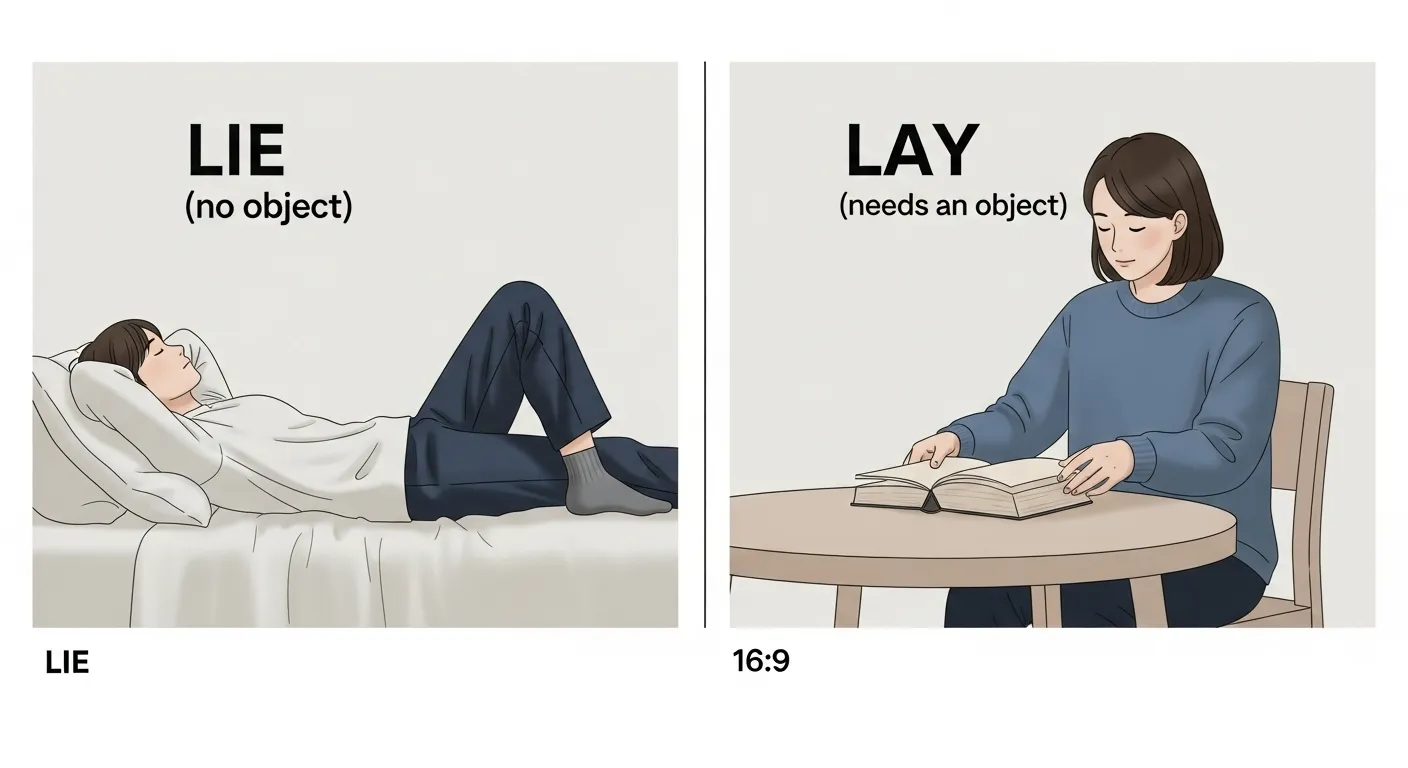
Lie is used without an object, while lay is used with an object, and this simple rule answers the main confusion right away. Many people search for “lay or lie” because these
two verbs look similar, sound related, and change forms in confusing ways. Even native English speakers make mistakes with them in emails, news writing, and everyday speech.
The problem becomes worse because the past tense of lie is lay, which looks exactly like the present tense of lay. This article solves that confusion step by step.
You will learn the difference between lay and lie, their origins, correct usage, common mistakes, real-life examples, and professional advice so you can use them confidently every time.
Lay or Lie : Quick Answer
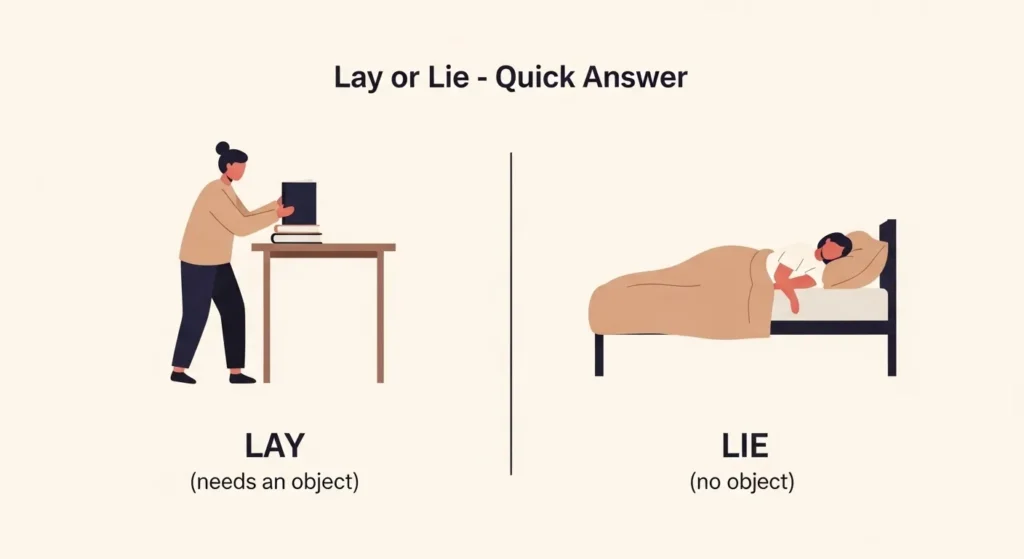
Lie means to rest or recline and does not take an object.
Lay means to put or place something and does take an object.
Examples:
- I will lie down for a while. ✅
- Please lay the book on the table. ✅
❌ I will lay down. (Wrong unless you specify what you lay)
Simple rule:
If there is an object, use lay. If there is no object, use lie.
The Origin of Lay or Lie
Historical Background
The verbs lay and lie come from Old English, where they were already separate words with different meanings. Lie comes from Old English licgan, meaning to recline or rest. Lay comes from Old English lecgan, meaning to place or put something down. These meanings were clear in early English and were never interchangeable.
Why Confusion Exists Today
The confusion developed over time because English verb forms changed. The past tense of lie became lay, which looks exactly like the present tense of lay. This overlap causes even fluent speakers to hesitate.
Spelling vs Meaning
Unlike many spelling differences, lay or lie is not about regional spelling. It is about grammar and verb structure. Both words exist in all varieties of English, but their usage depends on If an object is present.
British English vs American English Spelling
There is no spelling difference between British and American English for lay and lie. The rules are exactly the same in both varieties.
British English Usage
- I will lie down after dinner.
- She laid the papers on the desk.
American English Usage
- He likes to lie on the couch.
- Please lay the keys here.
Comparison Table
| Feature | British English | American English |
| Lie (present) | lie | lie |
| Lay (present) | lay | lay |
| Rule difference | None | None |
| Common mistakes | Same | Same |
Which Spelling Should You Use?
Because lay and lie are not regional spellings, your choice depends on sentence structure, not audience location.
For US Audiences
Follow the object rule strictly. American style guides strongly emphasize correct verb usage.
For UK & Commonwealth Audiences
The same rule applies. Examiners and editors expect accurate use of lay and lie.
For Global or Professional Writing
Correct usage is essential. Mistakes with lay or lie are very noticeable and can reduce credibility.
Professional advice:
Always ask: Am I placing something, or am I resting myself?
Verb Forms of Lay and Lie (Very Important)
Forms of “Lie” (No Object)
| Tense | Form | Example |
| Present | lie | I lie down daily. |
| Past | lay | Yesterday, I lay down early. |
| Past participle | lain | I have lain here before. |
Forms of “Lay” (With Object)
| Tense | Form | Example |
| Present | lay | I lay the phone here. |
| Past | laid | I laid the phone down. |
| Past participle | laid | I have laid the phone down. |
Common Mistakes with Lay or Lie
Mistake 1: Saying “Lay Down” Without an Object
❌ I will lay down now. ✅ I will lie down now.
Mistake 2: Using “Lie” With an Object
❌ Please lie the book here. ✅ Please lay the book here.
Mistake 3: Confusing Past Tense
❌ Yesterday, I laid on the sofa. ✅ Yesterday, I lay on the sofa.
Mistake 4: Avoiding the Verbs Completely
Some writers avoid both words. This weakens writing. Learning the rule fixes the issue.
Lay or Lie in Everyday Examples
Emails
- Please lay the documents on my desk.
- I need to lie down due to a headache.
News Writing
- The minister chose to lay the report before parliament.
- The victim was found lying on the ground.
Social Media
- Just want to lie in bed all day 😴
- Don’t lay your phone face down 📱
Formal Writing
- The committee has laid the proposal forward.
- The evidence has lain untouched for years.
Lay or Lie – Google Trends & Usage Data
Search trends show that “lay or lie” is one of the most searched grammar questions worldwide.
High-Interest Regions
- United States
- United Kingdom
- Canada
- India
- Pakistan
Context-Based Usage
- Lie is searched more in health, rest, and lifestyle topics.
- Lay appears more in academic, legal, and professional contexts.
This shows global confusion rather than regional difference.
Comparison Table: Lay vs Lie
| Feature | Lay | Lie |
| Needs object | Yes | No |
| Meaning | Place something | Recline/rest |
| Past tense | laid | lay |
| Past participle | laid | lain |
FAQs About Lay or Lie
Is “lay” always wrong for resting?
Yes. Resting requires lie, not lay.
Is “lie” ever used with an object?
No. Lie never takes a direct object.
Why is the past of “lie” called “lay”?
Because English evolved irregular verb forms.
Is this mistake common among native speakers?
Yes. It is one of the most common grammar errors.
Which form is correct: “I have laid down”?
Only correct if something was placed down.
Which form is correct in exams?
Always follow the object rule strictly.
Can context save a mistake?
Sometimes in speech, but never in formal writing.
Conclusion
The confusion between lay or lie is one of the most common grammar problems in English, but it is also one of the easiest to fix once you understand the rule.
The key difference is simple: lay requires an object, while lie does not. If you are placing something, you lay it down. If you are resting or reclining, you lie down.
Understanding the verb forms is just as important. Lie changes to lay in the past and lain in the perfect tense. Lay changes to laid in both past and past participle forms.
Remembering these patterns will help you avoid errors in writing and speaking.
There is no British or American spelling difference here. The rules are universal, which means accuracy matters even more.
If you are writing an email, an article, or an exam answer, correct use of lay or lie improves clarity and professionalism. Master this rule once, and you will never doubt yourself again.
Related posts!
The Origin of Aswell or As Well

I am Oliver H. Grant. I am a English language writer and editor my focuses on grammar, word usage, and common English mistakes.
I specializes in explaining the differences between British and American English in a clear and practical way.
my writing style is simple, learner-friendly, and designed to help readers understand English with ease.
My work is also SEO-focused, making it especially useful for online learners and readers.