Many English learners search for “layed or laidt” because they feel unsure about the correct past tense of the verb “lay.”
Both spellings look possible at first glance, especially for learners who apply regular -ed rules or rely on how words sound in spoken English.
This confusion is very common in exams, writing tasks, emails, captions, and even professional documents. People often pause and ask: Is it layed, laidt, or laid?
The problem exists because “lay” is an irregular verb, and English irregular verbs do not always follow predictable spelling patterns. On top of that, learners also confuse “lay” with “lie,” which adds another layer of difficulty.
Because of this, incorrect spellings like layed and laidt frequently appear in online searches, school assignments, and social media posts.
This article is written to fully solve that confusion. You will get a quick, clear answer, a deep explanation of word origins, British vs American spelling rules, common mistakes, real-life
examples, Google Trends insights, FAQs, and professional advice. By the end of this guide, you will clearly understand why “laid” is correct and why “layed” and “laidt” are wrong once and for all.
Layed or Laidt:Quick Answer
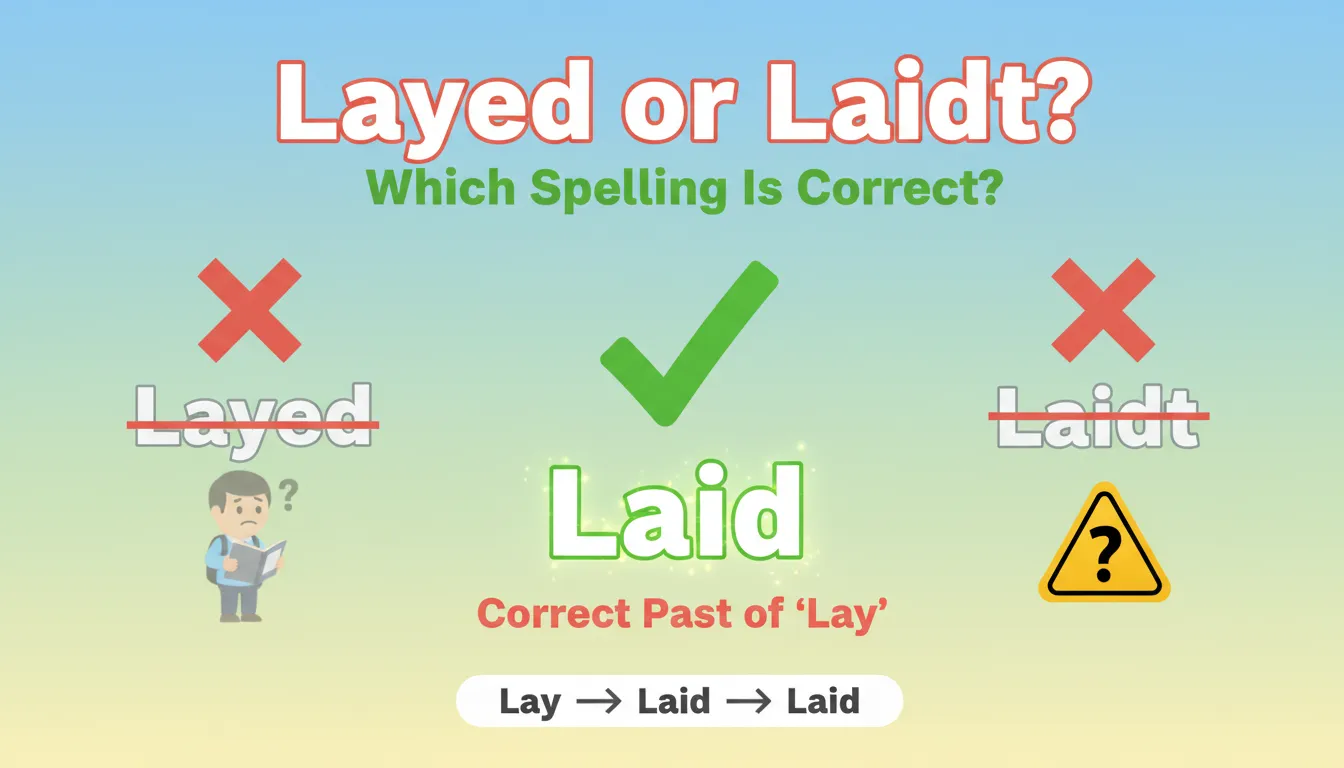
Neither “layed” nor “laidt” is correct.
The correct past tense and past participle of “lay” is “laid.”
- ✅ Correct: She laid the book on the table.
- ❌ Incorrect: She layed the book on the table.
- ❌ Incorrect: She laidt the book on the table.
Key point:
- Lay → Laid → Laid
Both layed and laidt are spelling mistakes and should not be used in formal or informal English.
The Origin of Layed or Laidt

To understand why people write “layed” or “laidt,” we must look at the history of the verb “lay.”
Origin of “Lay” and “Laid”
The verb “lay” comes from Old English lecgan, which meant to place or put something down. Over time, English evolved, but the verb remained irregular. Instead of adding -ed like regular verbs, its past form became “laid.”
Because many English verbs form the past tense by adding -ed (play → played, stay → stayed), learners naturally assume:
- lay → layed ❌
The spelling “laidt” often appears due to pronunciation influence, especially among ESL learners. In fast speech, laid may sound like it ends with a t sound, leading to the incorrect spelling laidt.
In short:
- Layed exists because of overgeneralizing grammar rules
- Laidt exists because of listening-based spelling errors
Neither form is accepted in standard English.
British English vs American English Spelling
There is no difference between British English and American English when it comes to layed or laidt.
Both varieties agree on one rule:
- The correct form is “laid.”
Examples
- British English: She laid the documents on the desk.
- American English: He laid the phone on the table.
Comparison Table
| Form | British English | American English | Correct? |
| laid | ✔️ Used | ✔️ Used | ✅ Correct |
| layed | ❌ Not used | ❌ Not used | ❌ Wrong |
| laidt | ❌ Not used | ❌ Not used | ❌ Wrong |
There are no regional spelling exceptions here.
Which Spelling Should You Use?
No matter who your audience is, the answer stays the same.
- US audience: Use laid only
- UK / Commonwealth audience: Use laid only
- Global audience: Use laid only
Professional advice: If you write layed or laidt, your writing may look incorrect or unpolished. Always choose laid in essays, articles, emails, captions, and exams.
Simple rule to remember:
If the verb is lay, the past is always laid.
Common Mistakes with Layed or Laidt
Mistake 1: Adding “-ed” to Lay
❌ She layed the keys on the shelf. ✅ She laid the keys on the shelf.
Mistake 2: Spelling Based on Sound
❌ He laidt the carpet yesterday. ✅ He laid the carpet yesterday.
Mistake 3: Confusing Lay with Lie
❌ He laid on the bed. (wrong meaning) ✅ He lay on the bed.
(Note: “lay” needs an object; “lie” does not.)
Layed or Laidt in Everyday Examples
Emails
- I laid the files on your desk.
- The assistant laid out the meeting agenda.
News
- The government laid new rules last night.
- Flowers were laid at the memorial.
Social Media
- Just laid my phone somewhere and lost it again 😅
- Fresh tiles laid today! 🧱
Formal Writing
- The committee laid the foundation for future reforms.
- The author laid out the argument clearly.
In all contexts, laid is the only correct choice.
Layed or Laidt:Google Trends & Usage Data
Search engine data shows that “layed or laidt” is commonly searched in:
- South Asia
- Middle East
- ESL-learning countries
- Exam preparation communities
These searches usually appear alongside queries like:
- “past tense of lay”
- “lay vs lie”
- “is layed correct”
Laid dominates real-world usage in books, news, and professional writing. Layed and laidt appear mostly in learner queries, spelling checks, and informal mistakes.
This shows strong user intent for quick clarification and correct grammar guidance.
Comparison Table:Layed vs Laidt vs Laid
| Word | Status | Meaning | Example |
| laid | Correct | past of lay | She laid the bag down |
| layed | Incorrect | ❌ Not acceptable | |
| laidt | Incorrect | ❌ Not acceptable |
Frequently Asked Questions
Is “layed” a real word?
No. Layed is not correct English.
Is “laidt” ever correct?
No. Laidt is always a spelling mistake.
What is the past tense of lay?
The past tense of lay is laid.
Can I say “have laid”?
Yes. Have laid is grammatically correct.
Why do people write “layed”?
Because they apply regular -ed rules incorrectly.
Is this different in British English?
No. Both British and American English use laid.
How can I remember the correct form?
Remember: lay → laid → laid.
read more about!
The Origin of Broche or Brooch
Conclusion
The confusion around “layed or laidt” is understandable, but the solution is simple and clear. In correct English, neither “layed” nor “laidt” exists as an accepted word.
The only correct past tense and past participle of lay is “laid.” This rule does not change with region, audience, or writing style.
Most mistakes happen because learners expect English verbs to follow regular -ed patterns or because they spell words the way they sound.
Unfortunately, English does not always work that way. Understanding that lay is an irregular verb instantly removes the confusion.
If you are writing an exam answer, a professional email, a news article, or a social media post, always choose laid. Avoid layed and laidt completely.
With the examples, tables, FAQs, and explanations in this guide, you now have a clear and confident understanding of the correct usage.
Once you master this rule, your writing will look more natural, accurate, and professional.
Related posts!
Me Either or Me Neither: Quick Answer