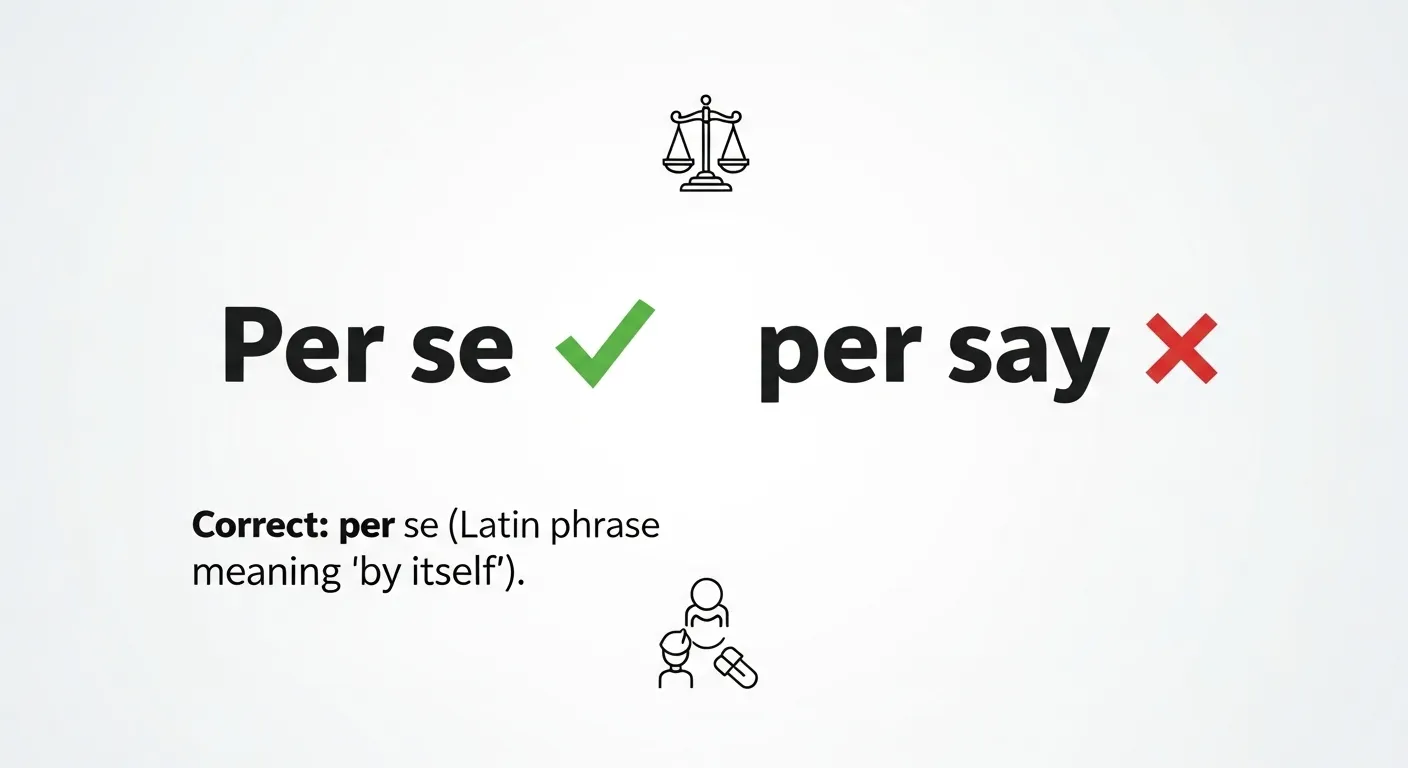
Per se is the correct form, not per say. Many people search for “per se or per say” because they hear the phrase in movies, podcasts, and conversations, but they are not sure
how to spell it. The confusion grows because “per say” sounds logical in English, and many speakers assume it comes from the word say. This article clears the doubt by explaining the
meaning, origin, and correct usage of per se. You will learn when to use it in writing and speaking, why the spelling is different, and how to avoid common mistakes. By the end, you will write confidently and correctly.
Per Se or Per Say: Quick Answer
What “Per Se” Means
Per se is a Latin phrase that means “by itself,” “in itself,” or “intrinsically.” It is used to show that something is true on its own, without considering other factors.
Quick Examples
- The idea is not bad per se, but it needs more research. ✅
- The food was not spicy per se, but it had a strong flavor. ✅
❌ The idea is not bad per say.
Simple Rule
If you want to say “by itself” or “in itself,” use per se.
The Origin of Per Se or Per Say
Latin Roots
Per se comes from Latin, where per means “through” or “by,” and se means “itself.” So, per se literally means “by itself.”
How It Entered English
The phrase entered English through legal and philosophical writing. It was used to describe something that is true in itself, without needing extra explanation. Over time, it became common in everyday speech and writing.
Why the Spelling Confusion Exists
The main reason people write per say is because they hear it spoken and assume it is spelled like the word say. English speakers often try to spell phrases exactly as they sound. Since per se sounds like per say, many people mistakenly write it that way.
Why “Per Se” Is the Correct Spelling
Because it is a Latin phrase, the spelling is fixed. Latin words do not change to match English pronunciation. The correct form remains per se, even though it sounds like per say.
British English vs American English Spelling
Is There a Difference?
No. Both British and American English use the same spelling: per se.
Why There Is No Spelling Difference
Since per se is a Latin phrase, it is treated as a fixed term in both versions of English. Unlike words such as color/colour or organize/organise, there is no alternate spelling.
Comparison Table
| Feature | British English | American English |
| Correct spelling | per se | per se |
| Incorrect spelling | per say | per say |
| Common usage | Formal and informal | Formal and informal |
| Meaning | by itself, in itself | by itself, in itself |
Which Spelling Should You Use?
For US Readers
Use per se in all writing I it is formal or casual. It is widely accepted and understood.
Example:
- The product is not dangerous per se, but it can be harmful if misused.
For UK and Commonwealth Readers
The rule is the same. Per se is correct and widely used in British English.
Example:
- The law is not unfair per se, but it needs clearer wording.
For Global Audiences
If you write for an international audience, per se is the safest choice. It is recognized in every English-speaking country and in academic writing.
For Exams and Professional Writing
Using per say may be marked wrong. Per se shows strong language control and accuracy.
Common Mistakes with Per Se or Per Say
Mistake 1: Writing “Per Say” Because It Sounds Right
❌ The idea is not wrong per say.
✅ The idea is not wrong per se.
Mistake 2: Using “Per Se” in the Wrong Context
Per se should not replace simple words like actually or really.
❌ I’m not tired per se, I’m just bored.
✅ I’m not tired per se; I’m just bored.
Mistake 3: Using It Too Often
Some writers overuse per se to sound smart. This makes writing sound unnatural.
❌ The movie wasn’t bad per se, per se it was just slow.
✅ The movie wasn’t bad per se; it was just slow.
Mistake 4: Treating It as Two Separate Words
Although it is two words, per se acts as a single phrase. Don’t separate it with commas unless needed.
Correct:
- The plan, per se, is good.
Incorrect:
- The plan per, se is good.
Per Se or Per Say in Everyday Examples
Emails
- Your idea is good per se, but we need more data.
- The report is accurate per se, yet the tone needs work.
News Writing
- The policy is not harmful per se, but its implementation is weak.
- The decision is not illegal per se, but it raises ethical questions.
Social Media
- The show isn’t bad per se, just not my style.
- I don’t hate the song per se, I just prefer the original.
Formal Writing
- The theory is valid per se, but it lacks practical application.
- The contract is fair per se, though some clauses need revision.
Per Se or Per Say: Google Trends & Usage Data
Why People Search This Keyword
People search “per se or per say” because the phrase sounds like “per say”, and many learners of English rely on pronunciation. They want to know the correct spelling for essays, exams, and professional writing.
Popular Search Regions
This keyword is most popular in:
- India
- Pakistan
- Philippines
- United States
- United Kingdom
- Canada
Context of Use
- Academic writing: to explain a concept clearly
- Legal writing: to describe an idea “by itself”
- Everyday speech: to add clarity or emphasis
What Trends Show
Search trends usually show spikes when:
- Students write essays or take exams
- People read or hear the phrase in media
- Writers want to sound more formal or precise
Even though per se is correct, the misspelling per say continues to appear because it feels more “English.”
Comparison Table (Keyword Variations Side by Side)
| Variation | Correct? | Meaning | Example |
| per se | ✅ Correct | by itself / in itself | The idea is not wrong per se. |
| per say | ❌ Incorrect | — | The idea is not wrong per say. |
| per-se | ❌ Incorrect (hyphen not needed) | — | — |
| perse | ❌ Incorrect | — | — |
FAQs
1. Is “per se” a Latin phrase?
Yes. Per se comes from Latin and means “by itself” or “in itself.”
2. Can I use “per se” in casual speech?
Yes. It is common in both formal and casual speech, but use it carefully to avoid sounding unnatural.
3. Is “per say” ever correct?
No. Per say is a spelling mistake.
4. Should I write “per se” with a hyphen?
No. Writing per-se is incorrect. It should be two separate words: per se.
5. What is a simple synonym for “per se”?
You can use “by itself,” “in itself,” or “intrinsically.”
6. Is “per se” used in legal writing?
Yes. It is often used in legal and academic contexts to describe something that is true on its own.
7. How do I remember the correct spelling?
Remember that it is Latin. The correct form is per se, not per say.
Conclusion
Per se is the correct spelling, and it means “by itself” or “in itself.” It is a Latin phrase that has been part of English for a long time. People often write per say because it sounds similar and feels natural in English. However, per say is incorrect and should be avoided in
all types of writing. Both British and American English use per se, so there is no spelling difference between them. This makes per se the safest choice for international writing.
Use per se when you want to separate a quality or fact from other factors. For example, you can say, “The plan is good per se, but the timing is wrong.” Avoid overusing the phrase, because too many “per se” phrases can make your writing sound formal or heavy. In emails,
essays, social media posts, and professional writing, per se adds clarity when used correctly. If you remember that it is a Latin phrase meaning “by itself,” you will never confuse it with per say again.
Related posts!
Ensure or Insure: Quick Answer

I am Oliver H. Grant. I am a English language writer and editor my focuses on grammar, word usage, and common English mistakes.
I specializes in explaining the differences between British and American English in a clear and practical way.
my writing style is simple, learner-friendly, and designed to help readers understand English with ease.
My work is also SEO-focused, making it especially useful for online learners and readers.