Period inside or outside parentheses is a common question in writing. Many learners wonder where to place the full stop when using parentheses in a sentence.
The confusion arises because punctuation rules differ depending on If the parentheses are part of a full sentence or just an added note. This guide explains the rules simply.
You will learn how to use periods correctly with parentheses, see examples in American and British English, understand common mistakes. By the end, you will know exactly where the period belongs.
Period Inside or Outside Parentheses: Quick Answer
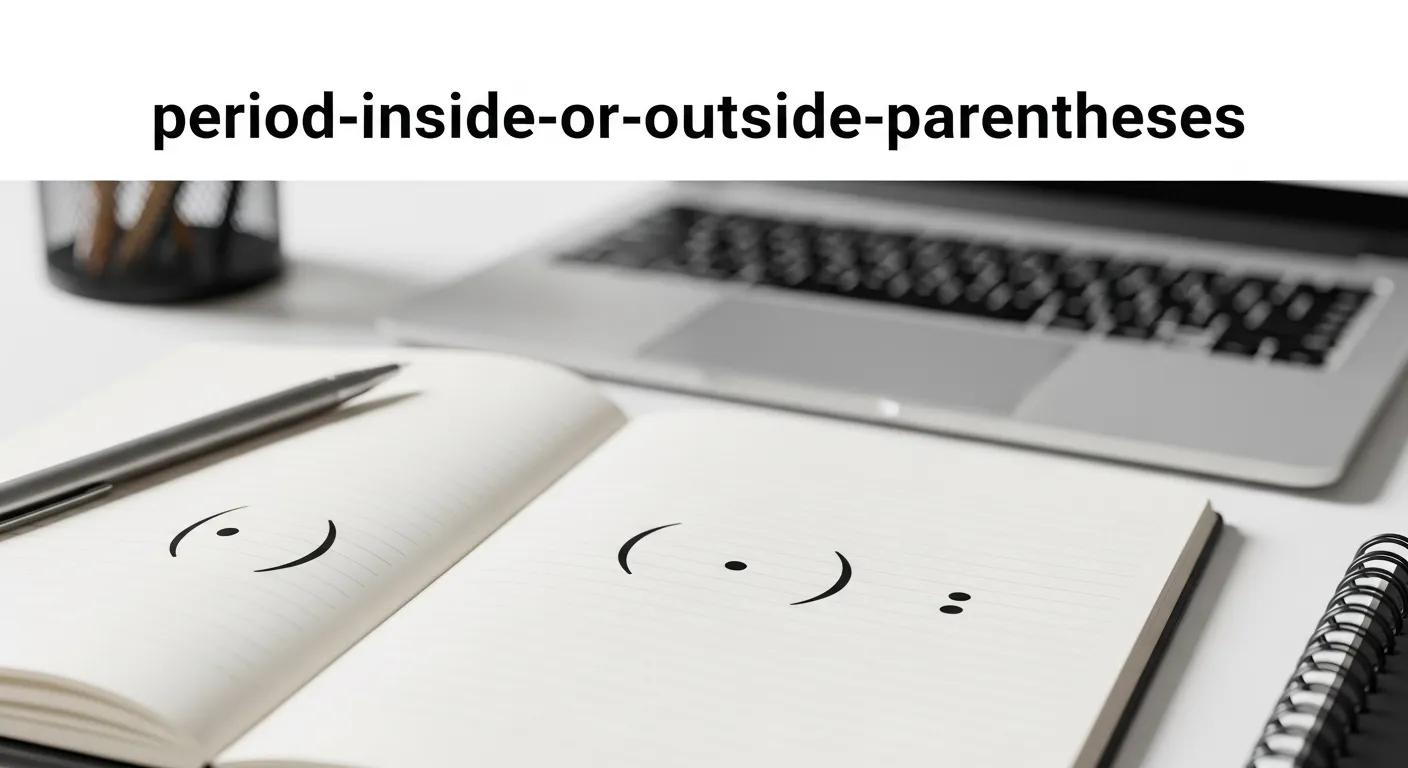
- Period inside parentheses → When the parentheses contain a complete sentence standing alone.
Example:
- “She finished her report. (It took three hours.)”
- “She finished her report. (It took three hours.)”
- Period outside parentheses → When the parentheses are part of another sentence.
Example:
- “She finished her report (it took three hours).”
- “She finished her report (it took three hours).”
Key rule:
- Standalone sentence → period inside.
- Part of another sentence → period outside.
The Origin of Period Inside or Outside Parentheses
Parentheses originated in the 15th century from the Greek word parenthesis, meaning “insertion.” Writers used them to add extra information without breaking the sentence.
- American English style guides often prefer minimal punctuation inside parentheses unless it is a complete sentence.
- British English allows some flexibility, especially in literary writing, but generally follows the same logic: complete sentences get periods inside; integrated phrases get periods outside.
The confusion persists because modern writing uses parentheses in informal notes, citations, and digital content, making correct punctuation essential for clarity.
British English vs American English Usage
| Rule | American English | British English | Example |
| Standalone sentence in parentheses | Period inside | Period inside | “(This is a complete thought.)” |
| Part of another sentence | Period outside | Period outside | “He went home (it was raining).” |
| Citation usage | Period outside parentheses | Period outside | “He stated the results (Smith, 2020).” |
| Informal notes | Flexible but recommended outside | Similar | “Remember to buy milk (and eggs).” |
Tips:
- Both styles aim to avoid confusing readers.
- The main sentence’s punctuation usually dictates placement.
Which Should You Use?
For US audiences
- Follow strict rules from style guides: APA, Chicago, and MLA.
- Use periods inside for complete parenthetical sentences.
- Use periods outside for integrated notes.
For UK or Commonwealth readers
- Same functional rules.
- Literary and journalistic contexts may allow minor flexibility, but clarity matters most.
global audiences
- Always prioritize readability.
- Standalone sentence → period inside.
- Integrated phrase → period outside.
Common Mistakes with Period Inside or Outside Parentheses
Mistake 1: Putting the period inside an integrated phrase
Incorrect:
- “She went to the store. (and bought milk.)”
Correct:
- “She went to the store (and bought milk).”
Mistake 2: Leaving out the period for a standalone sentence
Incorrect:
- “She went home (It was raining)”
Correct:
- “She went home. (It was raining.)”
Mistake 3: Confusing citation punctuation
Incorrect:
- “He said it was late. (Smith, 2020.)”
Correct:
- “He said it was late (Smith, 2020).”
Mistake 4: Overusing parentheses in one sentence
- Too many parentheses make sentences cluttered and confusing.
Period Inside or Outside Parentheses in Everyday Examples
Emails
- “Please review the document (it is attached).”
- “Please review the document. (It contains all recent updates.)”
News headlines
- “New study released (details inside).”
- “New study released. (This is the first study of its kind.)”
Social media posts
- “Don’t forget the meeting (tomorrow at 3 PM).”
- “Don’t forget the meeting. (It’s very important.)”
Formal writing
- “The results were conclusive (all data were analyzed).”
- “The results were conclusive. (The team worked for months.)”
Period Inside or Outside Parentheses: Google Trends & Usage Data
Search trends indicate:
- High interest from students, writers, and non-native English speakers.
- Queries spike around exams, essay writing periods, and academic deadlines.
- Most searches seek clarity for citations, email writing, and formal reports.
Insights:
- US learners focus on style guide rules.
- UK learners often ask about literary and journalistic usage.
- Global searches favor quick, easy-to-follow rules.
Comparison Table: Keyword Variations
| Phrase | Meaning | Use Case | Example |
| Period inside parentheses | Standalone parenthetical sentence | Academic, formal writing | “(This is a complete sentence.)” |
| Period outside parentheses | Integrated phrase in another sentence | Emails, articles, casual writing | “She left early (it was raining).” |
| Parentheses punctuation | General topic | Grammar tutorials | “Period inside or outside parentheses?” |
| Punctuation rules | Broader guide | Educational content | “Learn punctuation rules for parentheses.” |
| Parenthetical sentence | Complete idea inside parentheses | Essays, reports | “(This explains the main result.)” |
FAQs
1. When should the period go inside parentheses?
- Only if the parentheses contain a complete, standalone sentence.
2. When should it go outside?
- When the parenthetical is part of a larger sentence.
3. Is this rule the same in British and American English?
- Yes, the basic rule is the same, though minor stylistic differences exist.
4. Does this apply to citations?
- Yes. Periods usually go outside for references like (Smith, 2020).
5. Can informal writing ignore this rule?
- Flexibility exists, but following the rule improves readability.
6. How do I remember the rule?
- Standalone = inside; part of another sentence = outside.
7. Do question marks or exclamation marks follow the same rule?
- Yes, but placement may vary depending on sentence structure.
Conclusion
Knowing If to place a period inside or outside parentheses improves writing clarity and professionalism.
Standalone sentences inside parentheses always get a period inside, while integrated phrases get the period outside.
Both American and British English follow the same functional rules, though spacing and minor stylistic choices may differ.
Understanding these rules prevents common mistakes in emails, social media posts, academic writing, and formal documents.
By following these clear examples, writers can avoid confusing readers and maintain proper punctuation. Always check if the parenthetical content is a full sentence or part of another sentence.
Correct usage strengthens readability, conveys attention to detail, and ensures polished writing. Learning this simple rule enhances overall grammar skills and boosts confidence in writing.
With practice, the choice between period inside or outside parentheses becomes automatic, keeping your text professional and error free.
Discover More Posts!
In To or Into: Which One Is Correct? With In 30 Seconds
Period Before or After Quotes: Simple Guide for Correct Usage📝
Tweeking or Tweaking: Which Spelling Is Correct?📝

englifiy.com is my English grammar comparison website where I simplify confusing words, spelling differences, and usage rules through clear explanations and examples. My goal is to help learners, writers, and students understand English easily and use correct grammar with confidence.