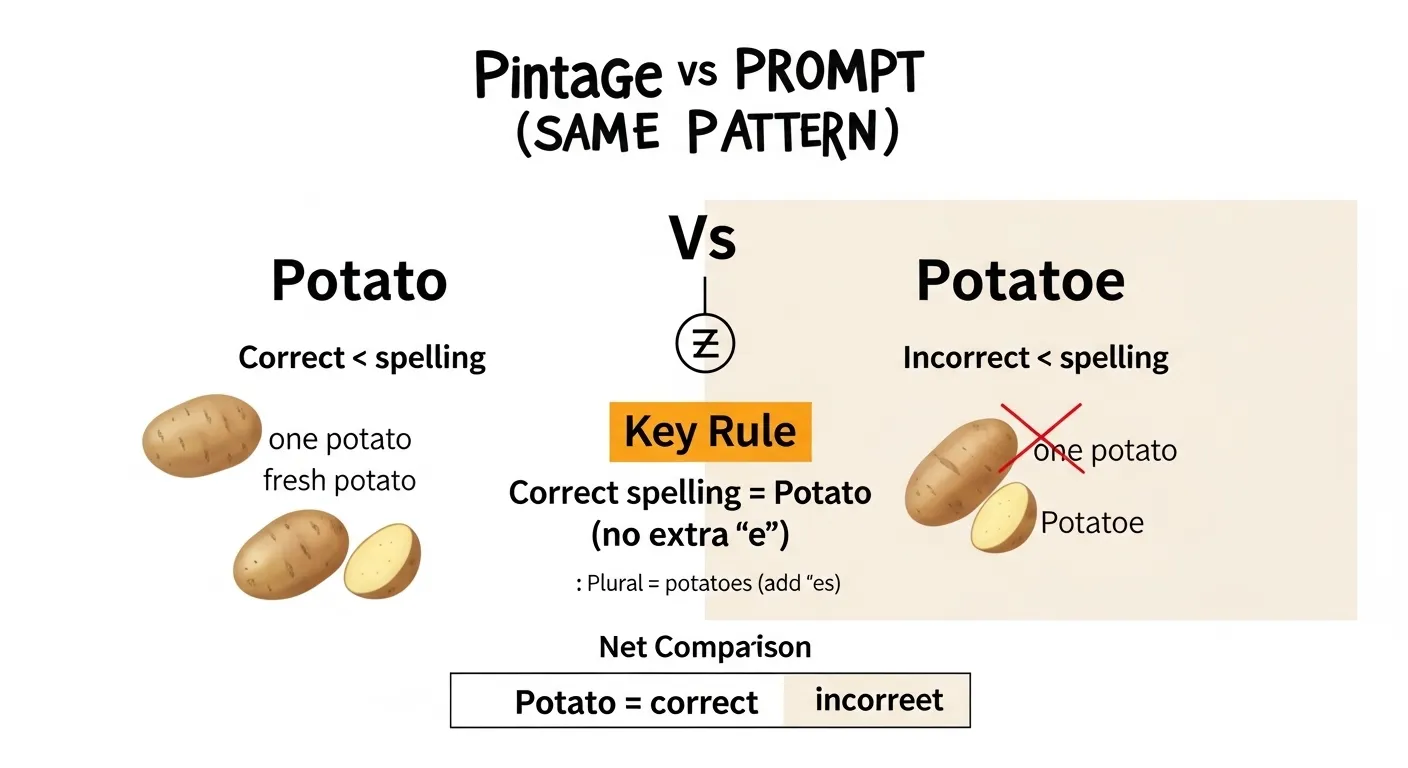
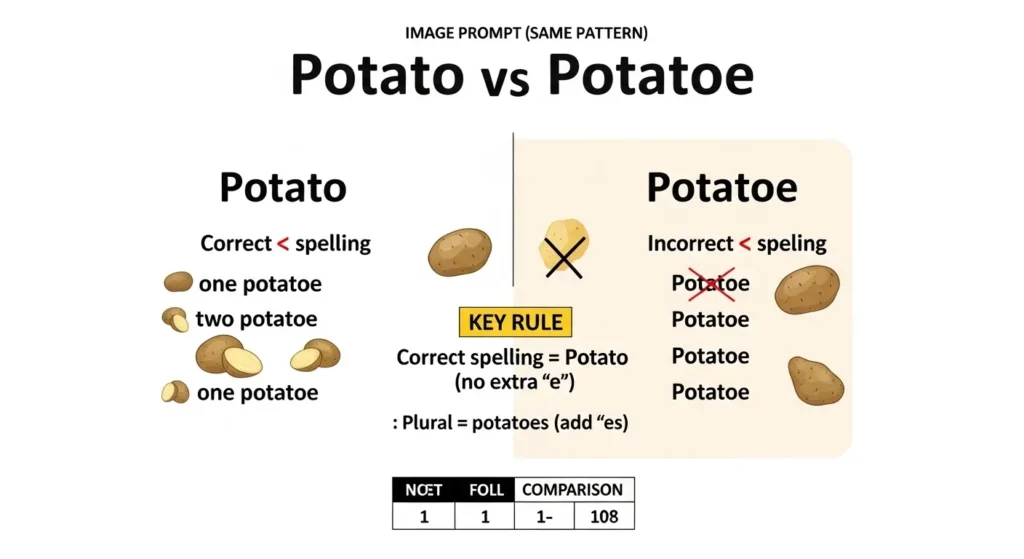
Potato is the correct spelling, while potatoe is incorrect in modern English.
Many people search for potato vs potatoe because they get confused about the correct spelling, especially when adding “-es” to make plurals like “potatoes.” The extra “e” in “potatoe” looks similar to the plural form, which causes mistakes in writing.
This confusion appears in exams, social media, and even casual conversations. Understanding the correct spelling helps you avoid simple but noticeable errors.
This guide explains the quick answer, origin, spelling rules, common mistakes, examples, usage patterns, and helpful tips so you can confidently use the correct form.
⚡ Potato or Potatoe : Quick Answer
The rule is simple:
- Potato = correct spelling
- Potatoe = incorrect spelling
Examples
- I ate a potato.
- We bought fresh potatoes.
Simple Explanation
- Always use potato for singular.
- Use potatoes for plural.
- Never use potatoe.
📜 The Origin of Potato
The word “potato” has an interesting history.
Origin of Potato
“Potato” comes from Spanish patata, which came from Indigenous Caribbean languages.
Example:
- Potato became common in English after being brought to Europe.
Why “Potatoe” Exists
“Potatoe” is a misspelling.
It often appears because people confuse it with the plural form potatoes.
There is no historical or grammatical reason to use “potatoe.”
🇬🇧🇺🇸 British English vs American English Spelling
There is no difference between British and American English.
| Word | British English | American English | Status |
| Potato | Potato | Potato | Correct |
| Potatoe | Potatoe | Potatoe | Incorrect |
Both regions follow the same spelling rule.
🌍 Which Spelling Should You Use?
You should always use potato.
Correct Usage
Examples:
- I cooked a potato.
- She peeled the potato.
- They planted potatoes.
Incorrect Usage
Examples:
- I cooked a potatoe. ❌
- She peeled a potatoe. ❌
These are incorrect in all forms of English.
❌ Common Mistakes with Potato vs Potatoe
These errors are very common.
1. Adding Extra “E”
Incorrect:
- Potatoe
Correct:
- Potato
2. Confusing Singular and Plural
Incorrect:
- Two potato
Correct:
- Two potatoes
3. Spelling Based on Sound
Incorrect:
- Potatoe (based on pronunciation)
Correct:
- Potato
📘 Understanding the Plural Rule
Here is a clear comparison.
| Form | Spelling | Example |
| Singular | Potato | One potato |
| Plural | Potatoes | Two potatoes |
| Incorrect | Potatoe | Not used |
Rule
Words ending in -o often add -es in plural.
Examples:
- Tomato → Tomatoes
- Potato → Potatoes
✍️ Potatoe vs Potato in Everyday Examples
📧 Email Example
“Please buy some potatoes from the market.”
📰 News Example
“Farmers reported a good potato harvest.”
📱 Social Media Example
“I love eating baked potatoes!”
📄 Formal Writing Example
“The potato is an important food crop.”
These examples show correct usage.
📊 Potato vs Potatoe: Google Trends & Usage Data
Search data shows that potato vs potatoe is a common spelling query.
Popular related searches include:
- potato or potatoe correct spelling
- how to spell potato
- potato plural spelling
- potato vs tomatoes spelling rule
- why potatoes have es
Countries where this query is common:
- United States
- United Kingdom
- India
- Pakistan
Many learners search this to avoid spelling mistakes.
📋 Comparison Table: Potato vs Potatoe
| Feature | Potato | Potatoe |
| Spelling | Correct | Incorrect |
| Usage | Standard English | Not accepted |
| Plural | Potatoes | Not used |
| Example | A potato | Wrong form |
🧠 Easy Memory Tricks
Simple tricks help you remember.
Trick 1: No Extra “E”
Think:
- Potato = no “e”
Trick 2: Add “ES” for Plural
Example:
- Potato → Potatoes
Trick 3: Tomato Pattern
If you know:
- Tomato → Tomatoes
Then: - Potato → Potatoes
📖 Advanced Usage Examples
Singular
- The potato is fresh.
- He ate a boiled potato.
Plural
- The potatoes are ready.
- She cooked roasted potatoes.
Incorrect Form
- Potatoe ❌ (never use)
🧾 Potato vs Potatoe in Professional Writing
Right spelling is important.
Correct:
- The company produces potato chips.
Correct:
- Farmers grow potatoes in large quantities.
Incorrect:
- The company produces potatoe chips.
Mistakes reduce credibility.
🌎 Why This Confusion Happens
This confusion happens because:
- The plural form ends in “-es.”
- People add “e” by mistake.
- Pronunciation can be misleading.
Understanding spelling rules solves the issue.
❓ FAQs About Potato vs Potatoe
1. What is the correct spelling, potato or potatoe?
Potato is correct. Potatoe is incorrect.
2. What is the plural of potato?
The plural is potatoes.
3. Why do people write potatoe?
They confuse it with the plural form “potatoes.”
4. Is potatoe ever correct?
No. It is always incorrect.
5. Does British English use potatoe?
No. Both British and American English use “potato.”
6. What is the rule for words ending in “o”?
Many add “-es” in plural (potato → potatoes).
7. Is this mistake common?
Yes. Many learners make this mistake.
🏁 Conclusion:
The difference between potato and potatoe is simple but important. “Potato” is the correct spelling used in all forms of English, while “potatoe” is a common mistake that should always be avoided.
The confusion usually comes from the plural form “potatoes,” where an “-es” ending is added. This makes some people think the singular form also includes an extra “e,” which is not true.
Using the correct spelling improves your writing and helps you avoid basic errors in exams, emails, and professional communication. Remember that “potato” is always written without an extra “e,” and its plural form is “potatoes.”
By understanding this rule and practicing it, you can use the word correctly in all situations. Over time, this will become natural and help you write more accurately and confidently in English.
Discover More Articals!
Since vs For: What Is the Difference?
Period Inside or Outside Parentheses: Correct Punctuation Guide.
Can vs May: What Is the Difference?(2026)

englifiy.com is my English grammar comparison website where I simplify confusing words, spelling differences, and usage rules through clear explanations and examples. My goal is to help learners, writers, and students understand English easily and use correct grammar with confidence.