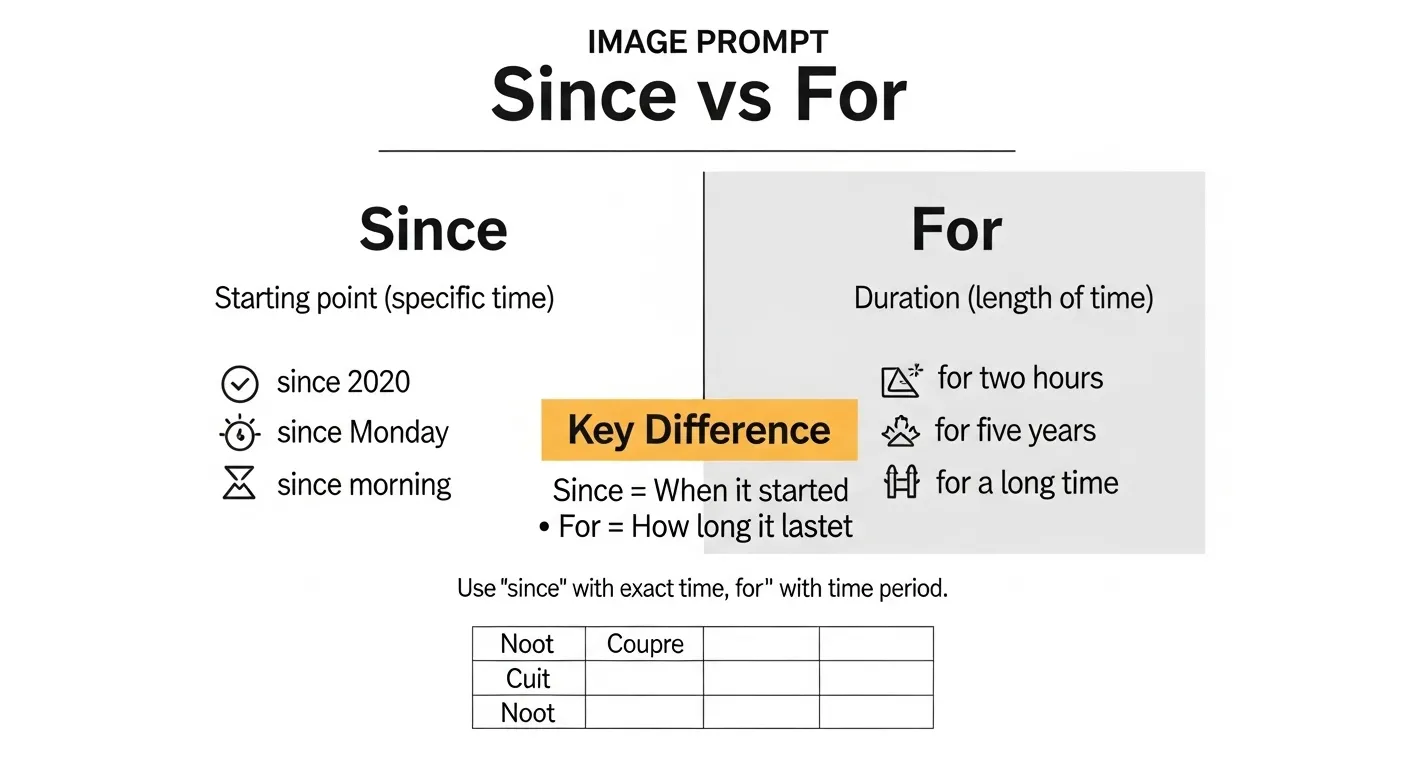
Since is used for a starting point in time, while for is used for a duration of time.
Many people search for since vs for because both words are used with time, but they are not used in the same way.
The confusion often appears in sentences like “I have lived here since five years” or “I have lived here for 2020,” which are incorrect. The problem happens because learners mix up starting time and length of time.
Understanding this difference helps you speak and write correct English in daily life, exams, and professional settings.
This guide explains the rules, examples, mistakes, and tips so you can use both words confidently.
⚡ Since or For: Quick Answer
The main rule is:
- Since = starting point (specific time)
- For = duration (length of time)
Examples
- I have lived here since 2020.
- I have lived here for five years.
Simple Explanation
- Use since to say when something started.
- Use for to say how long it lasted.
📜 The Origin of Since and For
Both words have long histories in English.
Origin of Since
“Since” comes from Old English siththan, meaning from a past time until now.
Example:
- She has worked here since Monday.
Origin of For
“For” comes from Old English for, meaning a period or duration.
Example:
- He studied for two hours.
Over time, their meanings stayed connected to time expressions.
🇬🇧🇺🇸 British English vs American English Usage
There is no spelling difference, and both follow the same rules.
| Word | British English | American English | Usage |
| Since | Since | Since | Starting point |
| For | For | For | Duration |
The grammar rule is the same worldwide.
🌍 Which Word Should You Use?
Your choice depends on the type of time expression.
Use Since for Starting Point
Examples:
- I have known him since 2015.
- She has been sick since morning.
- They have lived here since January.
These show when something began.
Use For for Duration
Examples:
- I have known him for 10 years.
- She has been sick for two days.
- They have lived here for a long time.
These show how long something continued.
❌ Common Mistakes with Since vs For
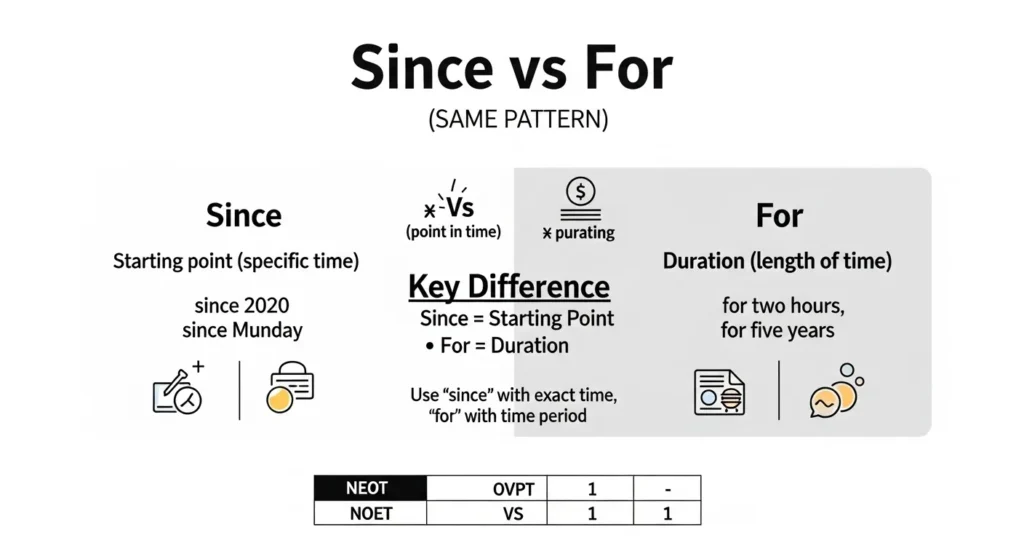
These mistakes are very common.
1. Using Since for Duration
Incorrect:
- I have lived here since five years.
Correct:
- I have lived here for five years.
2. Using For for Starting Point
Incorrect:
- I have lived here for 2020.
Correct:
- I have lived here since 2020.
3. Mixing Both Incorrectly
Incorrect:
- She has worked here since two months.
Correct:
- She has worked here for two months.
📘 Understanding the Grammar Rule
Here is a simple comparison.
| Word | Type of Time | Meaning | Example |
| Since | Specific point | When it started | Since Monday |
| For | Duration | How long | For two hours |
✍️ For vs Since in Everyday Examples
📧 Email Example
“I have been working here since 2022.”
📰 News Example
“The project has been delayed for several months.”
📱 Social Media Example
“I have not seen you for ages!”
📄 Formal Writing Example
“The company has operated since 1990.”
These examples show daily usage.
📊 Since vs For: Google Trends & Usage Data
Search data shows that since vs for is a common grammar query.
Popular related searches include:
- since vs for difference
- when to use since or for
- since vs for examples
- since vs for grammar rule
- since vs for present perfect
Countries where this topic is widely searched:
- United States
- United Kingdom
- India
- Pakistan
Students often search this for exams and writing.
📋 Comparison Table: Since vs For
| Feature | Since | For |
| Use | Starting point | Duration |
| Time type | Specific | Length |
| Example | Since 2020 | For 5 years |
| Question | When? | How long? |
🧠 Easy Memory Tricks
Simple tricks help you remember.
Trick 1: Since = Start
Think “since = start time.”
Example:
- Since Monday
Trick 2: For = Length
Think “for = how long.”
Example:
- For two hours
Trick 3: Question Test
Ask:
- When did it start? → Use since
- How long? → Use for
📖 Advanced Usage Examples
Using Since
- He has been busy since morning.
- They have lived here since 2010.
Using For
- He has been busy for hours.
- They have lived here for a decade.
With Present Perfect
Both are often used with present perfect tense.
Examples:
- I have worked here since 2021.
- I have worked here for three years.
🧾 Since vs For in Professional Writing
Correct usage improves clarity.
Correct:
- The company has operated since 2005.
Correct:
- The company has operated for many years.
Incorrect:
- The company has operated since many years.
Using correct grammar improves professionalism.
🌎 Why This Confusion Happens
This confusion happens because:
- Both words relate to time.
- Learners mix starting point and duration.
- Similar sentence structures cause mistakes.
Understanding the difference solves the issue.
❓ FAQs About Since vs For
1. What is the difference between since and for?
Since shows the starting time. For shows duration.
2. Can I use since with years?
Yes, for specific years like “since 2020.”
3. Can I use for with dates?
No. Dates need “since.”
4. Which tense is used with since and for?
Often the present perfect tense.
5. Is this mistake common?
Yes. Many learners confuse these words.
6. Are spellings different in UK and US English?
No. Both use the same spelling.
7. What is the easiest rule?
Since = when
For = how long
🏁 Conclusion:
The difference between since and for becomes easy when you focus on time. “Since” is used to show the starting point of an action, such as a specific date, day, or moment.
“For,” on the other hand, is used to show the duration or length of time that an action continues. This small difference plays a big role in making your sentences clear and correct.
In everyday speech, many people make mistakes by mixing these two words, but learning the basic rule can quickly fix the problem.
Always ask yourself a simple question: are you talking about when something started or how long it lasted? If it is the starting point, use “since.” If it is the duration, use “for.”
With practice, using since and for correctly will become natural. This will improve your English in conversations, writing, and professional communication.
Discover More Articals!
Colon or Semicolon:How to Use Them Punctually ✍️
Lay vs Lie: What Is the Difference?
Period Inside or Outside Parentheses: Correct Punctuation Guide.

englifiy.com is my English grammar comparison website where I simplify confusing words, spelling differences, and usage rules through clear explanations and examples. My goal is to help learners, writers, and students understand English easily and use correct grammar with confidence.