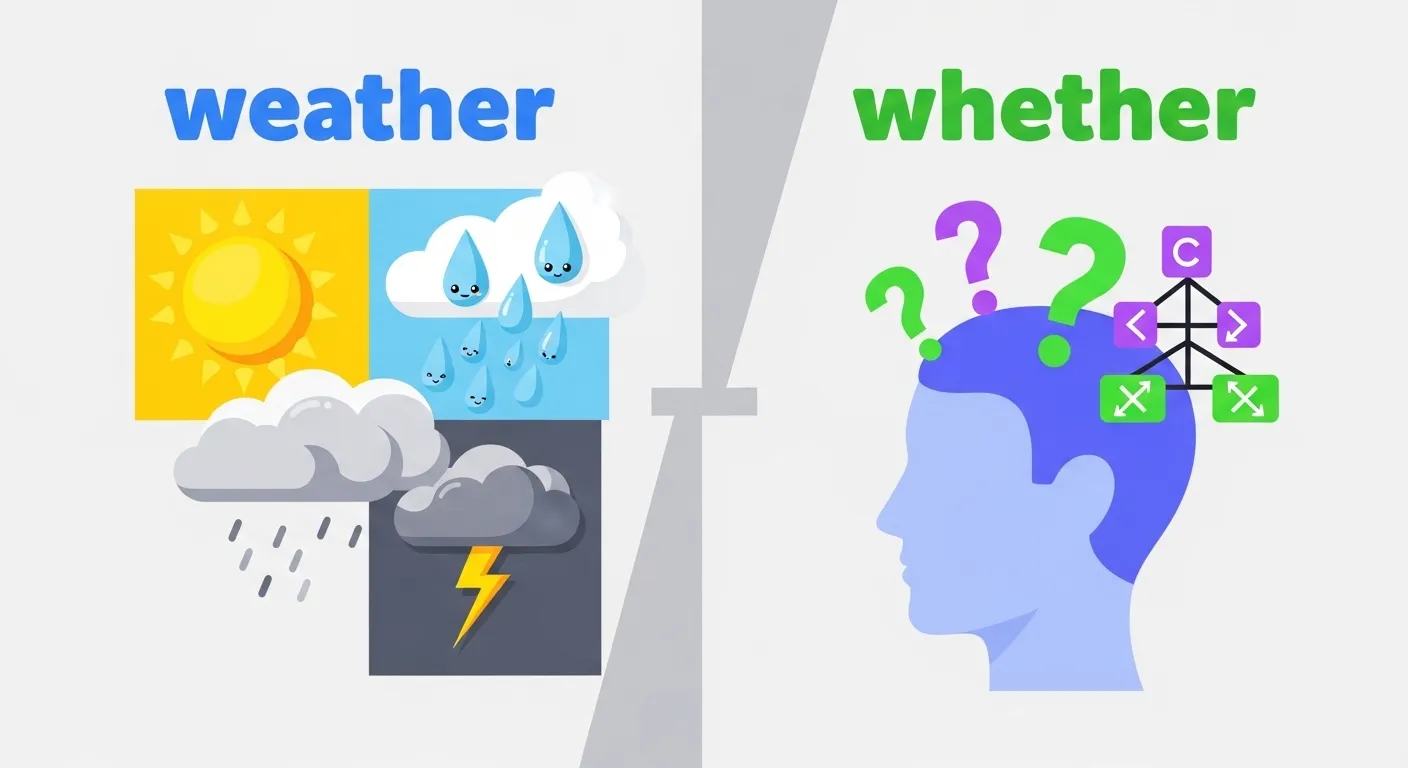
The correct choice depends entirely on the context. One word talks about the climate and conditions outside, while the other is used to introduce alternatives, choices, or possibilities.
Many people mix them up because they sound almost identical, but understanding their meanings ensures clarity in writing, emails, and social posts.
This confusion often arises in professional writing, exams, and online content. Knowing the difference helps avoid embarrassing mistakes and makes your writing precise.
In this guide, we’ll explore everything from definitions to examples and usage trends, helping you master the correct word every time.
Weather or Whether: Quick Answer
- First Word: Refers to natural atmospheric conditions like rain, sun, or wind.
- Example: “The outdoor event was canceled due to bad weather.”
- Example: “The outdoor event was canceled due to bad weather.”
- Second Word: Used to present alternatives, choices, or conditions.
- Example: “I am unsure whether I should take the job offer or wait.”
- Example: “I am unsure whether I should take the job offer or wait.”
Tip: If it describes sky conditions, it’s the first word. If it introduces a choice, it’s the second.
The Origin of Weather or Whether
- First Word: Comes from Old English weder, meaning air, sky, or storm. Historically, it always described atmospheric conditions.
- Over centuries, its meaning expanded to include temperature, precipitation, and general climate.
- Second Word: Originates from Old English hwæðer, used to indicate a choice or condition.
- Its spelling evolved over time but maintained its purpose as a conjunction introducing alternatives.
Why confusion exists: Both words sound nearly identical in speech. Additionally, their spellings differ by only one letter, which often leads to typing or proofreading errors.
British English vs American English Spelling
Interestingly, both words are spelled the same way in British and American English. The confusion does not come from regional spelling differences but rather from pronunciation similarities.
| Word | British English | American English | Example |
| Weather | Same | Same | “The weather is sunny today.” |
| Whether | Same | Same | “I don’t know whether I should attend.” |
Observation: The choice is always context-based, not regional.
Which Spelling Should You Use?
- For students and professionals worldwide: Use the first word when describing climate, the second for decisions.
- US vs UK/Commonwealth: No difference in spelling. Both follow the same rules.
- Global context: Most international style guides, including Cambridge and Oxford, confirm the distinction is purely semantic.
Practical advice: When proofreading, ask yourself: Am I talking about weather conditions or a choice? This question is usually enough to pick the right word.
Common Mistakes with Weather or Whether
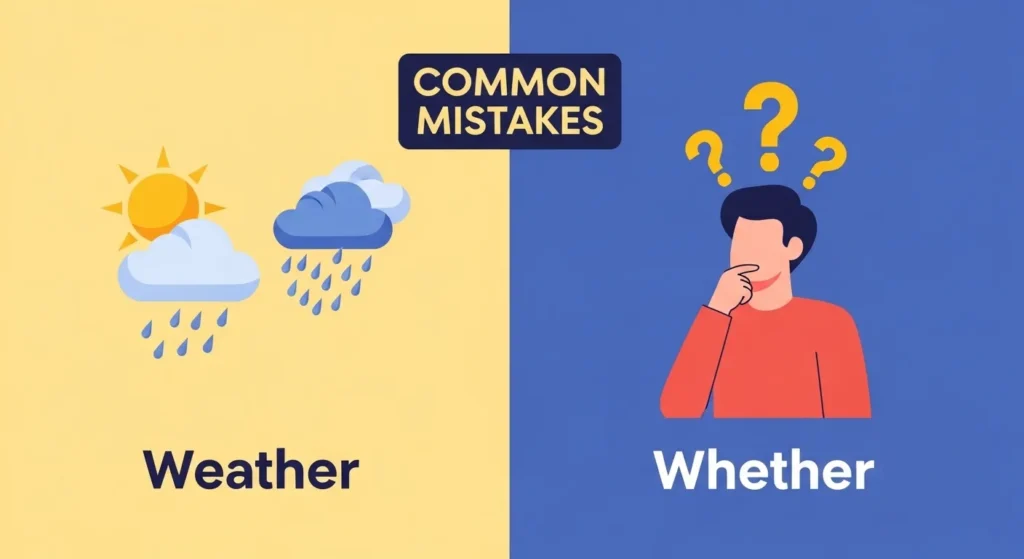
- Incorrect: “I don’t know weather I will attend.”
Correct: “I don’t know whether I will attend.” - Incorrect: “The whether was rainy.”
Correct: “The weather was rainy.” - Using the first word in conditional statements:
- Incorrect: “Check the weather if you want to know if you should go.” (If you mean a choice, use the second word.)
- Correct: “Check whether you want to go or stay home.”
- Incorrect: “Check the weather if you want to know if you should go.” (If you mean a choice, use the second word.)
- Omitting the second word in choices:
- Incorrect: “I am unsure I should call him.”
- Correct: “I am unsure whether I should call him.”
- Incorrect: “I am unsure I should call him.”
Pro tip: Read sentences out loud. Context usually reveals which word is correct.
Weather or Whether in Everyday Examples
Emails:
- Correct: “Please let me know whether you can attend the meeting tomorrow.”
- Correct: “The weather looks perfect for our outdoor team event.”
News articles:
- Correct: “Weather warnings have been issued for heavy rain this weekend.”
- Correct: “It is unclear whether the government will approve the new policy.”
Social media posts:
- Correct: “Can anyone tell me whether this recipe works for beginners?”
- Correct: “The weather here is amazing today!”
Formal writing:
- Correct: “The report will discuss whether the new regulations affect small businesses.”
- Correct: “Weather patterns have been changing rapidly due to climate change.”
Weather or Whether: Google Trends & Usage Data
Analyzing search trends shows:
- First Word: Frequently searched during seasonal changes, storms, or climate-related discussions. Countries with variable climates show spikes in searches.
- Second Word: Often searched by students, writers, and professionals asking grammar-related queries or checking formal documents.
| Word | Peak Search Regions | Common Context |
| Weather | US, UK, India, Australia | Climate, storms, forecast |
| Whether | US, UK, Canada | Grammar, choices, decisions |
Insight: Misuse often occurs in emails, social media captions, and casual writing. Awareness campaigns and grammar-check tools can reduce mistakes.
Keyword Variations Comparison Table
| Aspect | First Word | Second Word |
| Meaning | Climate, sky conditions, rain, sun | Choices, alternatives, conditions |
| Part of Speech | Noun | Conjunction |
| Example | “The weather is sunny.” | “I am unsure whether to join.” |
| Confusion Risk | Low in spoken form, high in written form | High in both spoken and written form |
| Synonyms | Climate, conditions, atmosphere | If…or, in case, provided that |
FAQs About Weather or Whether
- Q: Can I use the second word to talk about storms?
A: No. Use the first word for storms, rain, or sunshine. - Q: Is there a regional difference in spelling?
A: No, both words are spelled the same in British and American English. - Q: Can both words appear in the same sentence?
A: Yes. Example: “Check the weather to see whether we should postpone the trip.” - Q: How can I remember the difference?
A: First word = sky. Second word = choice. Simple mnemonic: “Sky = first, Choice = second.” - Q: Are there synonyms I can use to avoid mistakes?
A: For first word: climate, conditions. For second word: if, provided that, in case. - Q: Why do people confuse them so often?
A: They sound alike (homophones) and differ by only one letter. - Q: Does this affect formal writing?
A: Absolutely. Incorrect usage can undermine credibility, especially in business or academic writing.
Conclusion
Understanding the difference between these two words ensures clarity and professionalism. The first is always about the sky and climate; the second introduces choices, conditions, or alternatives. Both are spelled the same across English dialects, so context is the key to correct usage.
Common mistakes happen in casual writing, emails, and social media, but careful proofreading and awareness of meaning can prevent errors.
Using examples in daily life, such as checking forecasts or making decisions, strengthens your understanding. Remember the simple mnemonic: Sky = first word, Choice = second word.
Following this guide ensures your writing is precise, readable, and grammatically correct. Whether in academic papers, professional emails, or social posts, proper usage enhances credibility and avoids confusion.
Related More Posts!
The Origin of Deep-Seated or Deep-Seeded

englifiy.com is my English grammar comparison website where I simplify confusing words, spelling differences, and usage rules through clear explanations and examples. My goal is to help learners, writers, and students understand English easily and use correct grammar with confidence.