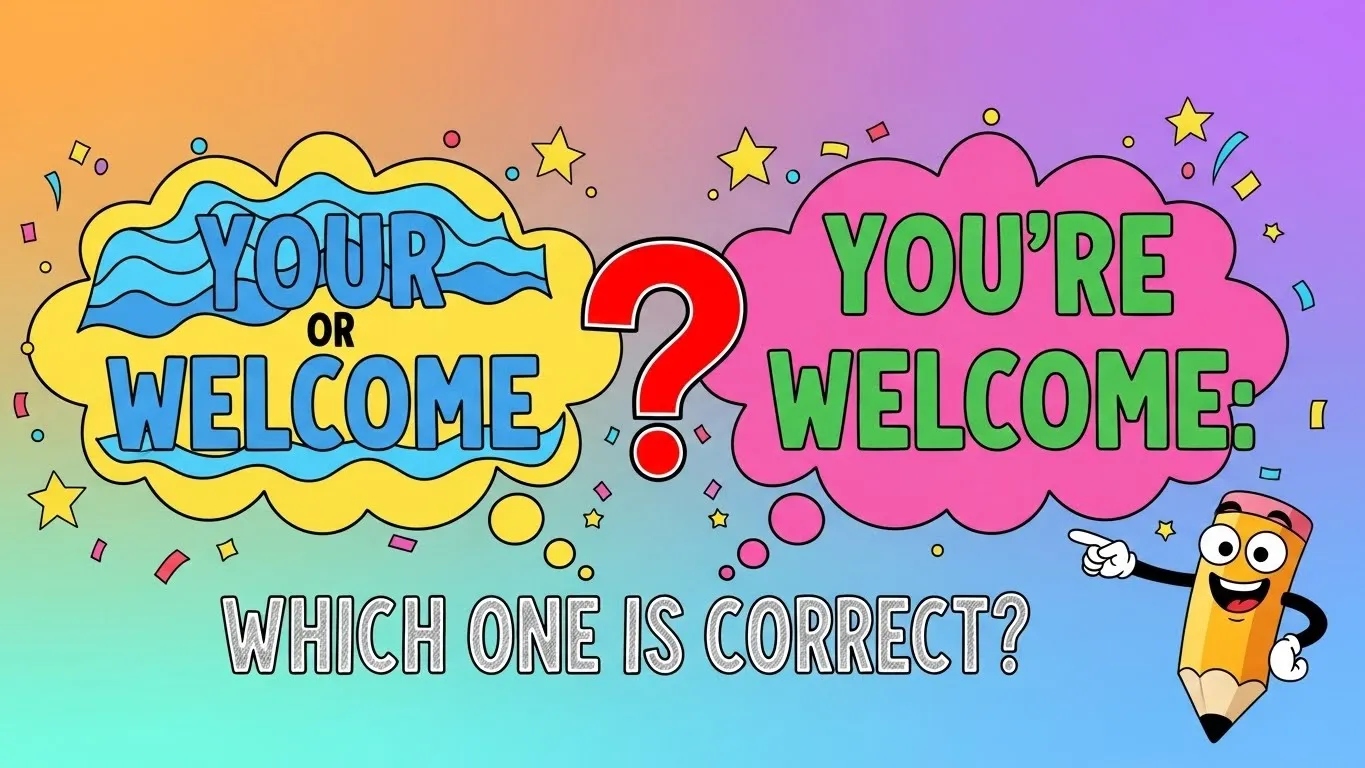
Many people search for “your welcome or you’re welcome” because the phrases look similar but mean different things. The confusion is common in emails, texts, social media, and professional writing, where one apostrophe changes the meaning.
When someone says thank you, people hesitate before replying and wonder which form is correct. Spellcheck and autocorrect often fail, increasing doubt. The problem exists because English contractions resemble possessives: your shows ownership, while you’re means you are.
Both sound identical when spoken. This article removes the confusion with rules, examples, mistakes, and practical advice, helping readers choose the correct form confidently every time.
Your Welcome or You’re Welcome:Quick Answer
You’re welcome is the correct phrase when replying to thank you.
Your welcome is incorrect in most situations because it suggests ownership of a “welcome,” which usually makes no sense.
Examples:
- Thank you for your help. → You’re welcome. ✅
- ❌ Your welcome. (Incorrect in standard English)
Rule:
- You’re = you are
- If you are welcome makes sense, then you’re welcome is correct.
The Origin of Your Welcome or You’re Welcome
To understand why only one form is correct, we need to look at the history and structure of the words involved.
Origin of “You’re”
You’re is a contraction of you are. Contractions became common in English to make speech and writing faster and more natural. Over time, you are welcome was shortened to you’re welcome, especially in polite conversation.
This phrase has been used for centuries as a polite response, meaning:
“You are welcome to what I did for you.”
Origin of “Your”
Your comes from Old English ēower, meaning belonging to you. It is a possessive adjective and must always modify a noun.
Examples:
- your book
- your idea
- your kindness
The confusion exists because your and you’re sound the same when spoken. However, they serve completely different grammatical roles, which is why spelling matters so much in writing.
British English vs American English Spelling
There is no difference between British English and American English when it comes to your welcome vs you’re welcome. Both varieties follow the same grammar rules.
The correct form in both is:
- You’re welcome ✅
Examples
- British English: You’re welcome. Happy to help.
- American English: You’re welcome! No problem at all.
Comparison Table
| Aspect | British English | American English |
| Correct phrase | You’re welcome | You’re welcome |
| Meaning | You are welcome | You are welcome |
| Use of “your welcome” | Incorrect | Incorrect |
| Grammar rule | Same | Same |
Which Spelling Should You Use?
The choice is simple because only one option is grammatically correct in normal usage.
Audience-Based Advice
- US audience: Always use you’re welcome.
- UK & Commonwealth audience: Use you’re welcome.
- Global or professional audience: Use you’re welcome to sound polite and educated.
When Could “Your Welcome” Ever Be Correct?
Only in rare and special sentences, such as:
- I appreciate your welcome at the conference.
Here, welcome is a noun, and your correctly shows possession. This is not a reply to thank you.
Common Mistakes with Your Welcome or You’re Welcome
Mistake 1: Using “Your welcome” as a reply
❌ Your welcome for the help. ✅ You’re welcome for the help.
Mistake 2: Forgetting the apostrophe
❌ Youre welcome. ✅ You’re welcome.
Mistake 3: Assuming both are correct
❌ Your welcome! ✅ You’re welcome!
Mistake 4: Overthinking informality
Some people think you’re welcome is informal. It is not. It is correct in both formal and informal writing.
Your Welcome or You’re Welcome in Everyday Examples
Emails
- Thank you for your quick reply. → You’re welcome. Please let me know if you need anything else.
News Writing
- The spokesperson replied politely, saying, “You’re welcome.”
Social Media
- Thanks for the info! → You’re welcome 😊
Formal Writing
- The host smiled and said, “You’re welcome.”
Using your welcome in these contexts would look unprofessional and grammatically incorrect.
Your Welcome or You’re Welcome:Google Trends & Usage Data
Search trend data shows that “your welcome or you’re welcome” is one of the most common English grammar queries worldwide.
Popularity by Region
- High search volume in:
- United States
- United Kingdom
- India
- Pakistan
- Philippines
- ESL-learning countries
Why People Search This Keyword
- Fear of making grammar mistakes
- Writing emails or exam answers
- Social media and messaging confusion
- Apostrophe misuse
Usage data clearly shows that you’re welcome is overwhelmingly more common and accepted in all forms of standard English.
Comparison Table:Your Welcome vs You’re Welcome
| Feature | Your welcome | You’re welcome |
| Grammar type | Possessive adjective | Contraction |
| Meaning | Belonging to you | You are welcome |
| Correct as reply to thanks | ❌ No | ✅ Yes |
| Used in daily conversation | ❌ Rare | ✅ Common |
| Professional usage | ❌ Wrong | ✅ Correct |
FAQs About
Is “your welcome” ever correct?
Yes, but only when welcome is a noun, not as a reply to thanks.
Why do people confuse your and you’re?
Because they sound the same when spoken.
Is “you’re welcome” formal English?
Yes, it is correct in both formal and informal settings.
Can I write “ur welcome” in messages?
Only in very informal chats. Avoid it in professional writing.
Is “you’re welcome” American English only?
No, it is correct in British English as well.
Does punctuation really matter here?
Yes. The apostrophe changes the meaning completely.
What is the easiest way to remember?
Replace you’re with you are. If it works, use you’re.
Conclusion
The confusion between your welcome or you’re welcome is small but important. A single apostrophe decides whether your sentence is correct or incorrect. In standard English, you’re
welcome is the only correct response when someone says thank you. It means you are welcome, which fits naturally and politely in conversation.
Your welcome, on the other hand, is only correct in rare cases where welcome is a noun, such as your warm welcome.
Using it as a reply to thanks is a common mistake that can make writing look careless or unprofessional.
The good news is that this rule is easy to remember. Just expand the phrase in your mind. If you are welcome sounds right, then you’re welcome is the correct choice.
This rule works every time, in emails, exams, social media, and formal writing.
By understanding the grammar, examples, common mistakes, and usage trends explained in
this article, you can now respond confidently and correctly. One small apostrophe can make a big difference and now you know exactly how to use it.
Read more about!
Everybody’s or Everybodies : Which One Is Correct?

**Emily R. Dawson** I am a English language writer and editor i specializes in grammar clarity, sentence structure, and common writing mistakes.I focuses on helping readers write correct, natural-sounding English through simple explanations and practical examples. Emily mainly creates beginner-friendly and intermediate-level language guidesmy writing style is clear, supportive, and easy to follow.