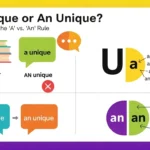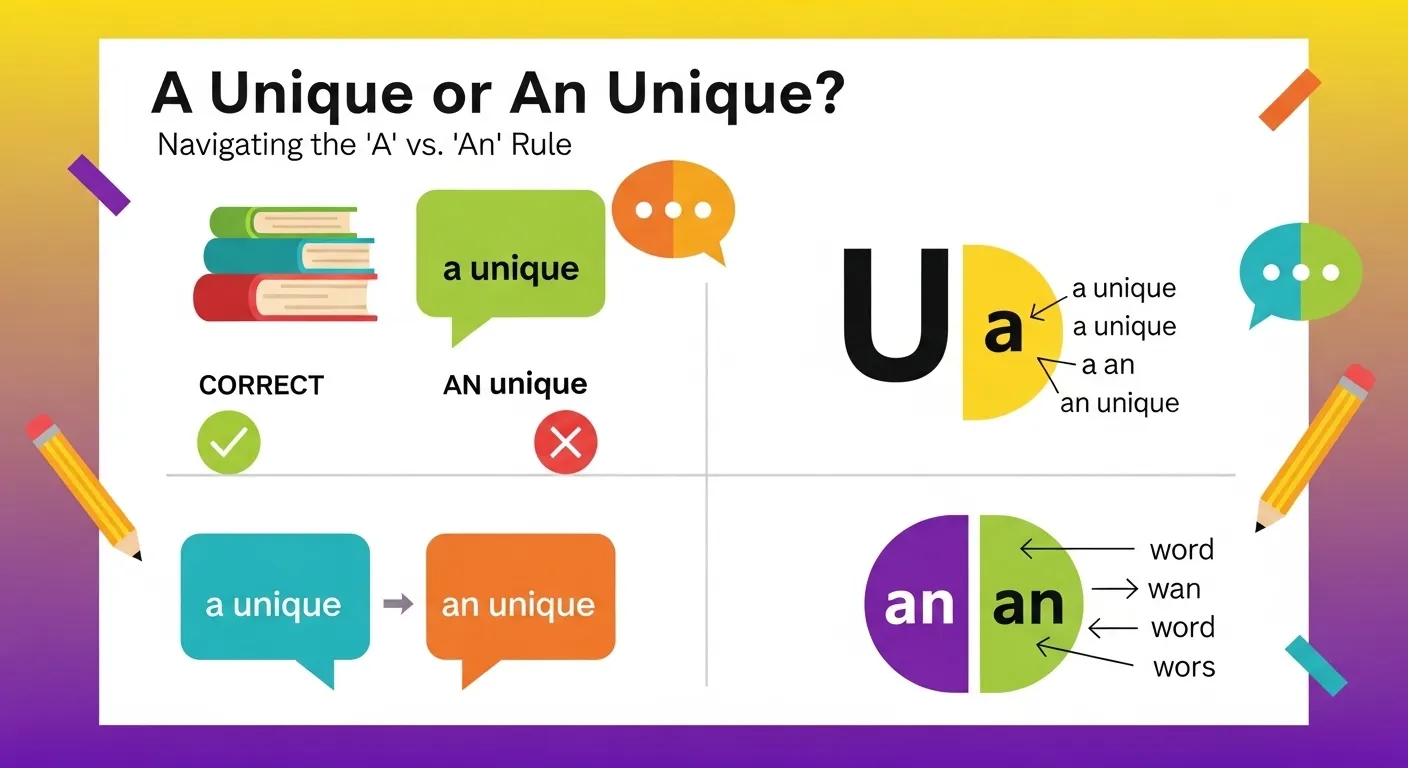
“A unique” is correct, not “an unique,” because the word unique starts with a consonant sound (you nique), not a vowel sound.
Many writers stop and think before using articles like “a” and “an.” The confusion happens because people often look at spelling instead of pronunciation.
Since unique begins with the letter “u,” some assume it needs “an,” but English articles follow sound rules.
Students, bloggers, and professionals search this topic because they want clear grammar and natural writing.
Small mistakes can make sentences sound awkward or incorrect. This guide explains the rule in a simple way, shows examples, and helps you remember the correct form easily in daily writing.
A Unique and An Unique: Quick Answer
The correct phrase is “a unique.”
English uses a before consonant sounds and an before vowel sounds. The key point is sound, not the first letter.
- Unique is pronounced “you-nique.”
- The starting sound is “y”, which is a consonant sound.
- Because of this, we use a unique, not an unique.
Examples:
✅ A unique idea changed the project.
✅ She has a unique style.
✅ That was a unique experience.
❌ An unique opportunity (incorrect)
❌ An unique design (incorrect)
Simple rule:
- If it sounds like “you,” use a.
- Example words: a university, a uniform, a unicorn, a unique plan.
The Origin of A Unique or An Unique
To understand the confusion, we need to look at the history of the word unique.
The word comes from the Latin word unicus, meaning “one of a kind.” It entered English through French.
Over time, pronunciation changed, but spelling stayed similar. This difference between spelling and sound causes confusion.
English articles “a” and “an” come from Old English forms used to make speech smoother. Speakers added “n” before vowel sounds to avoid awkward pauses. For example:
- an apple (smooth flow)
- a book (easy pronunciation)
The problem happens when writers look only at the letter “u.” Some words starting with “u” sound like vowels (umbrella, uncle), but others sound like “you” (university, unique). Since English mixes spelling history with pronunciation rules, people often guess wrong.
Another reason is teaching methods. Many learners hear the rule “an before vowels,” but they forget that sound matters more than spelling. This creates long-lasting confusion.
British English vs American English Spelling
Unlike some word pairs, the phrase a unique does not change between British and American English. The rule stays the same because pronunciation stays the same.
Both language styles follow pronunciation-based article rules.
Examples in both styles:
- A unique colour choice (British spelling for colour)
- A unique color choice (American spelling)
Notice that only other words change spelling, not the article.
Comparison Table
| Style | Correct Form | Example |
| British English | a unique | A unique programme idea |
| American English | a unique | A unique program idea |
| Global English | a unique | A unique solution |
Even though spelling differences exist in many words, article use remains consistent here.
Which Spelling Should You Use?
Your choice depends on pronunciation rules, not region or audience. Since the correct phrase is universal, writers across countries should use a unique.
If your audience is American:
Use American spelling for surrounding words, but keep “a unique.”
Example:
A unique organization created a new solution.
If your audience is British or Commonwealth:
Use British spelling patterns, but again keep “a unique.”
Example:
A unique organisation launched the project.
For global readers:
Choose clear, natural English that sounds correct when spoken. “A unique” sounds smooth and natural.
Helpful tip:
Say the phrase aloud. If the word begins with a “you” sound, use a.
Common Mistakes with A Unique vs An Unique
Many learners repeat similar errors. Here are common mistakes and corrections.
Mistake 1: Looking at letters instead of sound
❌ An unique experience
✅ A unique experience
Mistake 2: Applying the vowel rule incorrectly
People remember “an before vowels” but forget pronunciation.
Correct examples:
- an umbrella (uh sound)
- an hour (silent h)
- a unique story (you sound)
Mistake 3: Copying incorrect examples online
Some informal posts contain grammar errors. Always check pronunciation.
Mistake 4: Mixing rules with abbreviations
If a word starts with a vowel letter but consonant sound, use “a.”
Examples:
- a European trip
- a university lecture
- a useful tool
Quick correction guide:
| Word | Correct Article | Reason |
| Unique | a | sounds like “you” |
| Unicorn | a | consonant sound |
| Umbrella | an | vowel sound |
| Hour | an | silent h |
A Unique or An Unique in Everyday Examples
Seeing real-life usage helps build confidence.
Emails
- I have a unique suggestion for the meeting.
- This is a unique opportunity for our team.
News Writing
- The artist created a unique sculpture.
- Scientists found a unique pattern in the data.
Social Media
- That was a unique travel experience!
- She has a unique fashion style.
Academic or Formal Writing
- The study presents a unique perspective.
- Researchers discovered a unique solution.
Casual Conversation
- That restaurant has a unique taste.
- He has a unique way of explaining things.
Notice how the phrase works in all contexts.
A Unique or An Unique: Google Trends & Usage Data
Search data shows that many learners type both “a unique” and “an unique.” The incorrect version appears because people follow spelling instead of sound.
Interest is high in countries where English is widely learned as a second language, such as:
- India
- Pakistan
- Philippines
- Nigeria
Students preparing for exams or improving writing skills often check article rules. Teachers also search for clear explanations to help learners understand pronunciation-based grammar.
Native speakers rarely use “an unique” because it sounds unnatural in spoken English. Language tools and grammar checkers also mark “an unique” as incorrect.
Usage patterns show:
- “A unique” appears frequently in business writing, education, marketing, and storytelling.
- Writers use it to describe something special, rare, or different.
Comparison Table: Keyword Variations
| Phrase | Correct or Incorrect | Reason |
| A unique | Correct | Consonant “you” sound |
| An unique | Incorrect | Wrong article choice |
| A unique idea | Correct | Standard usage |
| An unique idea | Incorrect | Breaks pronunciation rule |
| A unique opportunity | Correct | Natural phrasing |
FAQs
1. Is “a unique” grammatically correct?
Yes. It follows pronunciation rules because unique begins with a consonant sound.
2. Why do some people write “an unique”?
They focus on the letter “u” instead of the sound “you.”
3. Do British and American English use different forms?
No. Both use “a unique.”
4. Are there other words like unique?
Yes. Examples include university, uniform, unicorn, and European.
5. How can I remember the rule quickly?
Say the word aloud. If it sounds like “you,” use “a.”
6. Can “unique” ever use “an”?
No, because its pronunciation always starts with a consonant sound.
7. Does pronunciation always decide article choice?
Yes. Sound matters more than spelling when choosing between “a” and “an.”
Conclusion
Understanding the difference between “a unique” and “an unique” becomes easy once you focus on sound instead of spelling.
Many learners feel confused because English rules are often taught in a simplified way, like “an before vowels.” While this works in many cases, the real rule depends on pronunciation.
Since unique starts with a “you” sound, it follows the consonant rule, making “a unique” the correct choice every time.
This applies in all English styles and across all regions. Using the correct form helps your writing sound natural, clear, and confident.
A simple habit can help: say the word aloud before choosing the article. Listening to the sound quickly shows the correct option.
With practice, you will start choosing articles automatically without thinking. Small grammar details may seem minor, but they improve clarity and build trust with readers.
Mastering this rule also helps with many similar words, making your writing smoother and more accurate.
Related More Posts!
Deep-Seated or Deep-Seeded: Meaning and Examples 🔍
Highschool or High School: Meaning, Examples, and Complete Guide✨
Til or Till: Meaning, and Simple Guide✨

**Emily R. Dawson** I am a English language writer and editor i specializes in grammar clarity, sentence structure, and common writing mistakes.I focuses on helping readers write correct, natural-sounding English through simple explanations and practical examples. Emily mainly creates beginner-friendly and intermediate-level language guidesmy writing style is clear, supportive, and easy to follow.