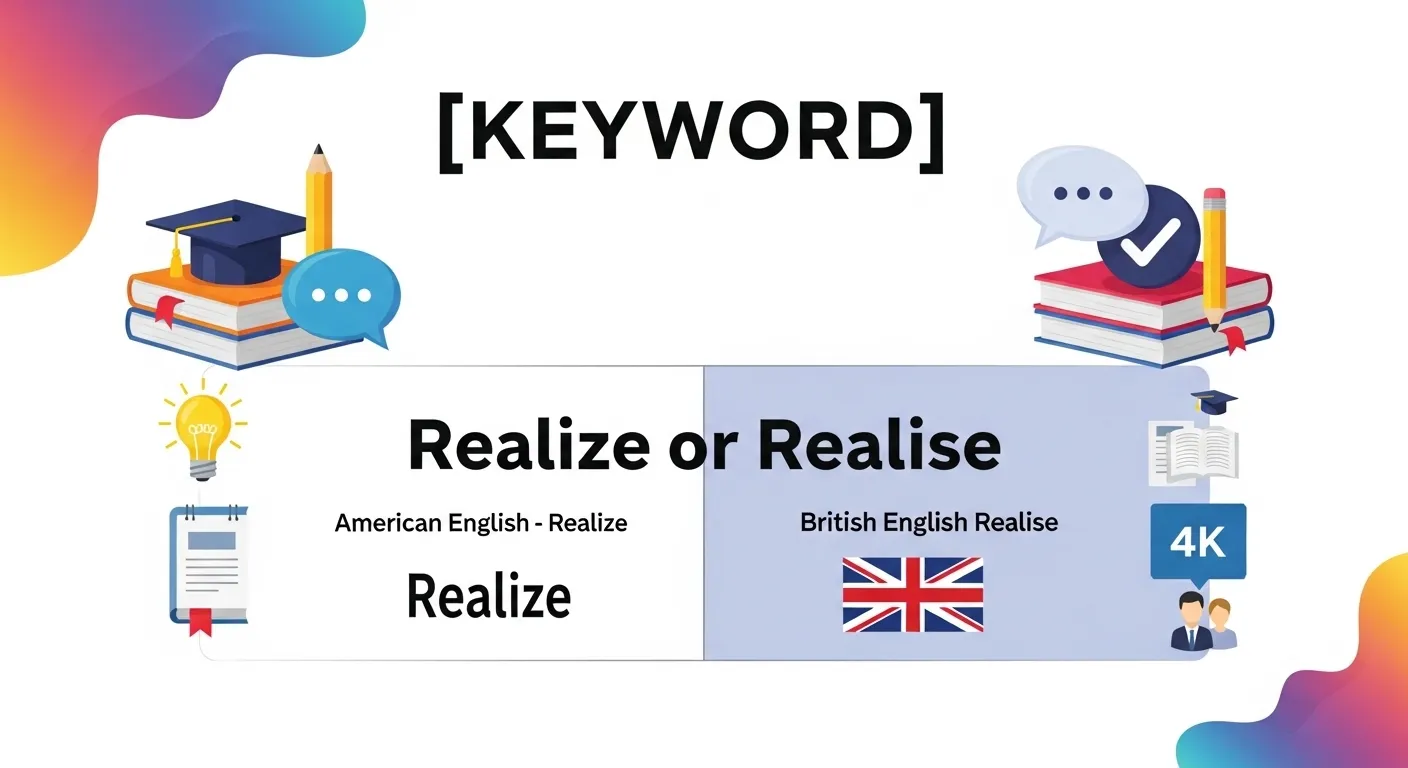
Realize and realise are both correct spellings, but their use depends on the type of English you follow.
Many people search for realize or realise because they see both forms in books, emails, exams, and online articles.
This difference creates confusion, especially for learners and professional writers. One version looks American, while the other feels British, yet both mean the same thing. Writers often worry about making a mistake or sounding unprofessional.
This guide removes that doubt. It explains where each spelling comes from, how different regions use them, and which one you should choose. By the end, you will know exactly which spelling fits your audience and writing style.
Realize or Realise: Quick Answer
Realize is preferred in American English.
Realise is preferred in British English.
Both spellings have the same meaning. They mean to understand, become aware of, or make something real.
Examples:
- I realized my mistake later.
- She realised the truth at last.
If you are writing for the United States, use realize.
If you are writing for the United Kingdom or Commonwealth countries, use realise.
The Origin of Realize or Realise
The verb comes from the word real, which traces back to Latin realis, meaning “actual” or “true.” When English adopted the word, it formed verbs by adding endings like -ize and -ise.
In early English, both endings were used freely. Over time, preferences changed by region. American English strongly favored -ize endings. British English leaned toward -ise, even though -ize also existed in Britain.
This is why both spellings survived. They grew from the same root and kept the same meaning. The difference is not about meaning or grammar. It is about regional tradition and style choices.
British English vs American English Spelling
This spelling difference follows a wider pattern seen in many verbs.
American English almost always uses -ize.
British English usually uses -ise, though -ize is not wrong there.
Comparison Table
| Aspect | American English | British English | Example |
| Preferred spelling | realize | realise | I realized the issue / I realised the issue |
| Ending style | -ize | -ise | organize / organise |
| Meaning | Same | Same | To understand or become aware |
So, the spelling choice depends on the variety of English you follow, not on correctness.
Which Spelling Should You Use?
Your audience should guide your choice.
- United States:
Use realize. This is the expected and standard form. - United Kingdom:
Use realise. This matches common British usage. - Canada and Australia:
Realise is more common, but realize is also accepted in some contexts. - Global or mixed audience:
Choose one form and stay consistent. Consistency matters more than the choice itself.
If you are following a style guide, always follow its recommendation.
Common Mistakes with Realize or Realise
Errors usually come from mixing styles or switching spellings within one text.
Mistake 1: Mixing spellings
- ❌ She realised the problem and later realized the solution.
- ✅ She realised the problem and later realised the solution.
Mistake 2: Thinking one spelling is wrong
Both spellings are correct. Using either is not a mistake by itself.
Mistake 3: Changing spelling randomly
Choose one based on your audience and use it everywhere.
Realize or Realise in Everyday Examples
Emails
- I realized we missed a detail.
- I realised we missed a detail.
News Writing
- The team realized the impact of the decision.
- The public realised the seriousness of the issue.
Social Media
- I just realized what happened.
- Can’t believe I realised this so late.
Formal Writing
- The study realized its objectives over time.
- The author realised the importance of clarity.
The meaning stays the same. Only the spelling changes.
Realize or Realise: Google Trends & Usage Data
Search interest for this pair is high in countries where learners interact with both British and American content.
General patterns show:
- Realize appears more in the United States.
- Realise appears more in the United Kingdom, Australia, and New Zealand.
In academic and professional writing, both forms appear often. This shows that users are not confused about meaning. They are unsure about which spelling suits their audience.
Comparison Table: Realize vs Realise
| Feature | Realize | Realise |
| Region | American English | British English |
| Meaning | Same | Same |
| Verb ending | -ize | -ise |
| Correctness | Correct | Correct |
This table summarizes the entire rule at a glance.
🔍 Realize vs Realise: Spelling, Meaning, and Usage Variations
Many users search for variations like realise vs realize, realize spelling, realise spelling, realized vs realised, and realizing or realising because they want clarity across different forms of the same verb.
Here’s a simple breakdown:
- Realize / realise → base verb
- Realized / realised → past tense
- Realizing / realising → present participle
Examples:
- I realized the mistake too late. (US)
- I realised the mistake too late. (UK)
- She is realizing her potential. (US)
- She is realising her potential. (UK)
Key insight:
All forms follow the same regional rule:
- American English → realize, realized, realizing
- British English → realise, realised, realising
This is why queries like “how to spell realize,” “how to spell realise,” “correct spelling of realise,” and “spelling of realised” are so common.
No matter which form you choose, the meaning stays exactly the same.
🌍 Realize or Realise in Different Countries and Contexts
Search queries like “realise or realize Australia,” “realise UK spelling,” “realize US spelling,” and “realise in British English” show that many users want region-specific guidance.
Here is how usage typically works worldwide:
🇺🇸 United States
- Preferred: realize
- Example: I realized the truth.
🇬🇧 United Kingdom
- Preferred: realise
- Example: I realised the truth.
🇦🇺 Australia / 🇨🇦 Canada / 🇿🇦 South Africa
- Common: realise
- Also accepted: realize (in some contexts)
🌐 Global & Online Writing
Both spellings appear, especially in mixed audiences.
Important rule:
Queries like “realize or realise which is correct,” “is it realize or realise,” and “difference between realize and realise” all have the same answer:
✔ Both are correct
✔ Choice depends on audience
✔ Consistency matters most
FAQs: Realize or Realise
1. Are realize and realise the same word?
Yes. They have the same meaning and use.
2. Is “realise” wrong in American English?
It is not preferred, but readers still understand it.
3. Is “realize” wrong in British English?
No. It is acceptable, though less common.
4. Should I switch spelling for different readers?
Yes, if you know your audience. Otherwise, stay consistent.
5. Do exams accept both spellings?
Most exams accept both if used consistently.
6. Does pronunciation change?
No. Both are pronounced the same way.
7. Are other words like this?
Yes. Organize/organise, recognize/recognise follow the same pattern.
Conclusion
The choice between realize or realise is not about meaning or correctness. It is about regional preference. American English favors realize, while British and many Commonwealth varieties prefer realise.
Both spellings come from the same origin and express the same idea: becoming aware or understanding something clearly. Writers often feel unsure because both forms appear in trusted sources.
The key is simple. Know your audience, choose the spelling they expect, and remain consistent throughout your writing. This small decision improves clarity and professionalism.
Once you understand this pattern, many similar spelling pairs become easier to handle. With this knowledge, you can now write confidently without second-guessing yourself.
Related More Posts!
Realize or Realise: Which Spelling Is Correct and When to Use Each?
Theatre or Theater: Which One Is Correct and When to Use Each?