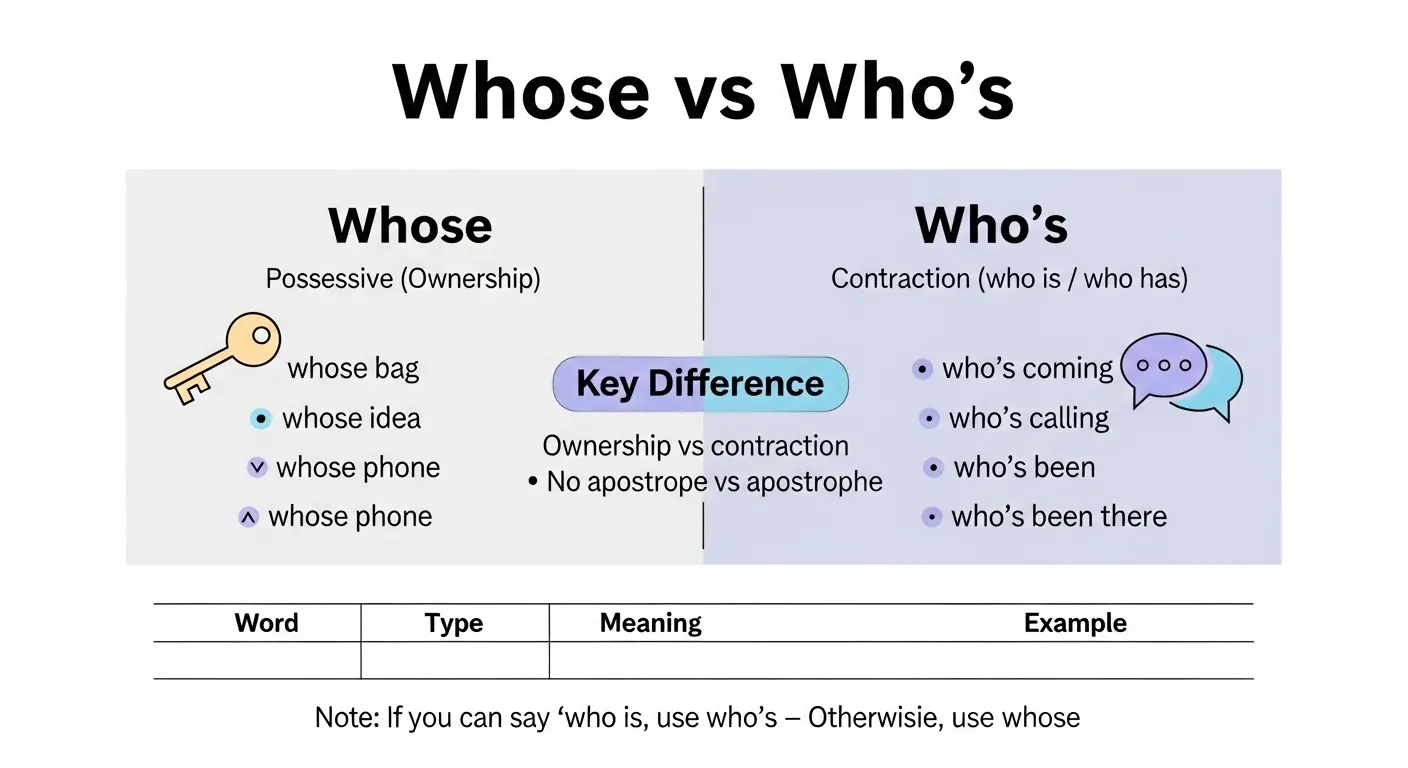
“Whose” shows possession, while “who’s” is a contraction of “who is” or “who has.”
Many English learners and even fluent speakers often feel confused when choosing between whose and who’s.
They look almost the same, sound identical when spoken, and appear frequently in emails, exams, social media posts, and professional writing.
Because of this similarity, people regularly search for “whose or who’s” to avoid embarrassing grammar
mistakes. The confusion mainly comes from the apostrophe in who’s, which many people wrongly use to show possession. This article solves that problem clearly and simply. You will
get a quick answer, deep explanation, real-life examples, common mistakes, and professional advice.
By the end, you will confidently know when to use whose and when to use who’s without hesitation.
Whose or Who’s: Quick Answer
Whose is a possessive pronoun. It shows ownership or connection.
Who’s is a contraction of who is or who has.
Examples:
- Whose bag is this? ✅
- Who’s calling you right now? ✅
❌ Who’s bag is this? (Incorrect)
The Origin of Whose or Who’s
Understanding the origin of these words helps explain why confusion exists.
Origin of “Whose”
The word whose comes from Old English hwæs, which was used to ask about ownership. Over time, it became the possessive form of who.
Unlike most possessive forms in English, whose does not use an apostrophe. This exception often confuses learners, but it follows historical grammar patterns.
Origin of “Who’s”
Who’s is a shortened form created by contraction. English commonly combines words to make speech faster and more natural. Who’s combines:
- who + is
- who + has
The apostrophe replaces the missing letter. This is why who’s never shows possession.
The spelling difference exists because one word shows ownership (whose) while the other simply shortens two words (who’s).
British English vs American English Spelling
There is no spelling difference between British English and American English when it comes to whose and who’s. Both follow the same grammar rules and meanings.
Examples
- British English: Whose responsibility is this?
- American English: Who’s going to lead the meeting?
Comparison Table
| Aspect | British English | American English |
| Possessive form | whose | whose |
| Contraction | who’s | who’s |
| Apostrophe rule | Same | Same |
| Common mistakes | Same | Same |
Which Spelling Should You Use?
The correct choice depends on sentence meaning, not location.
- US audience: Follow standard grammar rules.
- UK/Commonwealth audience: Use the same rules.
- Global audience: Keep usage clear and simple.
Easy Test
Replace the word:
- If you can say who is or who has, use who’s.
- If the sentence talks about ownership, use whose.
Example:
- Who’s ready? → Who is ready ✔️
- Whose phone is ringing? → Ownership ✔️
🔍 Who’s vs Whose: Common Search Questions Explained
Many people search variations like who’s vs whose, who’s or whose, whose vs who’s, and difference between whose and who’s to quickly understand the rule.
Here is the simple explanation again:
- Whose → shows possession
- Who’s → means who is or who has
Some common confusion based searches include:
- whos or whose
- whose or whos
- whose vs whos
- who’s ready or whose ready
- whose going or who’s going
Correct usage:
- Who’s ready? (Who is ready) ✅
- Whose book is this? (Ownership) ✅
Incorrect usage:
- ❌ Whose ready?
- ❌ Who’s book is this?
👉 Tip:
If you can expand it to “who is” or “who has,” use who’s. Otherwise, use whose.
This rule answers almost all variations like who’s whose, whose who has, and who is shortened.
Common Mistakes with Whose or Who’s
Mistake 1: Using an apostrophe for possession
❌ Who’s car is parked outside? ✅ Whose car is parked outside?
Mistake 2: Forgetting the contraction meaning
❌ Whose coming to the party? ✅ Who’s coming to the party?
Mistake 3: Guessing instead of testing
❌ Whose been calling me? ✅ Who’s been calling me?
Whose or Who’s in Everyday Examples
Emails
- Whose documents are missing?
- Who’s responsible for the report?
News Writing
- Police are investigating whose account was hacked.
- The senator who’s leading the debate spoke today.
Social Media
- Who’s watching this match tonight? ⚽
- Anyone know whose keys these are? 🔑
Formal Writing
- The committee will decide whose proposal is accepted.
- The manager who’s been appointed will start Monday.
Whose or Who’s: Google Trends & Usage Data
Search trend data shows that “whose or who’s” is frequently searched in:
- ESL-learning countries
- South Asia and the Middle East
- English exam seasons
- Content writing communities
Who’s appears more often in spoken English, dialogue, and informal writing. Whose appears more in questions, legal language, and formal writing. The confusion peaks because both words sound exactly the same when spoken.
People searching this keyword usually want:
- A quick grammar fix
- Clear examples
- Confidence in professional writing
🌍 Whose or Who’s: Usage Around the World
Many users also search:
- who’s or whose UK
- whose or who’s UK
- whose meaning in Hindi
- when to use who’s and whose
The good news is:
There is no regional difference between British and American English.
- UK English → whose / who’s
- US English → whose / who’s
- Global English → same rules apply
This is why queries like is whose correct, is who’s correct, or whose spelling are very common.
Important insight:
- Whose appears more in formal writing, exams, and questions
- Who’s appears more in speech, emails, and casual writing
Example for clarity:
- The student whose paper won the award.
- The teacher who’s guiding the class.
Best practice:
Focus on meaning, not region. The grammar rule never changes.
Comparison Table: Whose vs Who’s
| Feature | Whose | Who’s |
| Word type | Possessive pronoun | Contraction |
| Shows ownership | Yes | No |
| Has apostrophe | No | Yes |
| Means | belonging to whom | who is / who has |
| Example | Whose idea was it? | Who’s coming today? |
FAQs
Is “whose” grammatically correct?
Yes, whose is a correct possessive pronoun.
Is “who’s” informal English?
No, it is acceptable in both formal and informal writing when contractions are allowed.
Can “whose” refer to things?
Yes. Example: a company whose profits increased.
Does “who’s” ever show possession?
No. Apostrophes in contractions do not show ownership.
How can I remember the difference?
Expand who’s to who is. If it works, use who’s.
Is “whose” used in questions only?
No. It can be used in statements as well.
Are these words pronounced the same?
Yes, they sound identical, which causes confusion.
Conclusion
The difference between whose and who’s may seem small, but it has a big impact on clarity and professionalism. Many grammar mistakes happen simply because writers assume the
apostrophe shows possession. In reality, whose shows ownership, while who’s only shortens who is or who has. Remembering this rule will instantly improve your writing.
There is no difference between British and American English usage, which makes the rule universal. If you are writing an email, exam answer, article, or social media post,
choosing the correct form shows strong language skills. Always test the sentence by expanding who’s. If the sentence still makes sense, you are correct. If not, use whose.
By understanding meaning, structure, and context, you can avoid confusion forever. With regular practice and these clear examples, whose or who’s will no longer be a grammar problem it will be a strength in your English communication.
Discover More Articals!
The Origin of Minimize or Minimise
Worse Case or Worst Case : Which One Is Correct?
Shiney or Shiny: Which Spelling Is Correct and How to Use It