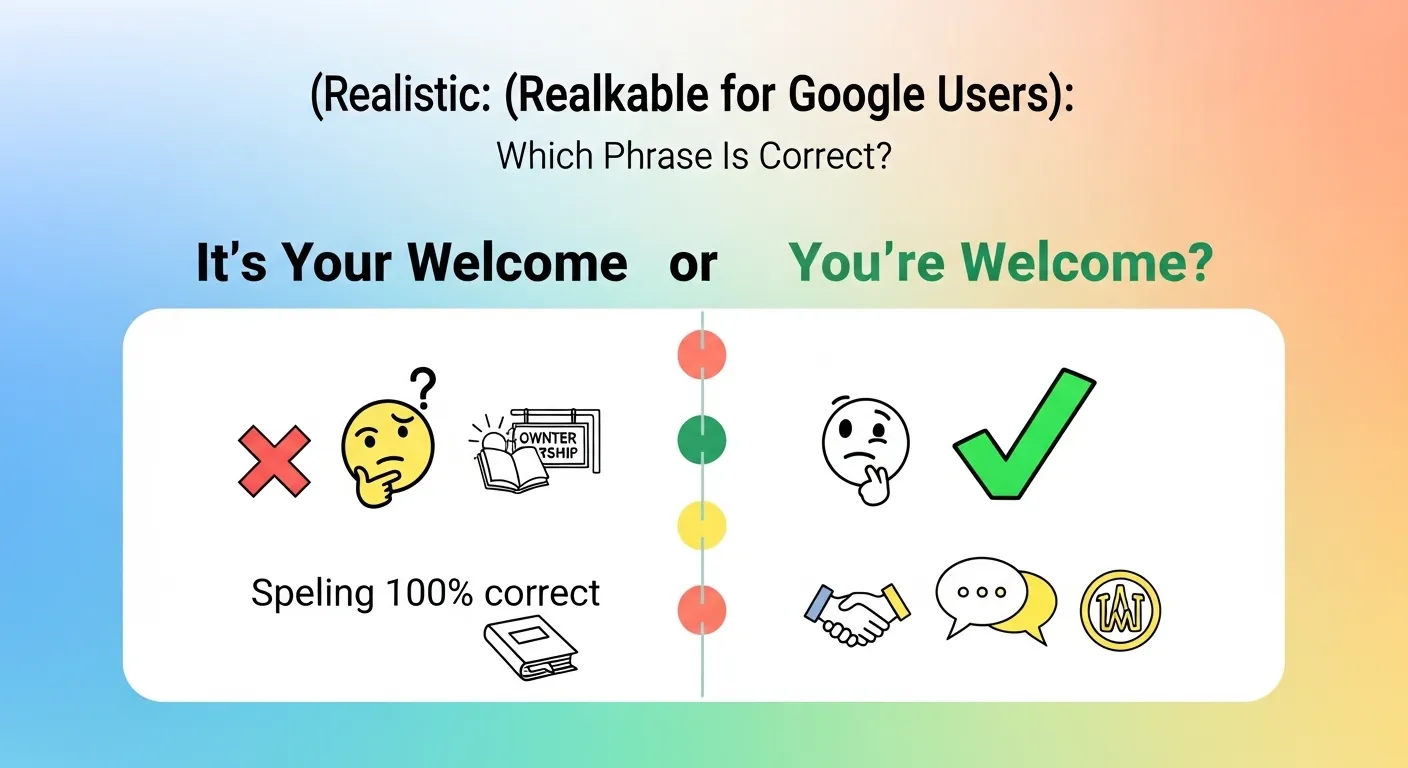
The correct phrase is “You’re welcome.” Many people search for “it’s your welcome or you’re welcome” because both sound similar when spoken.
This creates confusion in writing. Social media, texting, and emails often show the wrong usage. Some writers think “it’s your welcome” is correct because it seems logical.
However, grammar rules prove otherwise. “You’re” is a contraction of “you are.” “It’s your” is a different structure meaning “it is your.” This article explains the difference clearly.
You will learn proper usage, common mistakes, examples, and grammar tips. By the end, you will confidently use “you’re welcome” every time.
⚡ You’re Welcome vs It’s Your Welcome: Quick Answer
✅ What Does “You’re Welcome” Mean?
“You’re welcome” is a polite reply to thank you.
It means: you do not need to thank me.
Examples:
- Thanks for your help!
- You’re welcome!
- Thank you for the gift.
- You’re welcome.
It is used after someone says “thank you.”
❌ What About “It’s Your Welcome”?
“It’s your welcome” is almost always wrong.
It literally means “It is your welcome,” which makes little sense in conversation.
Example:
- ❌ Thank you for helping me.
- ❌ It’s your welcome.
Correct:
- ✅ You’re welcome.
🧠 Simple Memory Trick
If you mean “you are welcome,” always use you’re.
You’re = you are → contraction.
It fits perfectly as a reply to thanks.
📜 The Origin of “You’re Welcome”
📖 “Welcome” as a Word
The word “welcome” comes from Old English “wilcuma,” meaning “a person whose coming is pleasing.”
Over time, it became a polite response to thanks.
🔤 Contractions in English
“You’re” is a contraction of you are.
Contractions simplify speech and writing.
- You are welcome → You’re welcome
It became standard in polite conversation.
🗣️ Why People Write “It’s Your Welcome”
Many confuse you’re and your.
Your = possessive, shows ownership.
It does not make sense in this context.
- ❌ It’s your welcome.
- ✅ You’re welcome.
The misunderstanding comes from similar pronunciation.
🇬🇧 British English vs American English
🌍 Is There a Difference?
No. Both British and American English use you’re welcome.
The phrase is universal.
- Standard greeting etiquette in both regions.
- “It’s your welcome” is not used in formal writing.
📊 Comparison Table
| Phrase | Correct? | Meaning | Example |
| You’re welcome | ✅ Yes | You are welcome; polite reply | Thank you! → You’re welcome |
| It’s your welcome | ❌ No | Literally: it is your welcome | Incorrect usage |
| Your | ✅ Yes | Possessive | Your book is here |
| You’re | ✅ Yes | You are | You’re amazing |
This table makes it clear.
📝 Which Spelling/Grammar Should You Use?
🎯 Always Use “You’re Welcome”
Use you’re welcome when replying to thanks:
- Emails
- Text messages
- Social media posts
- Conversations
Never use it’s your welcome unless describing ownership:
- ❌ “It’s your welcome”
- ✅ “It’s your welcome sign on the door.” → Only literal, not as a reply.
📧 Business Example
Correct:
- Client: Thank you for the report.
- You: You’re welcome.
Wrong:
- Client: Thank you.
- You: ❌ It’s your welcome.
Accuracy matters in professional communication.
🎓 Academic Writing
In essays or assignments:
- Use you’re welcome after thanks.
- Avoid it’s your welcome.
- Teachers mark grammar mistakes.
Correct grammar improves credibility.
⚠️ Common Mistakes with It’s Your Welcome or You’re Welcome
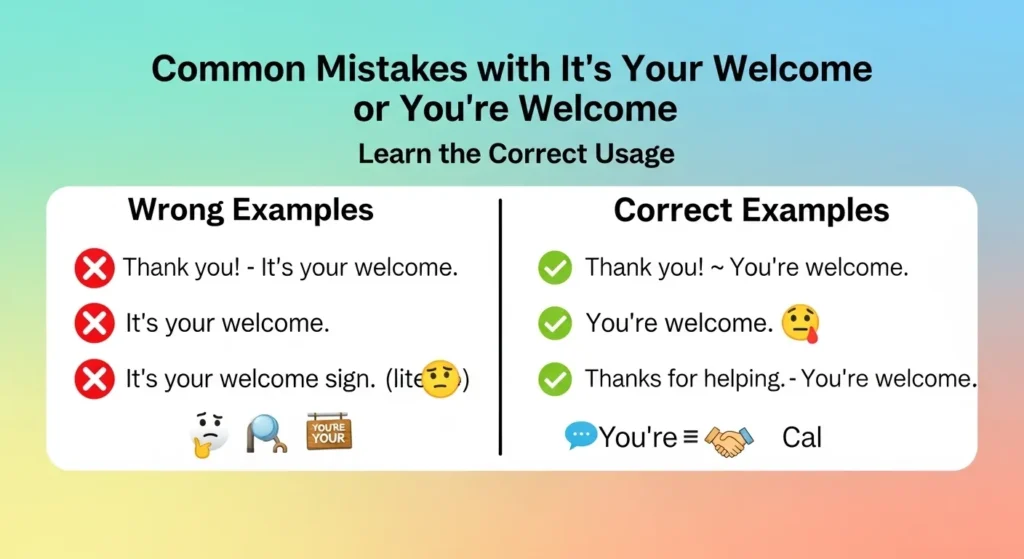
❌ Mistake 1: Using “your” instead of “you’re”
Wrong:
- ❌ Thank you! → It’s your welcome.
Correct: - ✅ Thank you! → You’re welcome.
❌ Mistake 2: Confusing contractions
“You’re” = you are
“It’s” = it is
Wrong:
- ❌ It’s your welcome.
Correct: - ✅ You’re welcome.
❌ Mistake 3: Overthinking
Some think “it’s your welcome” sounds polite.
It is incorrect.
Always reply: you’re welcome.
❌ Mistake 4: Mixing context
“You’re welcome” is used for thanks.
“It’s your welcome” only fits literal ownership.
Example:
- Correct: “Thanks for helping.” → You’re welcome.
- Literal: “It’s your welcome sign.” → correct, only as sign description.
🖊️ “You’re Welcome” in Everyday Examples
📱 Social Media
“Thanks for sharing the info!”
Reply: You’re welcome!
📰 News Writing
“The minister thanked the volunteers.”
“The volunteers said, you’re welcome.”
📄 Formal Writing
“The team expressed gratitude.”
Response: You’re welcome.
💬 Conversation
Friend: Thanks for picking me up.
You: You’re welcome!
📊 “You’re Welcome”: Search Trends & Popularity
Many people search it online monthly.
Confusion comes from your vs you’re.
Top search queries:
- it’s your welcome correct?
- you’re welcome meaning
- how to write you’re welcome
- your vs you’re common mistakes
Top countries searching:
- United States
- United Kingdom
- India
- Canada
- Australia
📊 Side-by-Side Comparison Table
| Feature | You’re Welcome | It’s Your Welcome |
| Correct? | ✅ Yes | ❌ No |
| Meaning | Polite reply to thanks | Literally: it is your welcome |
| Grammar | Contraction: you are | Possessive: your |
| Used in emails | ✅ Yes | ❌ No |
| Social media | ✅ Yes | ❌ No |
🧠 Extra Memory Tricks
🔹 Trick 1: Think “You Are”
“You’re” = You are → fits perfectly.
“Your” = ownership → wrong in reply to thanks.
🔹 Trick 2: Context Check
If replying to thanks → you’re welcome.
If describing an object → it’s your welcome (literal only).
🔹 Trick 3: Replace Test
Replace “you’re welcome” with “you are welcome.”
If it fits, use you’re.
❓ FAQs: It’s Your Welcome and You’re Welcome
1️⃣ Is it correct to write it’s your welcome?
No. It is almost always incorrect.
2️⃣ What does you’re welcome mean?
It means: you are welcome; polite response to thanks.
3️⃣ Can it be shortened in texting?
Yes. People write “ur welcome” informally. Not formal.
4️⃣ Why do people confuse your and you’re?
They sound the same in speech. Grammar differs.
5️⃣ Is it different in UK and US English?
No. Both use you’re welcome.
6️⃣ How do you pronounce “you’re welcome”?
Sounds like: /jʊər ˈwɛlkəm/
7️⃣ Can it be written as “your welcome”?
No. Only correct in literal ownership: “It’s your welcome sign.”
🎯 Why Correct Usage Matters
Using you’re welcome correctly shows grammar knowledge.
Incorrect usage looks careless.
Emails, social media, and assignments require precision.
Small grammar errors reduce credibility.
Correct spelling improves communication and professionalism.
✅ Conclusion
In conclusion, the correct phrase is you’re welcome, not “it’s your welcome.” You’re welcome is a polite reply to thanks.
“It’s your welcome” is almost always wrong unless describing a literal object. “You’re” is a contraction of “you are.” Using it correctly avoids confusion.
Always remember: responding to thanks → you’re welcome. Small grammar accuracy improves professional and academic communication. With practice, correct usage becomes automatic.
Confident writing requires understanding this simple rule. Master it, and your replies will always be grammatically correct and polite.
Discover More Posts!
Worshipping or Worshiping: Spelling Difference.In(2026)
By vs With: What’s the Difference and When to Use Each?
Desert vs Dessert: Grammar Difference, and Easy Usage Guide