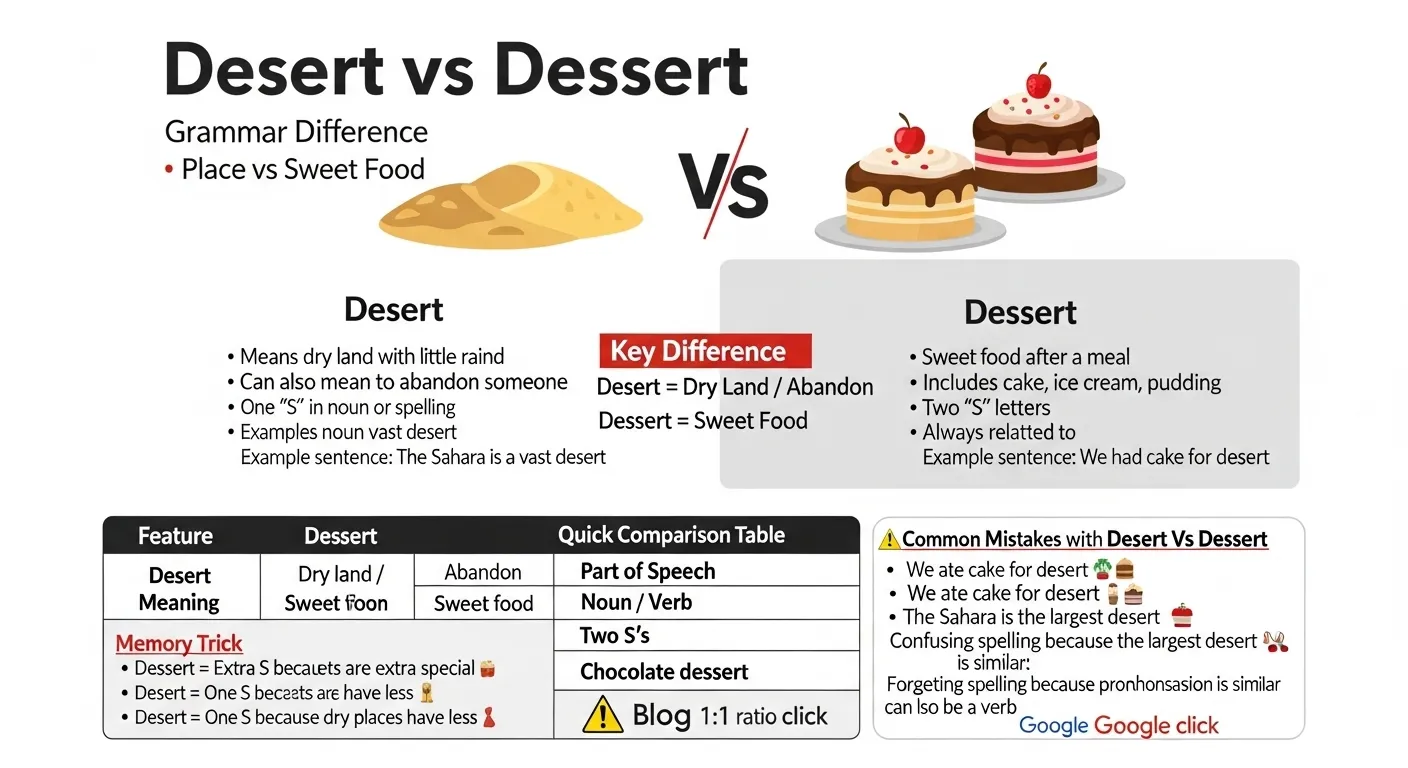
“Desert” means a dry land or to abandon, while “dessert” means sweet food eaten after a meal.
Many people search for desert vs dessert grammar difference, difference between desert and dessert, when to use desert or dessert, desert vs dessert meaning, and desert vs dessert examples because these two words look almost identical but have very different meanings.
This creates confusion for English learners and even native speakers. The only visible difference is one extra “s”, but that small spelling change completely changes the meaning.
This guide will explain the difference clearly so you can use desert and dessert correctly in writing and speaking.
⚡ Dessert vs Desert: Quick Answer
- Use desert for dry land or to leave/abandon
- Use dessert for sweet food after a meal
✅ Examples:
- The desert is very hot.
- He did not desert his team.
- We ate cake for dessert.
- Ice cream is my favorite dessert.
👉 Simple Rule:
Desert = sand / abandon
Dessert = sweet food
📖 Definitions with Examples
🟢 Desert (Definition):
“Desert” can be a noun or verb.
As a Noun:
A dry area with very little rain.
✅ Examples:
- The desert has little water.
- Camels live in the desert.
As a Verb:
To leave or abandon someone/something.
✅ Examples:
- He deserted his post.
- Never desert your friends.
🔵 Dessert (Definition):
“Dessert” means sweet food eaten after the main meal.
✅ Examples:
- We had ice cream for dessert.
- Chocolate cake is my favorite dessert.
- What’s for dessert tonight?
📜 The Origin of Desert vs Dessert
People also search history of desert and dessert.
- Desert comes from Latin meaning “abandoned place”
- That is why it refers to dry empty land or leaving someone
- Dessert comes from French meaning “to clear the table”
- It became the word for the sweet final course of a meal
👉 This is why:
- Desert = empty/abandoned place
- Dessert = sweet course after meal
🌍 British English vs American English Usage
People search desert vs dessert British vs American English.
Both words are spelled and used the same way in British and American English.
📊 Comparison Table:
| Word | British English | American English | Meaning |
| Desert | Same | Same | Dry land / Abandon |
| Dessert | Same | Same | Sweet food |
👉 No regional spelling difference.
🎯 Which One Should You Use?
People search when to use desert vs dessert correctly.
🟢 Use Desert when:
- Talking about dry sandy land
- Talking about abandoning someone
- Referring to empty/barren places
🔵 Use Dessert when:
- Talking about sweets after meals
- Referring to cakes, ice cream, pudding, etc.
👉 Pro Tip:
Dessert has 2 S’s because you want 2 servings of sweets.
❌ Common Mistakes with Desert vs Dessert
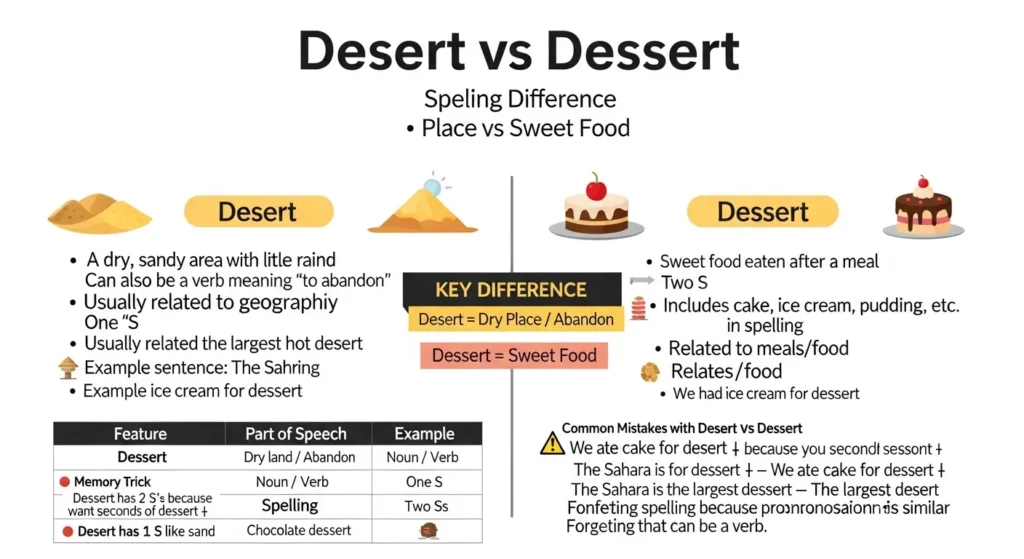
People search common mistakes with desert and dessert.
❌ Mistake 1:
We ate cake for desert
✔ Correct: We ate cake for dessert
❌ Mistake 2:
The Sahara is the largest dessert
✔ Correct: The Sahara is the largest desert
❌ Mistake 3:
Confusing spelling because pronunciation is similar
❌ Mistake 4:
Forgetting that “desert” can also be a verb
💬 Desert vs Dessert in Everyday Examples
People search desert vs dessert sentence examples.
📧 Emails:
- Dessert will be served after dinner.
- Our trip to the desert starts tomorrow.
📱 Social Media:
- Best dessert ever 🍰
- Adventure in the desert 🌵
📰 News:
- Heavy rain hit the desert region.
- The restaurant launched a new dessert menu.
🧑🏫 Classroom:
- Spell dessert with two S’s
- The desert is dry and hot
🏠 Daily Life:
- Save room for dessert
- We crossed the desert by jeep
📊 Desert vs Dessert: Google Trends & Usage Data
People search desert or dessert meaning, how to remember desert vs dessert, and dessert vs desert spelling.
🌎 Global Usage:
- Both words are common
- “Dessert” is searched more by learners due to spelling confusion
📍 Popular Search Queries:
- desert vs dessert trick
- desert vs dessert pronunciation
- difference between desert and dessert
- dessert or desert grammar
- how to spell dessert
📚 Context:
- Food → Dessert
- Geography / Abandon → Desert
📋 Comparison Table: Desert vs Dessert
| Feature | Desert | Dessert |
| Meaning | Dry land / Abandon | Sweet food |
| Part of Speech | Noun / Verb | Noun |
| Spelling | One S | Two S’s |
| Example | Hot desert | Chocolate dessert |
📌 Memory Trick to Remember
People search easy trick for desert vs dessert.
🍰 Dessert = Two S’s
Think: “Dessert is sweet, so it gets extra sugar (extra S).”
🌵 Desert = One S
Think: “A desert is dry, so it has less.”
❓ FAQs About Desert vs Dessert
1. What is the difference between desert and dessert?
Desert is dry land/abandon; dessert is sweet food.
2. Why does dessert have two S’s?
To separate it from desert; easy memory trick is “extra sweet = extra S.”
3. Can desert be a verb?
Yes, it means to abandon.
4. Is dessert always sweet?
Usually yes.
5. Why do people confuse them?
Because spelling and pronunciation are similar.
6. Which is more common in writing?
Depends on context.
7. How do I remember the rule?
Dessert has 2 S’s because sweets are special.
📝 Conclusion
The difference between desert vs dessert is simple once you know the spelling trick and meaning.
“Desert” with one S means dry land or to abandon, while “dessert” with two S’s means sweet food served after a meal. Even though the words look very similar, they have completely different meanings and uses.
Many learners confuse them because the pronunciation is close and the spelling difference is only one letter.
But remembering that dessert has an extra S because sweets are extra special makes it much easier to choose the correct word.
Understanding this distinction will help you avoid common spelling mistakes in emails, essays, exams, and everyday writing. With regular practice, you will quickly learn to use both words correctly and confidently.
Discover More Articals!
Each vs Every: What’s the Difference and?In 30 Seconds
Above vs Over: What’s the Difference?In 30 Seconds
By vs With: What’s the Difference and When to Use Each?