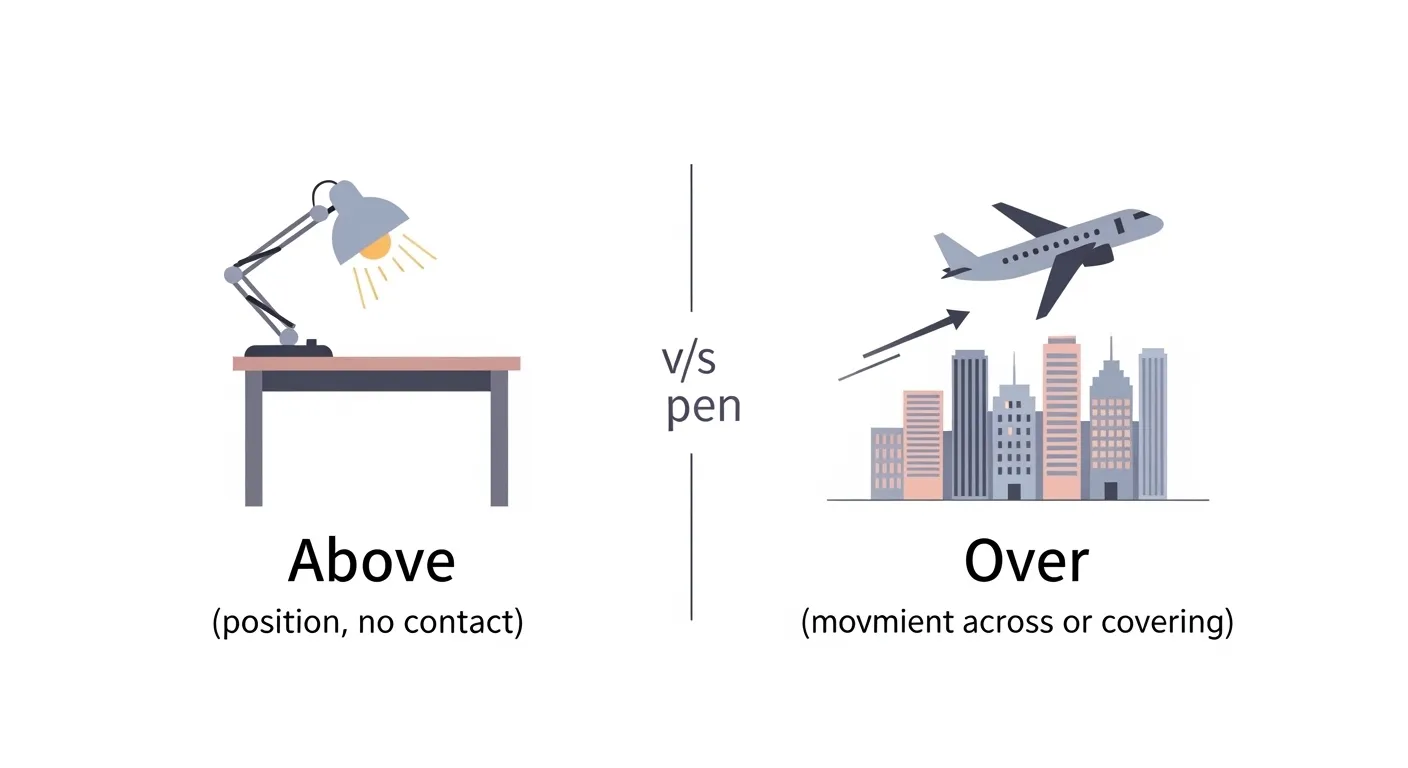
“Above” shows a higher position without contact, while “over” shows movement, covering, or position across something.
Many people search for above vs over, difference between above and over, when to use above or over, and above vs over examples in sentences because both words describe position.
This creates confusion, especially for learners. At first, both seem similar because they mean “higher than.”
But the difference is simple: “above” focuses on position, while “over” often shows movement, covering, or direction.
This guide will help you understand the difference clearly and use both words correctly in everyday English.
⚡ Above or Over: Quick Answer
- Use above for position (higher level, no contact)
- Use over for movement, covering, or across
✅ Examples:
- The lamp is above the table.
- The plane flew over the city.
- There is a fan above my head.
- He put a blanket over the child.
👉 Simple Rule:
Above = position
Over = movement / covering
📖 Definitions with Examples
🟢 Above (Definition):
“Above” is used to show a higher position than something, without touching it.
✅ Examples:
- The picture is above the sofa.
- The temperature is above 30°C.
- The bird is flying above the trees.
🔵 Over (Definition):
“Over” is used to show movement across something, covering something, or being higher.
✅ Examples (Movement):
- The bird flew over the house.
- He jumped over the wall.
🛏️ Examples (Covering):
- She put a blanket over the baby.
- He wore a jacket over his shirt.
📜 The Origin of Over vs Above
People also search history of above vs over.
- Above comes from old English meaning “higher than”
- It was used for position only
- Over comes from a word meaning “across or beyond”
- It developed to include movement and covering
👉 That’s why:
- “Above” = position
- “Over” = movement or covering
🌍 British English vs American English Spelling
People search above vs over British vs American English.
Both words are used the same way in British and American English.
📊 Comparison Table:
| Word | British English | American English | Use |
| Above | Same | Same | Position |
| Over | Same | Same | Movement / Cover |
👉 No spelling difference, only usage difference.
🎯 Which Spelling Should You Use?
People search when to use above vs over correctly.
🟢 Use above when:
- Talking about position
- No contact between objects
- Talking about levels (temperature, marks)
🔵 Use over when:
- Talking about movement
- Something covers another thing
- Talking about direction
👉 Pro Tip:
If something moves → use over
❌ Common Mistakes with Above vs Over
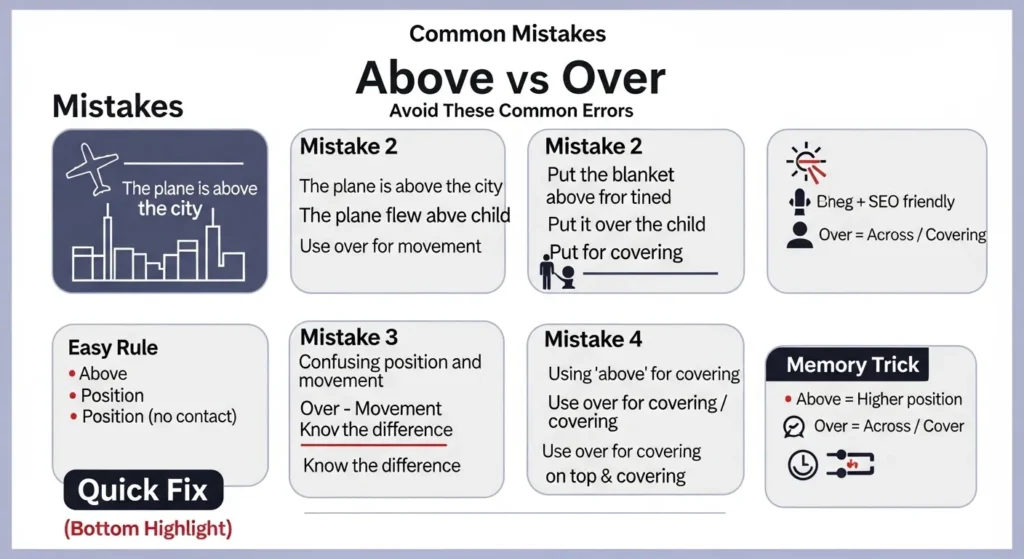
People search common mistakes above vs over.
❌ Mistake 1:
The plane is above the city (moving)
✔ Better: The plane flew over the city
❌ Mistake 2:
Put the blanket above the child
✔ Correct: Put it over the child
❌ Mistake 3:
Confusing position and movement
❌ Mistake 4:
Using “above” for covering
💬 Above vs Over in Everyday Examples
People search above vs over examples in sentences.
📧 Emails:
- Please see the information above.
📱 Social Media:
- The drone flew over the beach 🎥
📰 News:
- Temperatures are above normal.
- The helicopter flew over the city.
🧑🏫 Classroom:
- Write your name above the line
- Jump over the rope
🏠 Daily Life:
- The clock is above the door
- He placed a cloth over the table
📊 Above vs Over: Google Trends & Usage Data
People search which is more common above or over.
🌎 Global Usage:
- Both are very common
- “Over” is slightly more frequent
📍 Country Trends:
- USA → Balanced use
- UK → Balanced use
- Global → Both widely used
📚 Context:
- Position → Above
- Movement → Over
👉 Key insight:
People confuse them because both mean “higher.”
📋 Comparison Table: Above vs Over
| Feature | Above | Over |
| Meaning | Higher position | Movement / covering |
| Contact | No | Sometimes |
| Use | Static | Dynamic |
| Example | Above the table | Over the wall |
📌 Special Uses (Important)
People search above vs over rules and exceptions.
🟢 Use above for:
- Numbers → above 50
- Levels → above average
🔵 Use over for:
- Age → over 18
- More than → over 100 people
👉 Sometimes both can be used, but meaning changes slightly.
❓ FAQs About Above vs Over
1. Can I use above instead of over?
Not always, depends on context.
2. Which is more common?
“Over” is slightly more common.
3. Is “above 18” correct?
Yes, but “over 18” is more common.
4. Can over mean position?
Yes, sometimes.
5. Why do people confuse them?
Because both mean higher.
6. Which should beginners use?
Follow simple rule: position vs movement.
7. How to remember easily?
Above = place, Over = movement.
📝 Conclusion
The difference between above vs over is simple but important for clear English. Both words describe something at a higher level, but they are used in different ways.
“Above” is used when you are talking about position, especially when one thing is higher than another without touching it. On the other hand, “over” is used when something moves across another thing or covers it.
Understanding this difference helps you avoid common mistakes. For example, we say “the plane flew over the city” because it involves movement, not just position. Similarly, we say “the fan is above my head” because it is fixed in place.
If you remember one simple rule above for position and over for movement or covering you will use these words correctly.
With practice, this will become natural, and your English will sound more clear and correct in both speaking and writing.
Discover More Articals
Smoky or Smokey: Which One Is Correct and How to Use It📚
May vs Might: What Is the Difference?In 30 Seconds
IF or Statement Excel: How to Use OR Inside IF Function📝