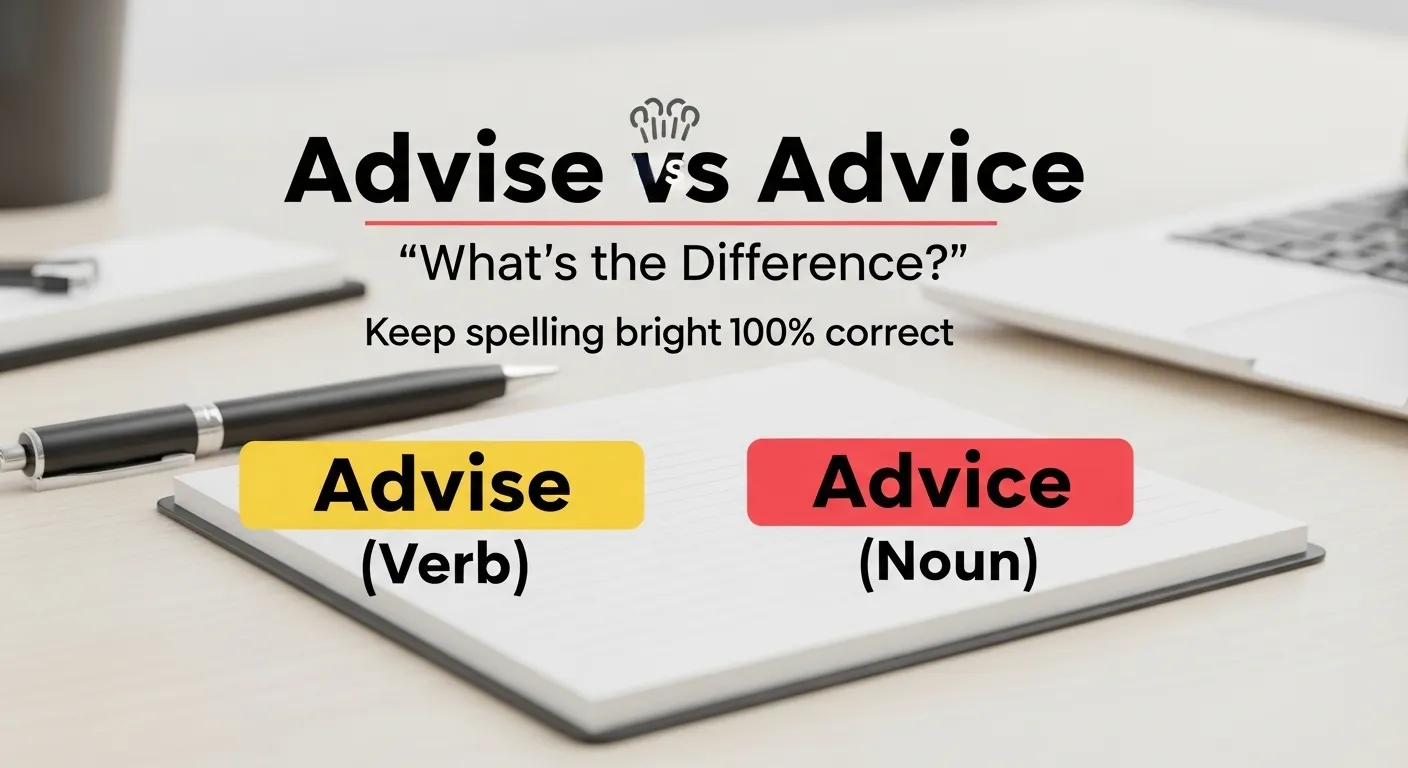
Advice is a noun. Advise is a verb. This is the main difference. Many people search for “advise or advice” because the words look almost the same.
They sound very similar. Only one letter changes. That small difference creates confusion.
Students mix them in exams. Professionals mix them in emails. Bloggers use the wrong form in articles. This mistake affects clarity. It also affects credibility.
This guide explains everything in simple language. You will learn meaning, grammar rules, examples, mistakes, and correct usage. After reading, you will confidently use advise and advice correctly.
⚡ Advise or Advice: Quick Answer
📌 What Is Advice?
Advice is a noun.
It means a suggestion or recommendation.
Examples:
- She gave me good advice.
- I need your advice.
- His advice helped me.
Advice is a thing.
You can receive it.
You can give it.
📌 What Is Advise?
Advise is a verb.
It means to give a suggestion.
Examples:
- I advise you to wait.
- The doctor advised rest.
- She advised me carefully.
Advise is an action.
Someone performs it.
🧠 Simple Memory Trick
Advice = noun = thing.
Advise = verb = action.
If you can replace the word with “suggestion,” use advice.
If you can replace it with “suggest,” use advise.
📜 The Origin of Advise and Advice
📖 Historical Background
Both words come from Old French.
The word “avis” meant opinion or view.
English adopted the word centuries ago.
Over time, English separated the forms.
One became a noun.
One became a verb.
🔤 Why the Spellings Differ
English often changes spelling to show grammar role.
The “c” in advice signals noun form.
The “s” in advise signals verb form.
This pattern helps readers understand meaning quickly.
Spelling shows function.
🗣️ Pronunciation Difference
Advice ends with soft “s” sound.
Advise ends with “z” sound.
Advice → /ədˈvaɪs/
Advise → /ədˈvaɪz/
The sound difference helps in speaking.
🇬🇧 British English vs American English Spelling
🌍 Is There a Regional Difference?
No.
Both British and American English use the same spelling.
Unlike some words, this pair does not change across regions.
📊 Comparison Table
| Word | Part of Speech | Meaning | Example |
| Advice | Noun | Suggestion | I need advice. |
| Advise | Verb | To suggest | I advise you. |
| Advised | Verb (past) | Suggested | She advised me. |
| Advising | Verb (continuous) | Giving suggestion | He is advising them. |
The grammar rule remains the same worldwide.
📝 Which Word Should You Use?
🎯 Step 1: Check the Role
Ask yourself:
Is it a thing? → Use advice.
Is it an action? → Use advise.
📧 In Business Writing
Correct: Please advise.
Wrong: Please advice.
Correct: Thank you for your advice.
Wrong: Thank you for your advise.
Professional writing requires accuracy.
🎓 In Academic Writing
Teachers deduct marks for grammar mistakes.
Advice is uncountable.
Never write “advices.”
Correct: She gave useful advice.
Correct: He advised patience.
🌎 For Global Audience
Follow grammar rule.
It applies everywhere.
There is no regional exception.
⚠️ Common Mistakes with Advise or Advice
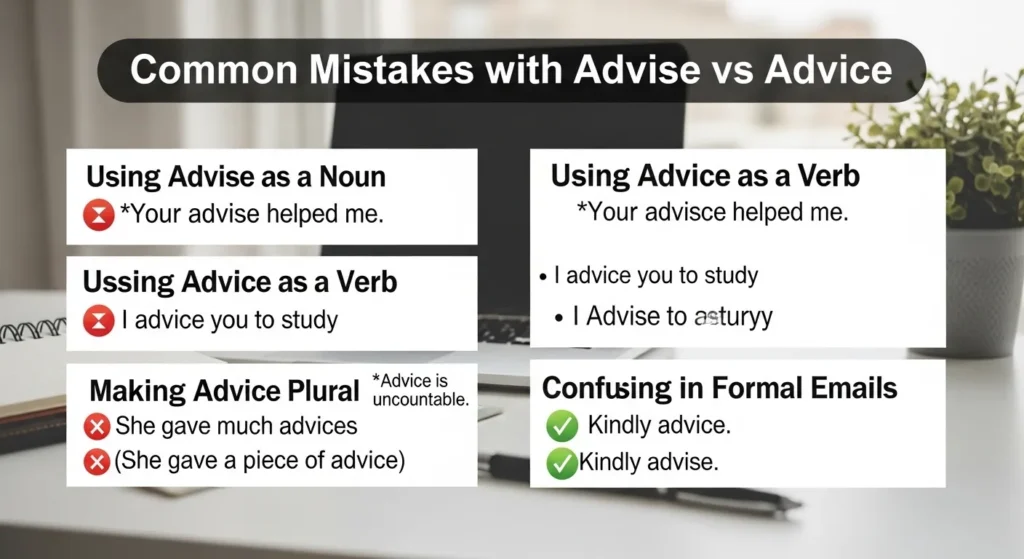
❌ Mistake 1: Using Advise as a Noun
Wrong: Your advise helped me.
Correct: Your advice helped me.
❌ Mistake 2: Using Advice as a Verb
Wrong: I advice you to study.
Correct: I advise you to study.
❌ Mistake 3: Making Advice Plural
Wrong: She gave many advices.
Correct: She gave much advice.
Correct: She gave a piece of advice.
Advice is uncountable.
❌ Mistake 4: Confusing in Formal Emails
Wrong: Kindly advice.
Correct: Kindly advise.
Small errors reduce professionalism.
🖊️ Advise or Advice in Everyday Examples
📱 Social Media
“I need advice about my career.”
“I advise following your passion.”
📰 News Writing
“The expert advised caution.”
“The government issued travel advice.”
📄 Formal Report
“The consultant advised the company.”
“The board accepted his advice.”
💬 Conversation Example
Friend 1: I need advice.
Friend 2: I advise saving money.
Context shows grammar role clearly.
📊 Advise or Advice: Usage Data & Popularity
Search engines show high confusion globally.
Students search before exams.
Office workers search before sending emails.
Common search phrases:
- advise vs advice difference
- sentence with advise
- advice meaning
- please advise correct usage
Top searching countries:
- United States
- India
- United Kingdom
- Canada
- Australia
Grammar confusion drives search volume.
📊 Side-by-Side Comparison Table
| Feature | Advice | Advise |
| Type | Noun | Verb |
| Meaning | Suggestion | To give suggestion |
| Countable? | No | Yes (verb changes form) |
| Example 1 | Good advice helps. | I advise patience. |
| Example 2 | She gave advice. | She advised me. |
| Pronunciation | Ends with “s” sound | Ends with “z” sound |
| Grammar Role | Object | Action |
This table summarizes the full difference.
🧠 Extra Memory Tricks
🔹 Trick 1: Ice Rule
Advice has “ice.”
Ice is a thing.
Advice is a thing.
🔹 Trick 2: Action Rule
Advise ends with “se.”
It signals action.
🔹 Trick 3: Replace Method
Replace with “suggest.”
If it works, use advise.
Replace with “suggestion.”
If it works, use advice.
Example:
I suggest waiting.
I advise waiting.
Correct.
❓ FAQs: Advise or Advice
1️⃣ What is the main difference?
Advice is a noun.
Advise is a verb.
2️⃣ Can advice be plural?
No.
It is uncountable.
3️⃣ Is spelling different in UK and US?
No.
Both use same spelling.
4️⃣ Which is correct: Please advise or Please advice?
Correct: Please advise.
5️⃣ Why do people confuse them?
They look almost identical.
Only one letter changes.
6️⃣ Can I say “an advice”?
No.
Say “a piece of advice.”
7️⃣ How can I remember easily?
Thing = advice.
Action = advise.
🎯 Why Correct Usage Is Important
Grammar mistakes reduce credibility.
Professional emails require accuracy.
Academic papers require precision.
Clients notice small errors.
Correct usage builds trust.
Clear writing improves communication.
Understanding this rule strengthens language skills.
✅ Conclusion
In conclusion, advise and advice have different grammar roles but related meanings. Advice is a noun. It means a suggestion. Advise is a verb. It means to give a suggestion. One letter changes the function completely.
Many people confuse them because they look and sound similar. However, the difference becomes simple when you remember noun versus verb.
Advice is uncountable. Never write advices. Use a piece of advice when needed. Use advise when describing an action.
Small grammar accuracy improves professional writing. It strengthens emails, academic papers, and online content.
With practice, correct usage becomes automatic. Mastering this difference ensures confident communication in every situation.
Discover More Posts!
Worshipping or Worshiping: Spelling Difference.In(2026)

englifiy.com is my English grammar comparison website where I simplify confusing words, spelling differences, and usage rules through clear explanations and examples. My goal is to help learners, writers, and students understand English easily and use correct grammar with confidence.