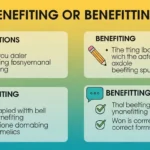
Benefiting is the preferred spelling in American English, while Benefitting is used in British English.
Many writers feel confused when they see both spellings. They wonder which one is correct. The difference comes from regional spelling rules.
British English often doubles the final consonant before adding “ ing.” American English usually does not.
This small change creates confusion in essays and exams. It can also affect emails and professional writing. People search for clarity to avoid mistakes.
In this article, you will learn the meaning of benefitting or benefiting. You will also understand when to use each spelling with simple examples.
Benefitting or Benefiting: Quick Answer
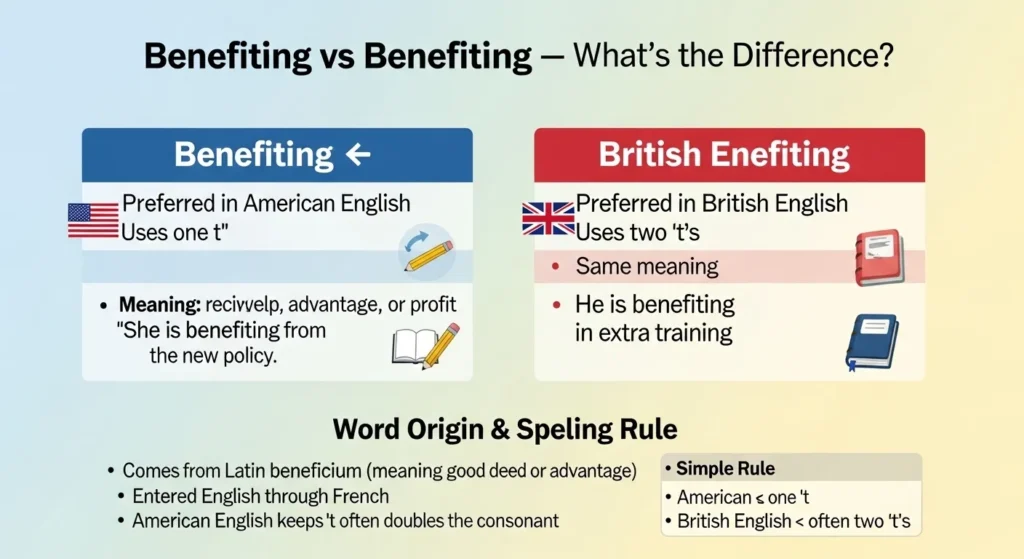
- Benefiting is preferred in American English.
- Benefitting is preferred in British English.
Both forms are correct.
Meaning: receiving help, advantage, or profit from something.
Examples:
- She is benefiting from the new policy. (US)
- He is benefitting from extra training. (UK)
Simple rule:
American English uses one “t.” British English often uses two.
The Origin of Benefitting or Benefiting
Word History
The word benefit comes from Latin beneficium. It means “a good deed” or “advantage.” The word entered English through French.
Development of Spelling
In early English, spelling was flexible. Over time, rules developed. One rule controls consonant doubling.
British English often doubles a final consonant when adding endings like -ing or -ed. American English prefers simpler forms.
Reason for Difference
The stress in benefit falls on the first syllable. Because of this, American English keeps one “t.” British English still allows doubling in many cases.
British English vs American English Spelling
UK English Usage
- Preferred spelling: benefitting
- Common in UK writing
- Seen in education and formal text
Example:
- Students are benefitting from the change.
American English Usage
- Preferred spelling: benefiting
- Standard in the United States
- Used in business and media
Example:
- Workers are benefiting from new rules.
Comparison Table
| Feature | British English | American English |
| Spelling | Benefitting | Benefiting |
| Double T | Yes | No |
| Region | UK, Commonwealth | United States |
| Meaning | Same | Same |
Which Spelling Should You Use?
Your audience decides.
Use Benefitting When
- Writing for the UK
- Following British English rules
- Preparing UK-based documents
Use Benefiting When
- Writing for the US
- Following American English style
- Preparing US-based content
For Mixed Audiences
Choose one spelling. Stay consistent.
Key advice:
Consistency matters more than preference.
Common Mistakes with Benefitting or Benefiting
Mistake 1: Mixing Spellings
❌ benefitting in one line, benefiting in the next ✅ Choose one form
Mistake 2: Thinking One Is Wrong
❌ benefitting is incorrect ✅ Both are correct
Mistake 3: Ignoring Audience
❌ Using British spelling for US readers ✅ Match the reader’s region
Mistake 4: Confusing Past Forms
❌ benefit, benefitted, benefited (mixed) ✅ benefit, benefitted (UK) / benefit, benefited (US)
Mistake 5: Relying Only on Sound
❌ Spelling by pronunciation ✅ Follow spelling rules
Benefitting or Benefiting in Everyday Examples
Emails
- Employees are benefiting from flexible hours.
- Staff are benefitting from training sessions.
Education
- Students are benefitting from small classes.
News Writing
- Local businesses are benefiting from tourism.
Social Media
- I am benefiting from this course.
- Many people are benefitting from the update.
Formal Writing
- Citizens are benefiting from reforms.
- Workers are benefitting from safety rules.
Benefitting or Benefiting: Google Trends & Usage Data
Regional Patterns
Search data shows clear differences.
- Benefiting appears more in US searches.
- Benefitting appears more in UK searches.
Context of Use
- Education: both forms used by region
- Business writing: follows regional rules
- Online platforms: spelling adapts by location
Comparison Table
| Aspect | Benefitting | Benefiting |
| Main Region | UK | US |
| Common Use | Formal writing | Media and business |
| Meaning | Same | Same |
Comparison Table: Benefitting vs Benefiting
| Point | Benefitting | Benefiting |
| Correct | Yes | Yes |
| English Style | British | American |
| Verb Form | Present participle | Present participle |
| Past Form | Benefitted | Benefited |
| Meaning | Receiving advantage | Receiving advantage |
Frequently Asked Questions
Is benefitting correct English?
Yes. It is correct in British English.
Is benefiting American English?
Yes. It is standard in the United States.
Which spelling should students use?
Follow the spelling taught in class or exams.
Can both spellings be used together?
No. Use one style only.
Do both spellings mean the same thing?
Yes. Meaning does not change.
Which looks more formal?
Both are formal in their regions.
Does pronunciation change?
No. Pronunciation stays the same.
Deeper Explanation of the Spelling Rule
To understand benefitting and benefiting, you must understand the consonant doubling rule. This rule applies when adding -ing or -ed to verbs.
In British English, a final consonant is often doubled even if the stress is not on the last syllable. In American English, the consonant is usually not doubled when the stress is on the first syllable.
The word benefit has stress on the first syllable. That is why American English keeps one “t.” British English still allows two.
This difference is not random. It comes from long-standing spelling traditions. British English values historical patterns. American English values simplified forms. Neither is wrong. They simply follow different systems.
Conclusion
The difference between benefitting or benefiting depends on language style, not meaning. Both spellings are correct.
British English prefers benefitting with double “t.” American English prefers benefiting with one “t.” Confusion happens when writers mix styles or ignore the reader’s region. Clear writing needs consistency.
Choose one spelling based on audience. Use it everywhere in the same document. This habit improves clarity and confidence. Students avoid mistakes.
Professionals appear careful. Once you understand this rule, choosing between benefitting and benefiting becomes easy and natural.
Discovers more posts!

**Emily R. Dawson** I am a English language writer and editor i specializes in grammar clarity, sentence structure, and common writing mistakes.I focuses on helping readers write correct, natural-sounding English through simple explanations and practical examples. Emily mainly creates beginner-friendly and intermediate-level language guidesmy writing style is clear, supportive, and easy to follow.