Complement and compliment are both correct English words, but they have different meanings and uses. Many people search for “complement or compliment” because these words look almost identical, sound similar, and often appear in similar contexts. This small
spelling difference creates big confusion, especially for students, writers, and professionals who want their English to sound accurate and polished.
The confusion usually happens because both words can relate to praise, appearance, or improvement, but only one of them actually means praise.
Choosing the wrong word can completely change the meaning of a sentence and make writing look careless. This article solves that confusion step by step.
You will get a quick answer, word origins, British vs American usage, common mistakes, real-life examples, trend insights, FAQs, and expert advice all written in very simple English.
Complement or Compliment: Quick Answer
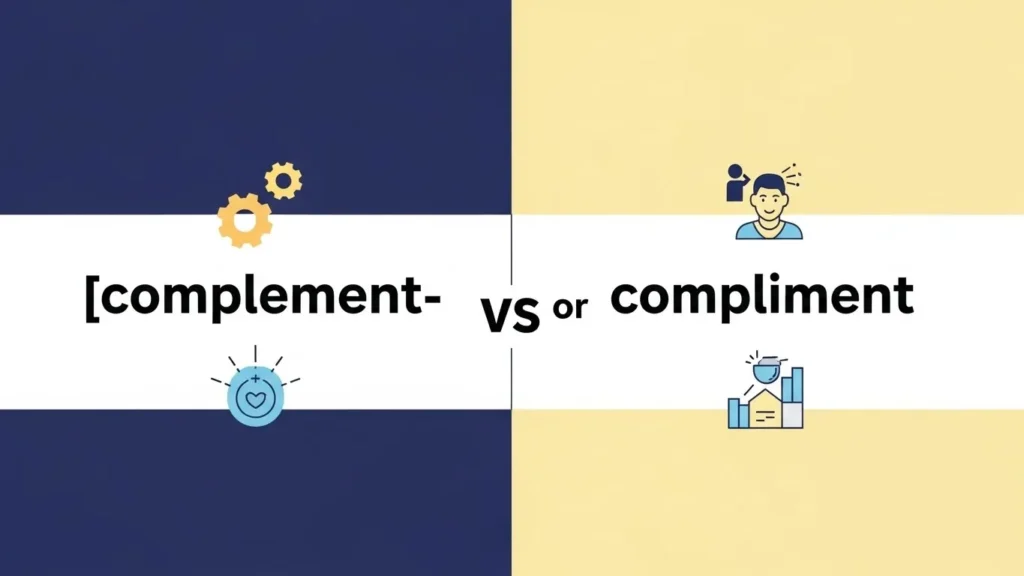
Complement means to complete, improve, or go well with something.
Compliment means to praise or say something nice about someone or something.
Examples:
- The sauce complements the dish. ✅
- She complimented him on his work. ✅
❌ The sauce complimented the dish. (Wrong meaning)
The Origin of Complement or Compliment
Understanding the history of these words makes the difference clearer.
Origin of “Complement”
The word complement comes from the Latin word complementum, meaning something that completes or fills up. It entered English in the 14th century and was used to describe things that make something whole or perfect.
Example idea from history:
- A team needs a strong defense to complement its attack.
Origin of “Compliment”
The word compliment comes from the Latin word complimentum, which later took the meaning of praise or expression of respect. Over time, English separated the spelling and meaning to avoid confusion.
Why the Spelling Difference Exists
Originally, both words shared similar spellings. As English developed, spelling changed to clearly separate completion (complement) from praise (compliment). One letter now makes all the difference.
British English vs American English Spelling
Unlike many confusing word pairs, complement and compliment do not change spelling between British and American English.
Key Point
- Complement = same spelling in US and UK
- Compliment = same spelling in US and UK
Examples
- British English: Her skills complement the team.
- American English: He received a compliment from his boss.
Comparison Table
| Word | American English | British English | Meaning |
| Complement | Same spelling | Same spelling | Complete or match |
| Compliment | Same spelling | Same spelling | Praise |
There is no regional spelling issue only a meaning issue.
Which Spelling Should You Use?
The right choice depends on what you want to say, not where you live.
Use “Complement” When:
- Something completes another thing
- Two things work well together
- One thing improves another
Example:
- The blue tie complements his suit.
Use “Compliment” When:
- You are praising someone
- You are saying something nice
- You are expressing admiration
Example:
- She complimented his presentation.
Easy Memory Tip
- Compliment has “I” → I praise you
- Complement completes something
Common Mistakes with Complement or Compliment
Mistake 1: Using “Compliment” for Things
❌ This color compliments the room. ✅ This color complements the room.
Mistake 2: Using “Complement” for Praise
❌ She complemented his skills. ✅ She complimented his skills.
Mistake 3: Guessing the Spelling
Many writers guess instead of checking meaning.
Mistake 4: Mixing Noun and Verb Forms
- Compliment (noun/verb)
- Complement (noun/verb)
Both forms exist but meanings stay different.
Complement or Compliment in Everyday Examples
Emails
- Thank you for the compliment on my report.
- Your experience will complement our team.
News Writing
- The new policy complements existing laws.
- The actor received many compliments.
Social Media
- That outfit really complements your style 👌
- Thanks for the kind compliment 😊
Formal Writing
- These findings complement earlier research.
- The author received critical compliments.
Complement or Compliment: Google Trends & Usage Data
Search data shows “complement or compliment” is one of the most searched English confusion pairs.
Popular by Country
- High search volume: United States, India, UK, Pakistan
- Common among: Students, bloggers, professionals
Usage by Context
- Compliment is more common in daily conversation and social media
- Complement appears more in academic, fashion, food, and business writing
People usually search this keyword when writing emails, captions, essays, or professional documents.
Comparison Table: Complement vs Compliment
| Feature | Complement | Compliment |
| Meaning | Complete or improve | Praise |
| Used for | Things, ideas, people | People or work |
| Verb example | Shoes complement outfit | She complimented me |
| Noun example | A perfect complement | A kind compliment |
Frequently Asked Questions
Is “compliment” always about praise?
Yes. Compliment always relates to praise or admiration.
Can “complement” be used for people?
Yes, but it means complete, not praise.
Is one more formal than the other?
No. Both are equally formal when used correctly.
Do British and American English differ here?
No. Spelling and usage are the same in both.
How can I remember the difference easily?
Remember: I in compliment = I praise you.
Can both be nouns and verbs?
Yes. Both words work as nouns and verbs.
Which is more common in writing?
Compliment is more common in daily writing. Complement is common in technical or descriptive writing.
Conclusion
The confusion between complement or compliment is very common, but it is also very easy to fix once you understand the core difference. These two words sound alike and look
similar, yet their meanings are completely different. Complement is about completion, balance, or improvement. Compliment is about praise, kindness, and appreciation.
There is no British vs American spelling problem here, which makes things simpler. The only thing that matters is meaning. If you are talking about how two things work well together,
choose complement. If you are praising someone or something, choose compliment. One helpful trick is to remember the letter “I” in compliment it reminds you of I praise you.
Using the correct word improves clarity, professionalism, and confidence in your writing. Whether you are writing emails, academic content, social posts, or business documents,
mastering complement vs compliment will help you avoid embarrassing mistakes. With the rules, examples, tables, and FAQs in this guide, you can now choose the right word every time.
related posts
Dieing or Dying: Which One Is Correct?

**Emily R. Dawson** I am a English language writer and editor i specializes in grammar clarity, sentence structure, and common writing mistakes.I focuses on helping readers write correct, natural-sounding English through simple explanations and practical examples. Emily mainly creates beginner-friendly and intermediate-level language guidesmy writing style is clear, supportive, and easy to follow.