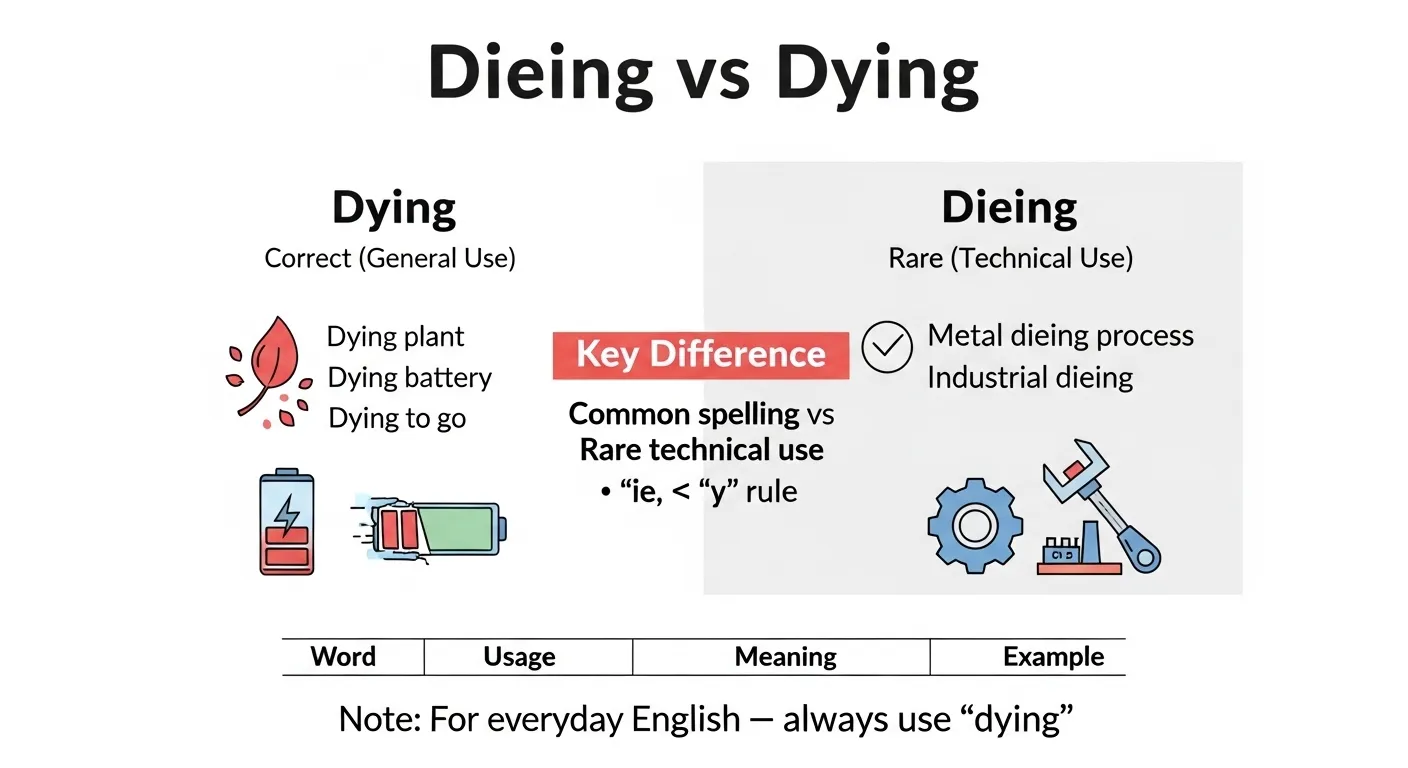
Dying is correct (related to death), while dieing is incorrect except in rare technical use (from “die” as a tool).
Many people search for “dieing or dying” because both spellings look possible, but only one usually feels right.
This confusion appears in emails, social media posts, news writing, and even exams. Writers worry about making mistakes, especially when discussing serious
topics like health, emotions, or machines stopping work. The problem exists because English spelling rules can change when letters are added to verbs. Learners often guess instead of knowing the rule.
This article clears that confusion completely. You will get a quick answer, word origins, British vs American spelling rules, common mistakes and expert advice.
By the end, you will confidently know when to use dying and when dieing is correct and when it is not.
Dieing or Dying: Quick Answer
Dying is the correct spelling in almost all cases.
Dieing is rarely correct and is only used in very specific technical meanings.
Examples:
- The plant is dying without water. ✅
- He is dying to see the movie. ✅
- The machine parts are being dieing. ✅ (technical use only)
❌ She is dieing from illness. (Incorrect)
The Origin of Dieing or Dying
To understand why confusion exists, we need to look at the history of the word.
Origin of “Die”
The verb die comes from Old English dīegan, meaning to cease living. Over time, it became one of the most basic English verbs used for life, death, emotion, and metaphorical meaning.
Why “Dying” Drops the “E”
In English spelling rules, when a verb ends in -ie, the -ie changes to -y before adding -ing.
Examples:
- die → dying
- lie → lying
- tie → tying
This rule exists to keep pronunciation clear and spelling simple.
Where “Dieing” Comes From
The spelling dieing does not come from die (to stop living). Instead, it comes from the noun die, meaning a tool used for cutting, shaping, or stamping metal. When talking about using that tool, dieing can be correct but this is rare and technical.
British English vs American English Spelling
Unlike many spelling debates, dieing vs dying is NOT a British vs American issue.
Both British and American English follow the same spelling rules here.
Standard Usage in Both Varieties
- Dying → correct for life, death, emotions, systems stopping
- Dieing → correct only for metalworking or printing contexts
Comparison Table
| Feature | American English | British English |
| Correct common form | dying | dying |
| Accepts “dieing” for death | ❌ No | ❌ No |
| Technical use of “dieing” | Rare | Rare |
| Meaning difference | None | None |
So, spelling choice does not depend on region it depends on meaning.
Which Spelling Should You Use?
The choice is simple once you know your context.
Use “Dying” When:
- Talking about life or death
- Expressing strong desire (“dying to”)
- Describing something stopping or fading
- Writing emails, articles, stories, or posts
Examples:
- The battery is dying.
- She was dying to tell the news.
Use “Dieing” Only When:
- Referring to industrial tools called dies
- Writing technical or manufacturing content
Example:
- The metal is dieing under high pressure.
Global Writing Advice
For 99.9% of readers and writers, always choose dying.
Common Mistakes with Dieing or Dying
Mistake 1: Using “Dieing” for Death
❌ He is dieing of hunger. ✅ He is dying of hunger.
Mistake 2: Overthinking the Spelling
❌ Thinking “dieing” looks more logical ✅ Follow the ie → y rule
Mistake 3: Ignoring Verb Rules
❌ She is die + ing ✅ die → dying
Mistake 4: Mixing Technical and General Meaning
❌ The patient is dieing. ✅ The patient is dying.
Dying vs Dieing: Common Questions and Spelling Confusion
Many learners search phrases like “dieing or dying,” “how to spell dying,” or “he is dieing or dying.” These questions usually come from spelling confusion, not meaning.
Here are clear answers:
- Dieing or dying which is correct?
✅ Correct: dying
⚠️ dieing is only used in rare technical contexts - How do you spell dying (as in death)?
👉 Correct spelling: dying - He is dieing or dying?
✅ Correct: He is dying - Dying vs dieing meaning
👉 Dying = losing life, fading, or stopping
👉 Dieing = related to industrial “die” tools (rare) - Is “dieing” a word?
👉 Yes, but not for normal English use
👉 Quick rule:
For everyday English → always use dying
Dieing or Dying in Everyday Examples
Emails
- My phone battery is dying. I need a charger.
News Writing
- Doctors are working to save a dying patient.
Social Media
- This trend is dying fast 😢
- I am dying to try this food 😍
Formal Writing
- The report discusses care for dying patients.
Technical Writing (Rare)
- The process of dieing metal sheets requires precision.
Dieing or Dying: Google Trends & Usage Data
Search data shows that “dieing or dying” is a very common spelling confusion worldwide.
Popular by Country
- United States
- United Kingdom
- India
- Pakistan
- Australia
Why People Search This Keyword
- Fear of spelling mistakes
- Writing about sensitive topics
- Exam and academic pressure
Usage Context
- Dying appears millions of times in books, news, and web pages
- Dieing appears mostly in industrial or technical documents
This shows strong user intent for quick correction and clear rules.
Comparison Table: Dieing vs Dying
| Word | Correct Usage | Meaning | Example |
| Dying | ✅ Yes | Death, desire, stopping | The flowers are dying |
| Dieing | ⚠️ Rare | Using a metal die | Metal is dieing |
Spelling Rules, Meaning, and Grammar of Die → Dying
Many users also search detailed queries like “why is it dying and not dieing,” “die + ing form,” or “dying spelling.” Here is a simple explanation:
Spelling Rule
When a verb ends in ie, it changes to y before adding -ing:
- die → dying
- lie → lying
- tie → tying
❌ die + ing → dieing (wrong in general use)
✅ die → dying (correct)
Meaning and Usage
- Dying meaning:
👉 losing life, stopping, fading, or strong desire - Examples:
- The flowers are dying
- I am dying to meet you
- Dieing meaning (rare):
👉 shaping or cutting metal using a die tool
Common Grammar Questions
- Why is it “dying” and not “dieing”?
👉 Because of the ie → y spelling rule - What is the -ing form of “die”?
👉 dying - How to spell dying correctly?
👉 D-Y-I-N-G - Is “diying” correct?
❌ No, incorrect spelling
Quick Examples
- She is dying of hunger.
- The phone battery is dying.
- The material is dieing under pressure. (technical)
Frequently Asked Questions
Is “dieing” ever correct?
Yes, but only in technical contexts related to metal dies.
Is “dying” always correct?
Yes, for life, death, emotion, and general use.
Why does “die” become “dying”?
Because -ie changes to -y before adding -ing.
Is this a British vs American spelling difference?
No. Both varieties use dying.
Can I use “dieing” in essays?
No, unless you are writing about manufacturing tools.
Is “dying to” informal?
Yes, but it is very common in spoken and written English.
Do spellcheckers catch this mistake?
Not always, so understanding the rule is important.
Conclusion
The confusion between dieing or dying is common, but the rule is actually simple. Dying is the correct spelling in almost every situation you will face in daily, academic, or professional
English. It follows a clear spelling rule where verbs ending in -ie change to -y before adding -ing. This rule also appears in words like lying and tying, making it consistent and easy to remember.
The spelling dieing is not wrong by definition, but it belongs to a very narrow technical world involving metalworking and industrial tools called dies.
For normal communication emails, news, stories, exams, or social media dieing will look incorrect and confusing to readers.
If your goal is clear, professional, and confident English, choose dying every time unless you are absolutely sure you are writing technical manufacturing content.
Understanding this difference saves you from embarrassing mistakes and improves your writing accuracy instantly.
Read more!
ravelling or Traveling: Quick Answer
Since vs For: What Is the Difference?
Potato vs Potatoe: What Is the Difference?