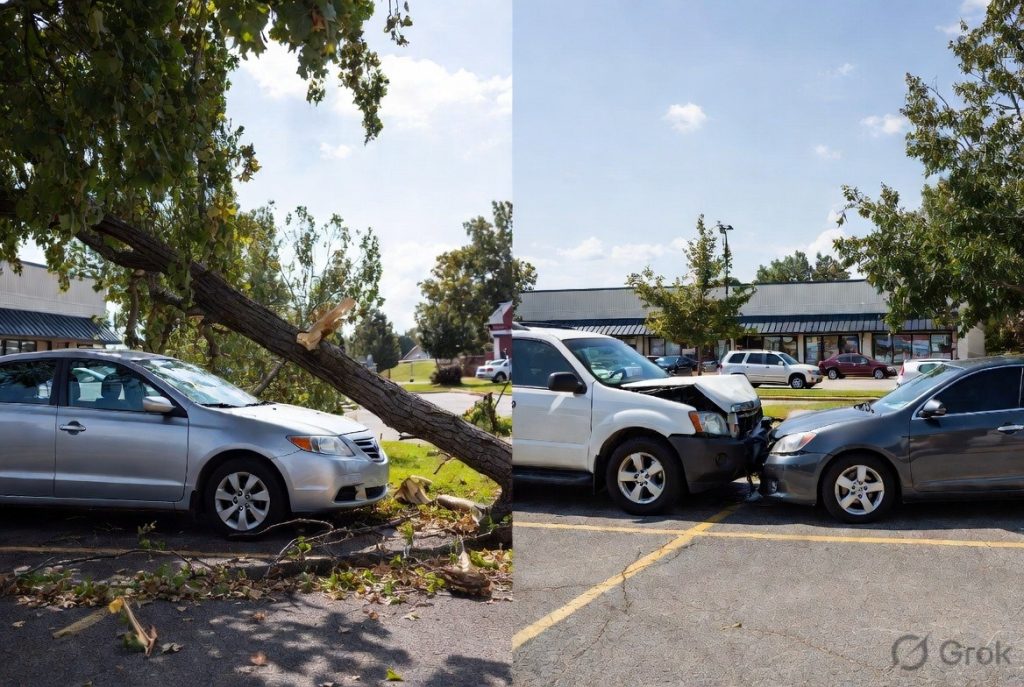
If you’ve ever stared at a renewal notice and wondered why you’re paying for both “comprehensive” and “collision” when they sound like the same thing, you’re not alone. In Cleveland, the distinction actually matters more than it does in a lot of the country, because between lake-effect snow squalls off Erie, deer season in the outer suburbs, and the occasional hailstorm that rolls through in late spring, this city gives both coverages plenty of work to do.
Ohio only requires liability insurance to drive legally: 25/50/25, meaning $25,000 per person and $50,000 per accident for injuries you cause, plus $25,000 for property damage. Neither comprehensive nor collision is mandatory unless a lender requires it. That leaves a lot of Cleveland drivers guessing about whether they need either one, or both, and what each would actually pay for if something happened tomorrow.
It’s worth saying up front that the state minimum is genuinely thin. $25,000 in property damage coverage doesn’t stretch far against a newer vehicle, and it does nothing at all for your own car if you’re the one at fault. Comprehensive and collision exist specifically to close that gap, and in Cleveland’s case, the gap tends to open up in fairly predictable ways: an icy on-ramp in January, a hailstorm in June, a deer on a two-lane road in October.
Collision: Damage From Hitting Something
Collision coverage pays to repair or replace your car after it hits another vehicle or object (another car, a guardrail, a curb, a mailbox) regardless of who caused it. Slide into the car ahead of you on an icy patch near Public Square, and collision is what pays for your bumper. It also applies if you’re the one at fault, which is where it earns its keep, since liability insurance only covers the other driver’s damage, not yours.
Ohio’s winters make collision claims a near-certainty for a lot of drivers eventually. Local agents who work the Cleveland market regularly point to ice, snow, and freezing rain as the biggest driver of collision claims in a given year, well ahead of anything else on the list. Anyone who’s tried to merge onto I-90 during a surprise squall off the lake knows exactly what that means in practice.
Comprehensive: Everything Else
Comprehensive covers damage that isn’t the result of a crash with another vehicle: theft, vandalism, fire, falling branches, hail, and, the one that catches people off guard every year, hitting an animal. If a deer steps out on Chagrin River Road at dusk and you can’t stop in time, that claim goes through comprehensive, not collision, even though it plainly felt like a crash when it happened. Attorneys who handle Ohio deer-accident claims see this confusion constantly: drivers assume collision coverage applies because something was struck, when insurers have always classified animal strikes as a comprehensive event.
That distinction trips people up constantly, because it seems backwards. You did technically collide with something. But insurers draw the line at what caused the impact, not whether an impact occurred, and animal strikes have always fallen under comprehensive.
Deer aren’t a minor footnote here, either. Northeast Ohio, and the more rural stretches ringing Cleveland in particular, sees some of the state’s highest deer-strike rates, especially once fall migration and mating season get underway. Hail is the other big one. A single storm can leave $3,000 to $8,000 in dents across a vehicle, and Cleveland’s spring and early-summer weather produces those storms with almost no warning.
Do You Actually Need Both?
If your car is financed or leased, the answer isn’t really up to you. Lenders and leasing companies almost always require both collision and comprehensive until the loan is paid off. Once you own the car outright, it becomes a math problem: is your car valuable enough that repairing or replacing it after a covered loss would actually be worth the added premium?
For a car worth $3,000, full coverage might cost more over a few years than the car itself, in which case liability-only starts to make sense, deductible and all. For anything newer or worth more than a few thousand dollars, dropping physical damage coverage means you’re personally on the hook for the full repair or replacement bill, no small thing after a bad ice storm or a deer strike that totals the car.
A reasonable middle ground a lot of Cleveland drivers land on: keep comprehensive, since it’s usually cheap relative to collision and covers the weather and wildlife risks this region actually has, and reconsider collision only once the car’s value drops low enough that it isn’t worth much anyway.
There’s a quick way to sanity-check that decision. Look up your car’s actual cash value, then compare it to roughly a year or two of the combined comprehensive and collision premium. If the premium is a meaningful chunk of the car’s worth, dropping collision (and keeping the cheaper comprehensive) is worth a real conversation with your agent rather than an automatic renewal. If the car is newer, financed, or something you’d struggle to replace out of pocket, that math usually points the other way.
What Actually Moves the Price
Deductibles are the biggest lever you control. Bumping from a $500 to a $1,000 deductible on either coverage usually lowers your premium noticeably, though it also means you’re covering more out of pocket if something happens. It’s worth running the numbers on your actual driving habits rather than guessing. Someone who rarely files claims can often save more with the higher deductible than they’d pay out over several years.
Credit-based insurance scores are another factor that catches people off guard, since Ohio (like most states) allows insurers to use credit history in pricing. Drivers rebuilding their credit sometimes see quotes that look wildly out of line with their actual driving record, which is frustrating but not unusual. If that’s the situation you’re in, it’s worth looking specifically at insurance for bad credit options rather than assuming every quote you get reflects your real risk as a driver. Some insurers weight credit more heavily than others, and shopping around can turn up a meaningfully different number.
Where you park matters too. A car kept in a garage overnight is a lower theft and hail risk than one parked on the street, and insurers price that in. So does your ZIP code within Cleveland proper versus the suburbs, since claim frequency varies block by block more than most people expect.
None of this is a reason to just take whatever quote your current insurer sends at renewal. Rates for identical coverage can vary by hundreds of dollars a year between carriers for the exact same driver, and that gap tends to be wider in a market like Cleveland’s, where weather and wildlife risk push base rates up to begin with. Comparing a few options, including looking specifically for affordable auto insurance in Cleveland rather than a generic national quote, is usually worth the twenty minutes it takes.
The Bottom Line
Collision handles what happens when you hit something. Comprehensive handles what happens when something else (weather, an animal, a thief) happens to you. In a city that gets real winters, real hailstorms, and a real deer population in the surrounding counties, both coverages tend to see actual use rather than sitting on a policy unused for years. The Insurance Information Institute has found that most drivers who carry physical damage coverage at all end up carrying both together, precisely because the risks each one covers rarely announce themselves in advance.
The state minimum will keep you legal. Whether it’s enough to keep you financially whole after a bad winter or an unlucky encounter with a deer on Fairmount Boulevard is a separate question, and one worth answering before the storm rolls in rather than after.