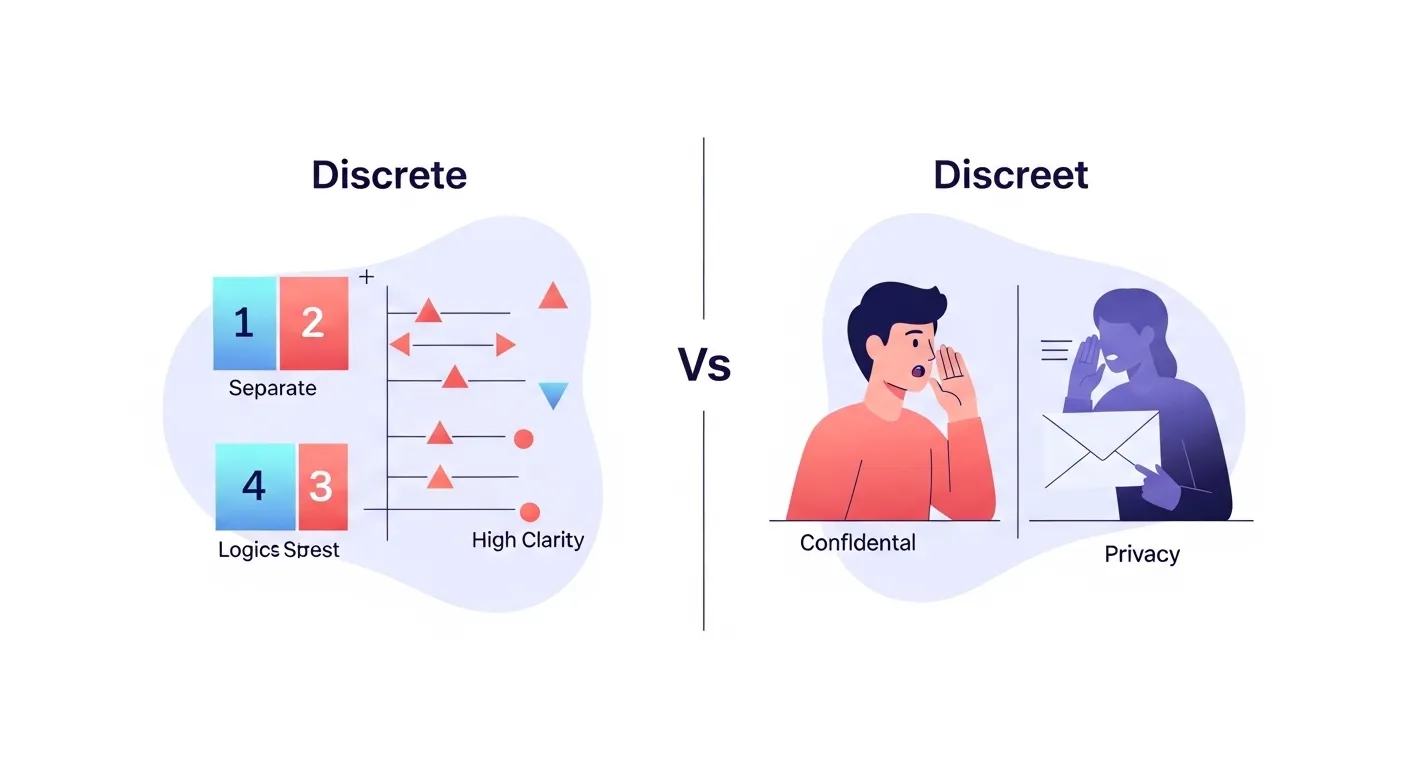
Discrete and discreet are both correct words, but they have very different meanings, and knowing this solves the confusion instantly.
Many people search for “discrete or discreet” because the spellings look almost identical and the pronunciation is very similar. This often leads to mistakes in emails, academic writing,
news articles, and professional communication. Writers want to know which word fits their sentence and how to avoid sounding careless or unprofessional. This article clears that confusion completely.
You will learn the difference between discrete and discreet, their origins, British and American usage, common mistakes, real life examples, trend insights, and expert advice so you can choose the correct word with confidence every time.
Discrete or Discreet: Quick Answer
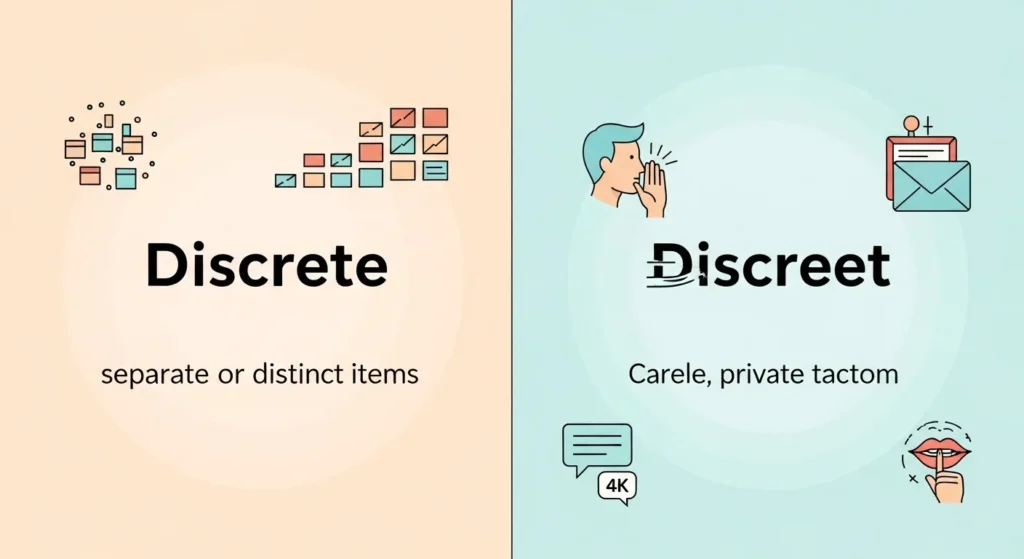
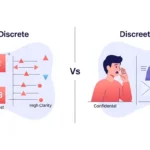
Discrete means separate, distinct, or individual.
Discreet means careful, private, or respectful about not attracting attention.
Examples:
- The project has three discrete stages. ✅
- Please be discreet when discussing the issue. ✅
❌ The project has three discreet stages. (Incorrect) ❌ The data was handled in a discrete manner. (Incorrect)
Simple rule:
If it means separate → discrete
If it means careful or private → discreet
The Origin of Discrete or Discreet
Historical Background
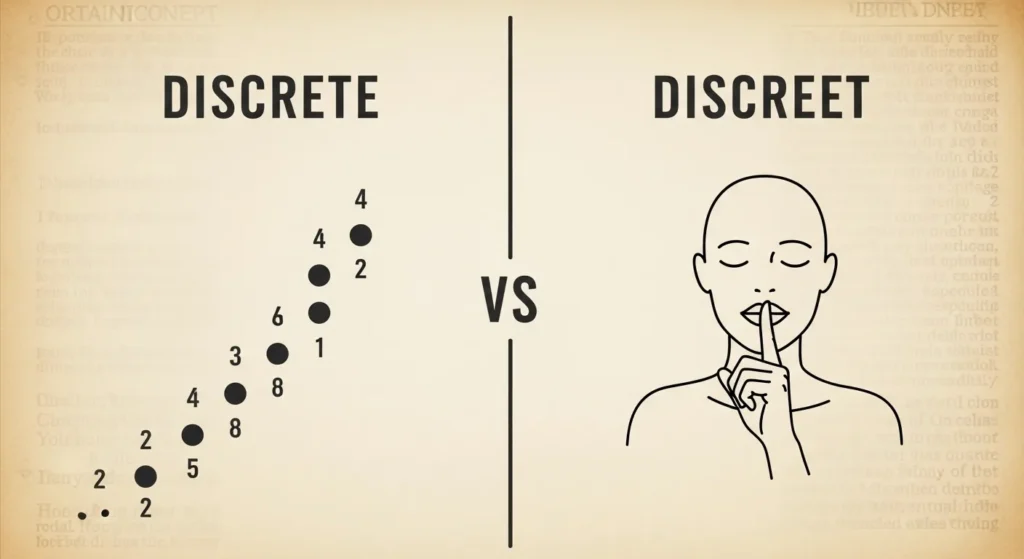
Both discrete and discreet come from the Latin word “discernere,” which means to separate or distinguish.
As English developed, the word entered through Old French in slightly different forms, which later evolved into two spellings with two meanings.
Why Two Spellings Exist
Over time, English speakers began using:
- Discrete to describe things that are separate or distinct
- Discreet to describe behavior that is careful or tactful
This separation helped make written English clearer, even though the words still look confusingly similar.
Meaning Shift Over Time
Originally, the meanings overlapped. By the 17th century, English usage settled into the clear distinction we follow today.
British English vs American English Spelling
There is no spelling difference between British and American English for discrete and discreet. Both varieties use the same spellings and meanings.
British English Usage
- Discrete: separate or distinct units
- Discreet: polite, cautious, or private behavior
Examples:
- The report is divided into discrete sections.
- She was discreet about the matter.
American English Usage
American English follows exactly the same rules.
Examples:
- The system processes discrete signals.
- The lawyer remained discreet.
Comparison Table
| Feature | Discrete | Discreet |
| US spelling | discrete | discreet |
| UK spelling | discrete | discreet |
| Core meaning | separate | careful/private |
| Refers to behavior | ❌ No | ✅ Yes |
Which Spelling Should You Use?
For American Audiences
Choose based on meaning, not location. Use discrete for things that are separate and discreet for careful behavior.
For UK & Commonwealth Audiences
The same rule applies. There is no regional difference.
For Global and Professional Writing
Using the wrong word can confuse readers or change meaning. In technical, academic, or legal writing, this mistake can reduce clarity and credibility.
Professional tip:
If you can replace the word with separate, use discrete. If you can replace it with private, use discreet.
Common Mistakes with Discrete or Discreet
Mistake 1: Using “Discreet” for Technical Meanings
❌ The system uses discreet variables. ✅ The system uses discrete variables.
Mistake 2: Using “Discrete” for Personal Behavior
❌ Please be discrete about the issue. ✅ Please be discreet about the issue.
Mistake 3: Assuming One Is a Misspelling
Both words are correct but serve different purposes.
Mistake 4: Spellcheck Confusion
Spellcheck often fails because both spellings are valid English words.
Discrete or Discreet in Everyday Examples
Emails
- Please handle these two tasks as discrete items.
- Kindly be discreet when emailing clients.
News Writing
- The investigation covered discrete incidents.
- Officials spoke discreetly to the press.
Social Media
- Life has discrete moments that matter most ✨
- Be discreet online about private matters 🔒
Academic and Technical Writing
- Mathematics studies discrete values.
- The researcher remained discreet during interviews.
Discrete or Discreet :Google Trends & Usage Data
Search data shows that “discrete or discreet” is commonly searched by students, engineers, writers, and professionals.
Popular Search Regions
- United States
- United Kingdom
- Canada
- Australia
- India and Pakistan
Usage by Context
- Discrete appears frequently in mathematics, computer science, engineering, and data analysis
- Discreet appears more in social, legal, medical, and professional communication
This confirms that confusion is meaning based, not regional.
Comparison Table: Discrete vs Discreet
| Word | Meaning | Common Contexts | Example |
| discrete | separate or distinct | math, tech, analysis | discrete values |
| discreet | careful or private | behavior, communication | discreet conversation |
Frequently Asked Questions
Is “discrete” the same as “discreet”?
No. They have different meanings.
Which word means “separate”?
Discrete means separate or distinct.
Which word means “careful or private”?
Discreet means careful, polite, or private.
Are spellings different in British and American English?
No. Spellings and meanings are the same.
Is one more common than the other?
Usage depends on context, not frequency.
Can spellcheck catch this mistake?
Often no, because both words are correct spellings.
Is this a common exam mistake?
Yes, especially in writing and vocabulary tests.
Conclusion
The confusion between discrete or discreet is common, but it is also easy to fix once you understand the meanings. Although the words look and sound similar, they describe very
different ideas. Discrete refers to things that are separate, distinct, or clearly divided. It is widely used in mathematics, science, technology, and formal analysis.
Discreet, on the other hand, describes behavior that is careful, respectful, or private, especially when handling sensitive matters.
There is no difference between British and American English spellings here. The rule is universal and meaning based.
Using the wrong word can confuse readers or change the message of your sentence. In professional, academic, or legal writing, such a mistake can reduce clarity and credibility.
The easiest way to choose correctly is to pause and test the meaning. If separate fits, use discrete.
If private or careful fits, use discreet. By applying this simple rule and following the examples in this guide, you can write with clarity, accuracy, and confidence in any context.
Related posts!
Ensure or Insure: Quick Answer

I am Oliver H. Grant. I am a English language writer and editor my focuses on grammar, word usage, and common English mistakes.
I specializes in explaining the differences between British and American English in a clear and practical way.
my writing style is simple, learner-friendly, and designed to help readers understand English with ease.
My work is also SEO-focused, making it especially useful for online learners and readers.