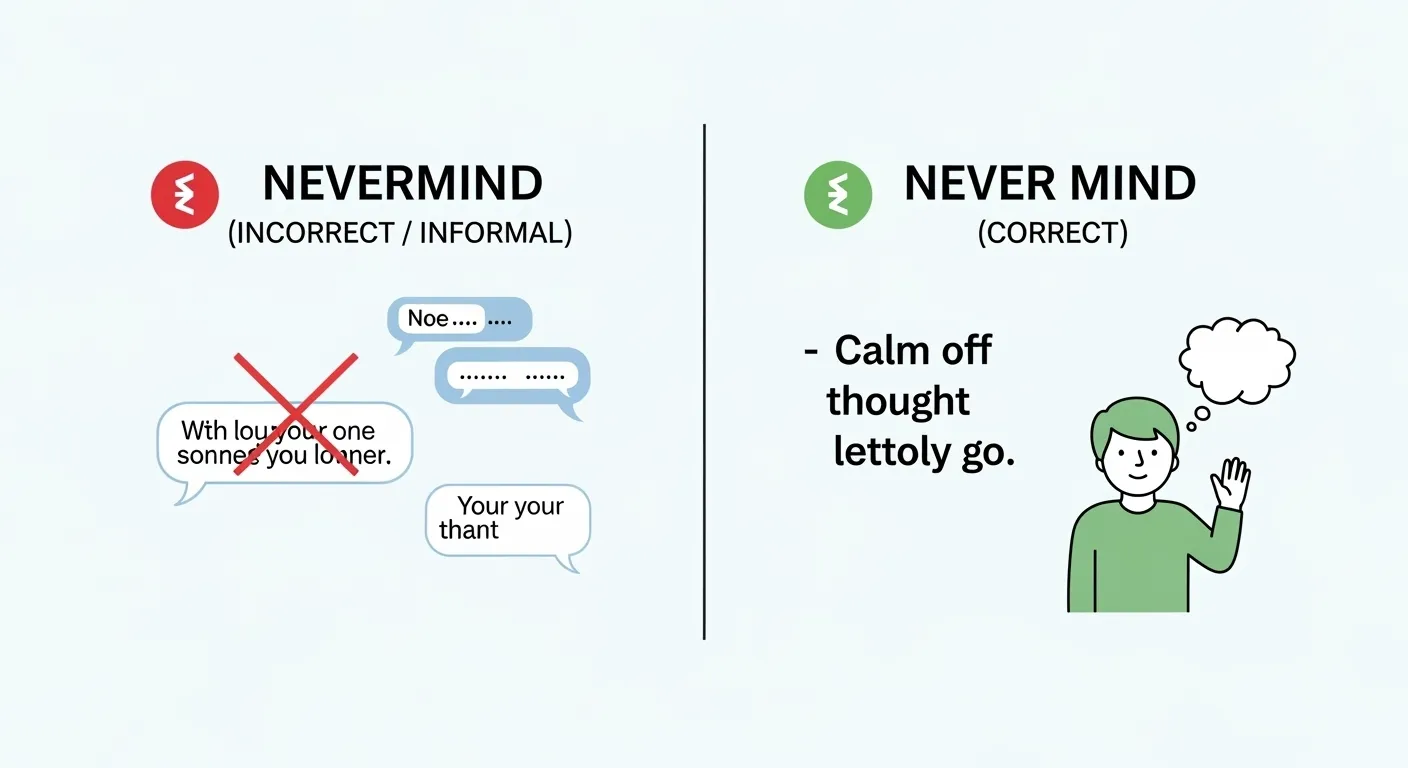
“Never mind” is the correct and standard form; “nevermind” is informal and generally not recommended in formal writing.
Many people search for “nevermind or never mind” because both versions appear online, in texts, songs, and social media.
Spellcheck sometimes allows nevermind, which adds to the doubt. Writers want to know which one is
correct for emails, exams, professional writing, and daily conversation. This confusion matters because using the wrong form can look informal or incorrect in serious contexts.
This article explains the difference in simple words, covers history, British and American usage, common mistakes and expert advice so you always choose the right form with confidence.
Nevermind or Never Mind – Quick Answer

Never mind (two words) is the correct and accepted form in standard English.
Nevermind (one word) is informal and mostly nonstandard, though it appears in casual writing and pop culture.
Examples:
- Never mind, I will do it later. ✅
- Never mind what he said. ✅
❌ Nevermind what he said. (Informal / not recommended in formal writing)
Simple rule:
For correct and professional English, always use never mind.
Never Mind Meaning, Definition, and Usage
Many people search for terms like “never mind means,” “never mind meaning,” “never mind definition,” and “what does never mind mean.”
The phrase never mind is used to tell someone:
- Do not worry
- Ignore something
- It is not important anymore
- Cancel what was just said
Simple Meaning:
Never mind = it does not matter / forget it
Examples:
- Never mind, I solved the problem.
- Never mind what others say.
- Okay, never mind, let’s move on.
Some users also search for “never mind cancel” or “okay never mind meaning,” which reflects how the phrase is used to stop or dismiss a topic in conversation.
Important Note:
Queries like “nevermind mean,” “nevermind meaning,” and “meaning of nevermind” all point to the same idea, but the correct form in writing is still never mind (two words).
👉 Key takeaway:
The meaning stays the same, but the correct form is always never mind in standard English.
The Origin of Nevermind or Never Mind
Origin of “Never Mind”
The phrase never mind comes from Middle English. It originally meant do not pay attention or do not worry about it. The word mind referred to attention, concern, or thought.
Over time, never mind became a common phrase used to dismiss a topic, cancel a request, or show that something is not important anymore.
Where “Nevermind” Came From
The single-word form nevermind developed later through informal usage. People often combine common phrases when they speak quickly or write casually.
Music, pop culture, and internet slang helped spread nevermind as one word, even though it was not fully accepted in formal grammar.
Why Spelling Confusion Exists
The confusion exists because:
- Spoken English sounds the same
- Informal writing merges words
- Spellcheck may not flag nevermind
- Famous titles and songs use nevermind
Despite this, traditional grammar still prefers never mind.
British English vs American English Spelling
Unlike color vs colour, nevermind and never mind are not British vs American spellings. Both British and American English follow the same rule.
British English
- Never mind is standard and correct
- Used in speech, writing, and formal contexts
Example:
- Never mind the delay; we will continue.
American English
- Never mind is also standard
- Used the same way as in British English
Example:
- Never mind, it is not important.
Comparison Table
| Feature | Never mind | Nevermind |
| British English | Correct | Informal |
| American English | Correct | Informal |
| Formal writing | Yes | No |
| Casual writing | Yes | Sometimes |
Which Spelling Should You Use?
For Professional and Academic Writing
Always use never mind. It is correct, clear, and accepted everywhere.
For Emails and Work Communication
Use never mind to sound polite and professional.
For Social Media and Texting
You may see nevermind, but never mind is still safer and clearer.
For Global Audiences
If your audience includes international readers, never mind avoids confusion and looks correct.
Best advice:
When in doubt, choose never mind.
Common Mistakes with Nevermind or Never Mind
Mistake 1: Using “Nevermind” in Formal Writing
❌ Nevermind the attached file. ✅ Never mind the attached file.
Mistake 2: Thinking They Are Equal
❌ Both spellings are always correct. ✅ Only never mind is standard.
Mistake 3: Using It as a Verb Incorrectly
❌ I will nevermind the issue. ✅ I will ignore the issue. / Never mind the issue.
Mistake 4: Overusing It
Using never mind too often in emails can sound dismissive.
Nevermind or Never Mind: One Word or Two Words?
A very common question is:
“Is nevermind one word or two?”
The correct answer:
- Never mind = correct (two words) ✅
- Nevermind = informal (one word) ⚠️
This is why people search queries like:
“is never mind one word,” “never mind two words,” “never mind one or two words,” and “is nevermind a word.”
Spelling Explanation:
- never mind (correct spelling)
Used in exams, emails, articles, and professional writing - nevermind (informal spelling)
Seen in casual texting, songs, or social media
Example Comparison:
- Never mind, I understand now. ✅
- Nevermind, I understand now. ⚠️ (informal)
Related Search Clarifications:
- “how do you spell nevermind” → correct form is never mind
- “nevermind spelling” → not standard
- “nevermind or never mind UK” → both UK and US prefer never mind
- “define nevermind / nevermind define” → informal version of never mind
Even when you see queries like “nevermind in a sentence,” “nevermind examples,” or “nevermind in short,” the correct formal structure remains never mind.
👉 Simple rule to remember:
If you are writing seriously, always use two words: never mind.
Nevermind or Never Mind in Everyday Examples
Emails
- Never mind the previous message.
- Never mind, the issue is resolved.
News Writing
- Never mind the rumors, officials confirmed the facts.
Social Media
- Never mind 😅 I figured it out.
- Never mind what people think.
Formal Writing
- Never mind the earlier assumption; new data changes the result.
Nevermind or Never Mind – Google Trends & Usage Data
Search trends show that “nevermind or never mind” is a popular query among students, writers, and English learners.
Popular Search Regions
- United States
- United Kingdom
- Canada
- India
- Pakistan
Usage by Context
- Never mind dominates books, news, and professional writing
- Nevermind appears more in social media, song titles, and casual posts
This data confirms that never mind is the safer and more accepted choice.
Comparison Table: Nevermind vs Never Mind
| Feature | Never mind | Nevermind |
| Word type | Phrase | Informal variant |
| Grammar status | Standard | Nonstandard |
| Formal use | Yes | No |
| Casual use | Yes | Sometimes |
| Recommended | ✅ | ❌ |
FAQs About Nevermind or Never Mind
Is “nevermind” a real word?
It exists informally but is not standard in formal English.
Is “never mind” always correct?
Yes. It is correct in both British and American English.
Can I use “nevermind” in texting?
You can, but never mind is still better.
Why do songs use “nevermind”?
Artists often use informal spelling for style.
Is “never mind” rude?
It can sound dismissive depending on tone and context.
Can “never mind” start a sentence?
Yes. It is common in conversation and writing.
Is there a verb form of “never mind”?
No. It functions as a phrase, not a verb.
Conclusion
The confusion between nevermind or never mind is very common, but the correct choice is simple once you understand the rule. Never mind, written as two words, is the standard and accepted form in modern English.
It works in professional writing, academic papers, emails, news articles, and everyday conversation. On the other hand, nevermind is an informal variation that appears mainly in casual writing, pop culture, and social media.
While many people recognize it, it is not recommended for serious or polished communication.
There is no British versus American spelling difference here. Both language varieties prefer never mind. This makes the decision even easier for global writers and learners.
If your goal is clarity, correctness, and professionalism, never mind is always the safer choice.
A helpful tip is to remember the meaning. The phrase tells someone not to worry, not to pay attention, or to cancel a thought. Keeping the words separate reflects this meaning clearly.
By following the guidance, examples, and tables in this article, you can confidently choose the right form every time and avoid a very common English mistake.
Discover More Posts!
Ensure or Insure: Quick Answer
By vs With: What’s the Difference and When to Use Each?
Desert vs Dessert: Grammar Difference, and Easy Usage Guide