
The correct phrase is “free rein,” not “free reign,” when you mean giving someone full freedom or control.
Many people confuse these two because they sound the same. Writers, students, and professionals often search this topic to avoid mistakes in emails, articles, and formal writing.
The confusion happens because “reign” relates to kings and power, while “rein” comes from horse riding. Knowing the difference helps you sound clear and confident.
It also improves credibility in professional communication. This guide explains meanings, origins, spelling differences, common errors, and real examples.
You will learn how to choose the correct phrase every time and avoid one of the most frequent English usage mistakes.
Free Rein or Free Reign: Quick Answer
The correct expression is free rein when you want to say someone has complete freedom to act, decide, or create.
👉 Free rein = correct phrase
👉 Free reign = common mistake (usually incorrect)
Simple meaning:
“Free rein” means giving full control or allowing someone to do something without limits.
Examples:
- The manager gave her free rein to design the campaign.
- Parents allowed their child free rein in choosing hobbies.
- The artist had free rein to explore new ideas.
Why do people write “free reign”? Because it sounds similar. Since “reign” relates to rulers or authority, many assume it fits.
But historically and grammatically, the correct phrase uses “rein,” like the straps used to guide a horse.
The Origin of Free Rein or Free Reign
Understanding the origin makes the correct usage easy to remember.
Horse riding history
The phrase free rein comes from horseback riding. A “rein” is the strap used to guide and control a horse.
When riders loosen the reins, the horse moves freely without tight control. This action became a metaphor for giving someone independence or freedom.
Over time, people began using “free rein” outside riding contexts. It became common in leadership, creativity, and decision-making language.
Why “free reign” appeared
The word “reign” refers to ruling or governing, often connected with kings or queens. Because both words sound alike, many writers assumed “free reign” made sense.
They thought it meant allowing someone to rule freely. However, historical records show that “free rein” came first and remains correct.
Language evolution often creates such mix-ups. Homophones lead to spelling confusion, especially when one word feels more familiar.
British English vs American English Spelling
Unlike many English differences, this phrase does not change between British and American usage. Both varieties use free rein as the correct form.
Still, people may wonder if regional spelling rules affect it. They do not. The correct phrase stays the same worldwide.
Key points:
- British English: free rein ✔️
- American English: free rein ✔️
- Commonwealth usage: free rein ✔️
Comparison Table
| Aspect | British English | American English | Notes |
| Correct phrase | Free rein | Free rein | Same in both systems |
| Common mistake | Free reign | Free reign | Seen online but incorrect |
| Meaning | Full freedom or control | Full freedom or control | No difference |
| Formal writing | Preferred | Preferred | Standard usage |
Even though spelling conventions differ in many cases, this expression remains consistent.
Which Spelling Should You Use?
Choosing the right phrase depends on meaning, not location.
If you are writing for US audiences:
Use free rein. It is accepted in business, academic, and casual writing.
If you are writing for UK or Commonwealth readers:
Also use free rein. It aligns with traditional English usage.
If your audience is global:
Stick with free rein to avoid confusion. It is the safest choice.
Professional advice:
- Always choose the historically correct phrase.
- Avoid “free reign” unless you intentionally refer to monarchy or ruling periods, which is rare.
- Check spelling tools carefully, as some may not flag the mistake.
Using the correct phrase shows attention to detail and strong language skills.
Common Mistakes with Free Rein or Free Reign
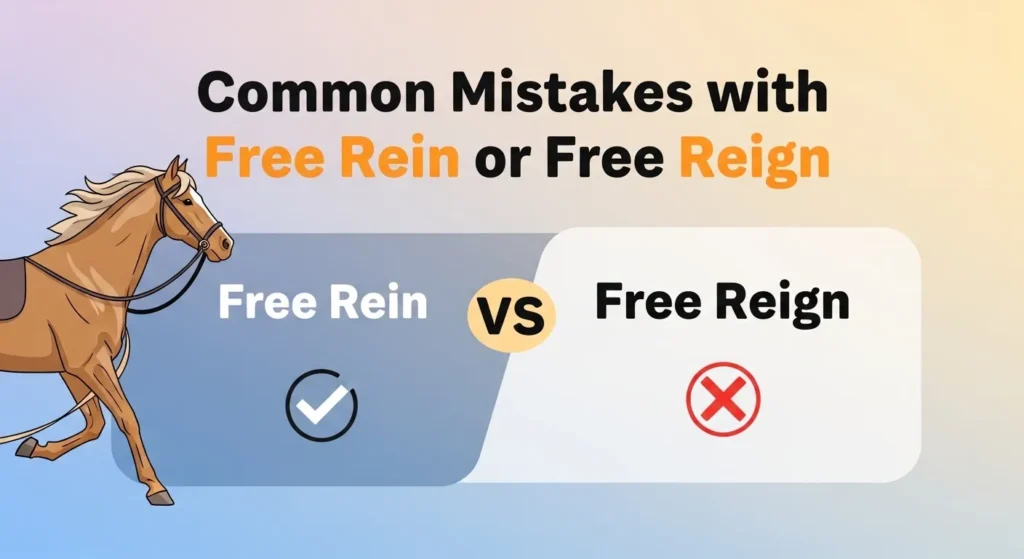
Many writers mix these phrases because they rely on sound rather than meaning.
Frequent errors:
❌ Writing “free reign” instead of “free rein.”
✔️ Correct: The teacher gave students free rein during the project.
❌ Assuming “reign” means power, so it must be correct.
✔️ Remember: The phrase comes from horse riding, not royal authority.
❌ Using both words together.
Example mistake: “He had free reign and rein.”
Correct: Use only free rein.
❌ Avoiding the phrase entirely due to confusion.
Better solution: Learn the origin and use it confidently.
Quick memory tip:
👉 Rein = horse control = freedom when loosened
Free Rein or Free Reign in Everyday Examples
Seeing real-life usage helps you remember the correct form.
Emails
- “You have free rein to adjust the schedule if needed.”
- “The team has free rein to test new ideas.”
News writing
- The director was given free rein to restructure the department.
- Investors allowed management free rein in decision-making.
Social media
- “My parents gave me free rein over my room design.”
- “Creative teams need free rein to innovate.”
Formal writing
- Researchers received free rein to explore new methods.
- The author had free rein in shaping the narrative.
These examples show how common and flexible the phrase is.
Free Rein or Free Reign: Google Trends & Usage Data
Usage patterns show interesting insights.
Popularity trends:
- “Free rein” appears more often in professional and academic writing.
- “Free reign” is common in casual online posts due to spelling confusion.
- Search interest rises when people check grammar or improve writing skills.
Country patterns:
- United States: high searches for both phrases, many users verifying correctness.
- United Kingdom: strong preference for “free rein.”
- Australia and Canada: similar to UK usage patterns.
- Global online spaces: both forms appear, but experts recommend “free rein.”
Context trends:
- Business communication
- Leadership discussions
- Creative industries
- Education and writing advice
Search data shows people want clarity, quick answers, and reliable explanations.
Comparison Table: Keyword Variations Side by Side
| Phrase | Correct or Incorrect | Meaning | Example |
| Free rein | ✔️ Correct | Full freedom or control | She had free rein to manage the project. |
| Free reign | ❌ Usually incorrect | Misheard version | Avoid using in this context |
| Rein | ✔️ Correct word | Horse strap for control | The rider held the rein. |
| Reign | ✔️ Different meaning | Period of rule by a monarch | The king’s reign lasted decades. |
FAQs About Free Rein or Free Reign
1. Is “free reign” ever correct?
It is rarely correct. Only use it if you literally mean ruling or governing freely, which is uncommon.
2. Why do people confuse these phrases?
They sound the same. Many assume “reign” relates to power and control, which feels logical but is historically incorrect.
3. Is “free rein” formal or informal?
It works in both. You can use it in business emails, academic writing, or casual conversation.
4. Does spelling change between countries?
No. The correct phrase remains “free rein” everywhere.
5. How can I remember the correct form?
Think of a horse. Loosening the rein gives freedom.
6. Can grammar tools detect the mistake?
Some tools catch it, but not all. Manual checking helps.
7. Is this mistake common among native speakers?
Yes. Many native speakers write “free reign” by accident.
Conclusion
Understanding the difference between free rein and free reign helps you avoid a common language mistake.
The correct phrase is “free rein,” rooted in horse riding, where loosening the rein allows freedom of movement.
Despite sounding similar, “reign” relates to rulers and does not match the original meaning of the expression.
Both British and American English follow the same rule, so you can confidently use “free rein” across audiences and contexts. Remembering the origin makes it easier to avoid confusion.
In daily communication, using the correct phrase shows clarity, professionalism, and attention to detail.
If you write emails, articles, or social media posts, choosing accurate wording improves credibility.
Language mistakes are normal, but learning the reasoning behind expressions gives you long-term confidence.
With practice, “free rein” will become natural, and you will avoid one of the most frequent writing errors seen online.
Related Posts!
Too Late or To Late: Meaning and Examples With In 30 Seconds🌟
Formal vs Informal Usage of Themself and Themselves 🎯
All of a Sudden or All of the Sudden: Which One Is Correct?🌟