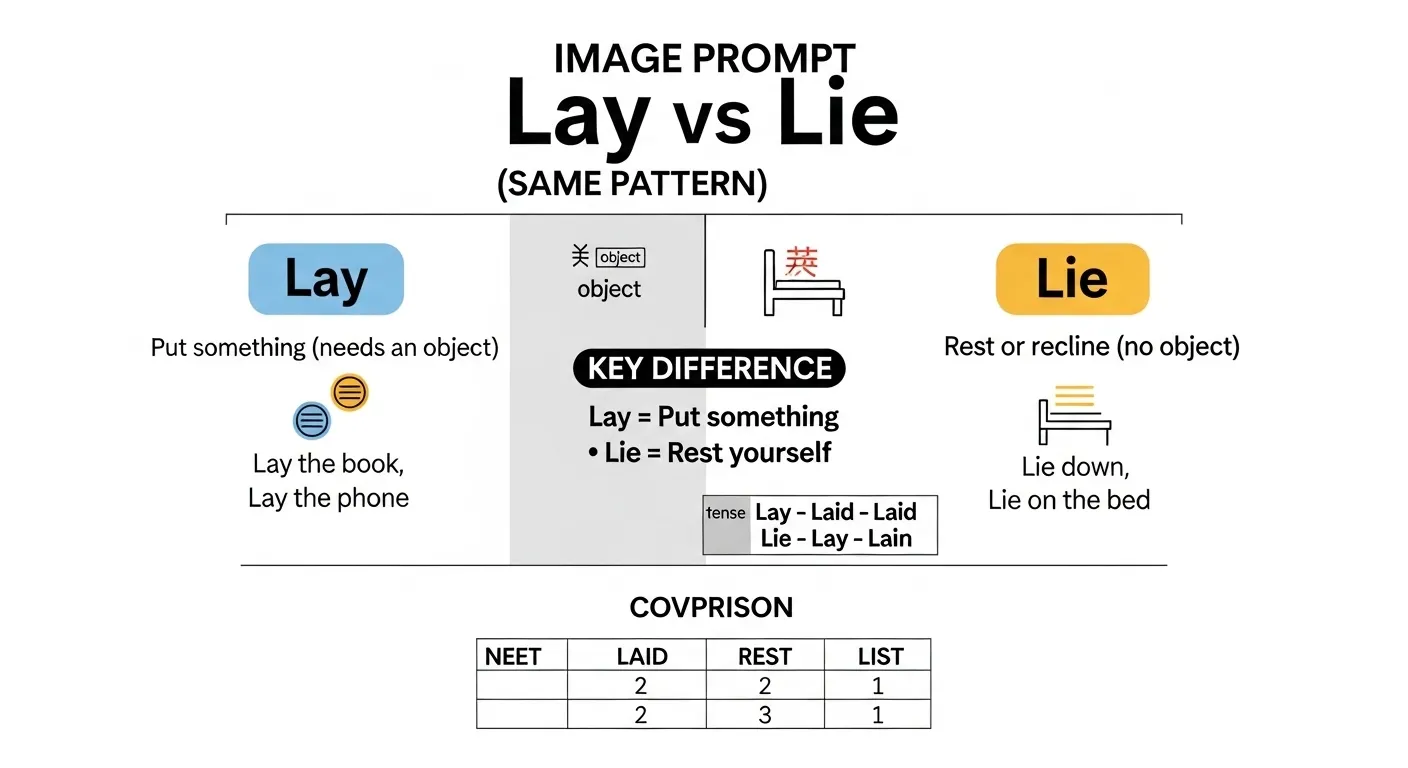
Lay means to put something down, while lie means to rest or recline.
Many people search for lay vs lie because these two verbs look similar but follow different grammar rules.
The confusion becomes stronger in past tense forms like “lay,” “laid,” and “lain.” Students, writers, and even native speakers often mix them up in daily conversation, emails, and exams. The main issue is that one verb needs an object and the other does not.
This guide explains the quick answer, origin, grammar rules, common mistakes, real-life examples, usage patterns, and memory tricks so you can clearly understand and use both words correctly.
⚡ Lay vs Lie: Quick Answer
The basic rule is:
- Lay = put something (needs an object)
- Lie = rest or recline (no object needed)
Examples
- I lay the book on the table.
- I lie on the bed.
Simple Explanation
- Use lay when you are placing something.
- Use lie when you are resting yourself.
📜 The Origin of Lay and Lie
Both verbs come from Old English.
Origin of Lay
“Lay” comes from Old English lecgan, meaning to place or put down.
Example:
- She lays the keys on the table.
Origin of Lie
“Lie” comes from Old English licgan, meaning to recline or rest.
Example:
- He lies on the sofa.
Over time, both verbs kept similar meanings but different grammar roles.
🇬🇧🇺🇸 British English vs American English Usage
There is no spelling difference, and both follow the same grammar rules.
| Word | British English | American English | Usage |
| Lay | Lay | Lay | Put something |
| Lie | Lie | Lie | Rest or recline |
The confusion exists in both regions equally.
🌍 Which Word Should You Use?
Your choice depends on If there is an object.
Use Lay (Needs Object)
Examples:
- Lay the book on the table.
- She lays the baby in the crib.
- They laid the carpet yesterday.
Here, something is being placed.
Use Lie (No Object)
Examples:
- I lie on the bed.
- He lies down after work.
- They lay on the grass yesterday (past tense of lie).
Here, the subject is resting.
❌ Common Mistakes with Lay or Lie

These mistakes are very common.
1. Using Lay Without Object
Incorrect:
- I will lay down.
Correct:
- I will lie down.
2. Using Lie with Object
Incorrect:
- Lie the book on the table.
Correct:
- Lay the book on the table.
3. Confusing Past Tense
Incorrect:
- Yesterday, I laid on the bed.
Correct:
- Yesterday, I lay on the bed.
📘 Understanding the Grammar Rule
Here is a clear comparison.
| Word | Type | Needs Object | Example |
| Lay | Transitive verb | Yes | Lay the book |
| Lie | Intransitive verb | No | Lie down |
⏳ Past Tense Forms (Important)
This is where most confusion happens.
| Verb | Present | Past | Past Participle |
| Lay | Lay | Laid | Laid |
| Lie | Lie | Lay | Lain |
Examples
- Present: I lie down.
- Past: I lay down yesterday.
- Perfect: I have lain down.
✍️Lie vs Lay in Everyday Examples
📧 Email Example
“Please lay the documents on my desk.”
📰 News Example
“The injured man lay on the road.”
📱 Social Media Example
“I just want to lie down and relax.”
📄 Formal Writing Example
“The worker laid the materials carefully.”
These examples show real usage.
📊 Lay and Lie: Google Trends & Usage Data
Search data shows that lay vs lie is one of the most confusing grammar topics.
Popular related searches include:
- lay vs lie difference
- lay vs lie examples
- lay vs lie past tense
- when to use lay or lie
- laid vs lain difference
Countries where this query is common:
- United States
- United Kingdom
- India
- Pakistan
Even native speakers often search this topic.
📋 Comparison Table: Lay vs Lie
| Feature | Lay | Lie |
| Meaning | Put something | Rest/recline |
| Object needed | Yes | No |
| Past tense | Laid | Lay |
| Example | Lay the book | Lie on bed |
🧠 Easy Memory Tricks
Simple tricks make it easy.
Trick 1: Lay = Place
Think “lay = place something.”
Example:
- Lay the phone down.
Trick 2: Lie = Recline
Think “lie = relax yourself.”
Example:
- Lie on the sofa.
Trick 3: Object Test
Ask:
Is there an object?
- Yes → Use lay
- No → Use lie
📖 Advanced Usage Examples
Using Lay
- She laid the baby in bed.
- He is laying the table for dinner.
Using Lie
- She lies down every afternoon.
- He lay on the couch yesterday.
- He has lain there for hours.
🧾 Lay vs Lie in Professional Writing
Right usage is important.
Correct:
- The assistant laid the files on the desk.
Correct:
- The patient lay on the bed.
Incorrect:
- The patient laid on the bed.
Mistakes can reduce clarity in formal writing.
🌎 Why This Confusion Happens
This confusion happens because:
- Past tense of “lie” is “lay.”
- Both words sound similar.
- Grammar rules are complex.
Practice helps remove confusion.
❓ FAQs About Lay vs Lie
1. What is the difference between lay and lie?
Lay means to put something. Lie means to rest.
2. Does lay need an object?
Yes. Lay always needs something to act on.
3. What is the past tense of lie?
The past tense of lie is “lay.”
4. What is the past tense of lay?
The past tense of lay is “laid.”
5. Can I say “lay down”?
Only if you are placing something. Otherwise, say “lie down.”
6. Is this mistake common?
Yes. Even native speakers make this mistake.
7. What is the easiest rule?
Object = lay
No object = lie
🏁 Conclusion:
The difference between lay and lie becomes clear when you focus on If an object is involved. “Lay” is used when you are placing something, which means it always needs an object.
“Lie,” on the other hand, is used when someone is resting or reclining and does not need an object. The confusion increases because the past tense of “lie” is “lay,” which looks exactly like the present form of “lay.”
This makes it important to understand the full verb forms and practice using them in sentences. Remember the simple rule: if you are putting something somewhere, use “lay.” If you are resting, use “lie.” With time and practice, this difference becomes natural.
Using these verbs correctly improves clarity in both speaking and writing. It also helps you sound more confident and professional in English communication.
Discocer More Articals!
Tweeking or Tweaking: Which Spelling Is Correct?📝
Among vs Between: What Is the Difference?
Period Before or After Quotes: Simple Guide for Correct Usage📝

englifiy.com is my English grammar comparison website where I simplify confusing words, spelling differences, and usage rules through clear explanations and examples. My goal is to help learners, writers, and students understand English easily and use correct grammar with confidence.