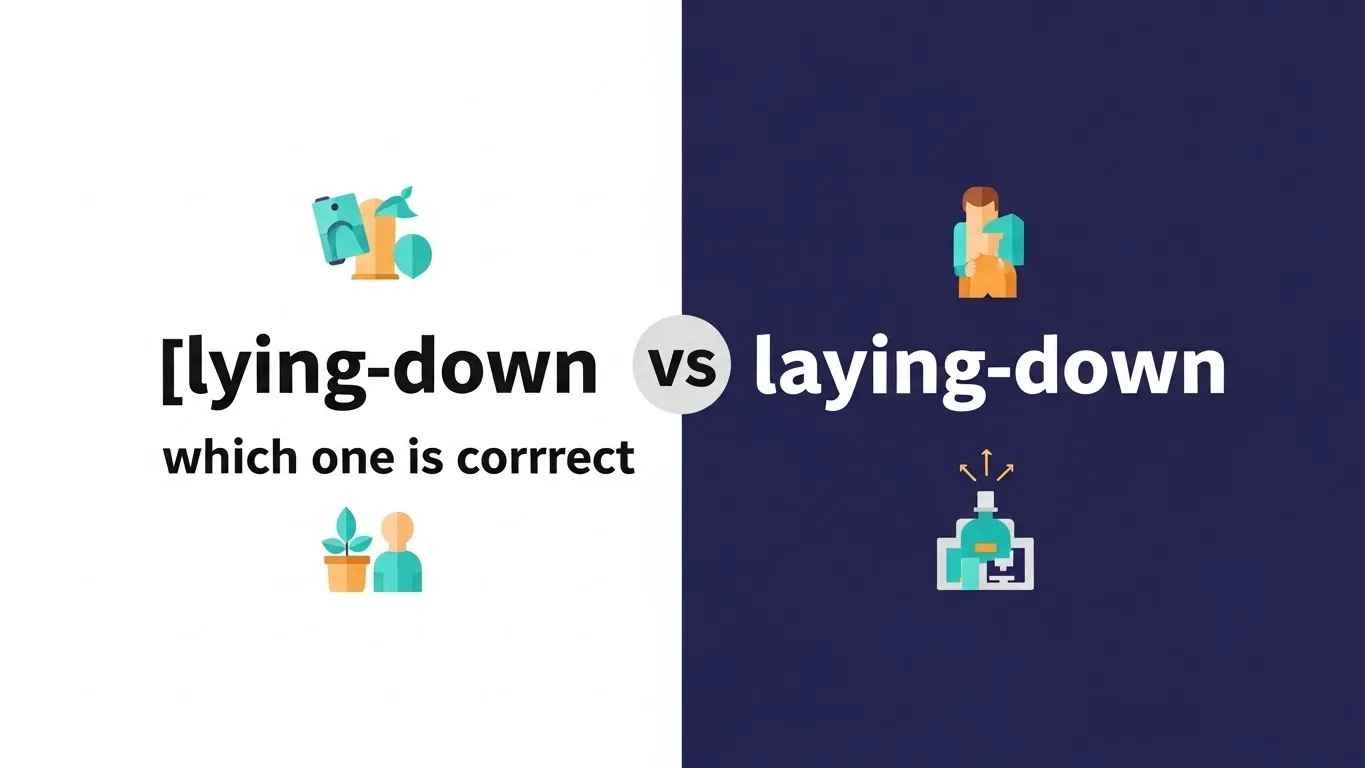
Many people search for “lying down or laying down” because these two phrases sound very similar but follow different grammar rules. Even native English speakers often mix them up in daily conversation, emails, and social media posts.
The confusion usually happens because the verbs lie and lay are closely related, irregular, and change form in ways that are not easy to remember. One verb needs an object, while the other does not, but most learners are never clearly taught this rule.
This article solves that problem in a simple way. It explains when to use lying down and when laying down is correct, with clear examples, common mistakes, and practical advice for real-life writing.
Lying Down or Laying Down: Quick Answer
Lying down is correct when someone or something rests or reclines by itself.
Laying down is correct when someone puts something else down.
Examples:
- I am lying down on the sofa. ✅
- She is laying down the baby. ✅
❌ I am laying down on the sofa. (Incorrect) ❌ He is lying down the book. (Incorrect)
Simple rule:
- No object → lying down
- Needs an object → laying down
The Origin of Lying Down or Laying Down
The confusion between lying down and laying down comes from the long history of the verbs lie and lay in English.
Origin of “Lie / Lying”
The verb lie comes from Old English licgan, meaning to rest or recline. It has always described a state, not an action done to something else. Over time, its present participle became lying, which we now use in phrases like lying down.
- Base form: lie
- Present participle: lying
- Past tense: lay (this adds more confusion)
- Past participle: lain
Origin of “Lay / Laying”
The verb lay comes from Old English lecgan, meaning to put or place something. This verb has always required an object.
- Base form: lay
- Present participle: laying
- Past tense: laid
- Past participle: laid
The spelling difference exists because English kept two separate verbs with related meanings but different grammar rules. Over time, their sounds became similar, but their functions stayed different.
British English vs American English Spelling
There is no spelling difference between British English and American English for lying down or laying down. Both varieties follow the same grammar rules.
What may differ slightly is style and frequency. American English uses these phrases more often in casual speech, while British English may prefer slightly more formal sentence structures.
Examples
- British English: He was lying down after lunch.
- American English: She is laying down the rules clearly.
Comparison Table
| Feature | British English | American English |
| Lying down | Same usage | Same usage |
| Laying down | Same usage | Same usage |
| Grammar rules | Identical | Identical |
| Spelling | No difference | No difference |
Which Spelling Should You Use?
The choice between lying down and laying down depends on your sentence, not your location.
- US audience: Follow object vs no-object rule
- UK/Commonwealth audience: Same rule applies
- Global audience: Use clear structure to avoid confusion
Ask yourself one question:
Am I putting something down?
- If yes, use laying down
- If no, use lying down
This rule works everywhere and in all types of English.
Common Mistakes with Lying Down or Laying Down
Mistake 1: Using “laying down” without an object
❌ I am laying down because I am tired. ✅ I am lying down because I am tired.
Mistake 2: Using “lying down” with an object
❌ She is lying down the baby. ✅ She is laying down the baby.
Mistake 3: Confusing past forms
❌ Yesterday, I laid down on the bed. ✅ Yesterday, I lay down on the bed.
Mistake 4: Overcorrecting in formal writing
❌ The manager is lying down the rules. ✅ The manager is laying down the rules.
Lying Down or Laying Down in Everyday Examples
Emails
- I will be lying down for an hour due to a headache.
- Please make sure you are laying down all documents neatly.
News
- The injured player was lying down on the field.
- The government is laying down new safety laws.
Social Media
- Just lying down and watching my favorite show 😴
- Parents are laying down strict screen-time rules 📵
Formal Writing
- The patient was advised to remain lying down.
- The policy document is laying down clear procedures.
Lying Down or Laying Down:Google Trends & Usage Data
Search data shows that “lying down or laying down” is most commonly searched in:
- ESL-learning countries
- South Asia and Southeast Asia
- The United States and the UK
People usually search this keyword when:
- Writing emails or assignments
- Preparing for exams
- Editing professional content
Lying down appears more often in health, lifestyle, and daily conversation content. Laying down appears more often in legal, instructional, and professional contexts, such as rules, laws, or procedures.
This shows strong user intent for quick clarity plus detailed explanation.
Comparison Table: Lying Down vs Laying Down
| Phrase | Base Verb | Needs Object | Meaning | Example |
| Lying down | lie | No | Resting or reclining | He is lying down |
| Laying down | lay | Yes | Putting something down | She is laying down the book |
FAQs
Is “lying down” always correct?
Yes, when someone rests by themselves and no object is involved.
Is “laying down” wrong?
No, it is correct when an object is involved.
Why do people confuse lying and laying?
Because lie and lay sound similar and have irregular past forms.
Can I say “I am laying down”?
Only if you are putting something down.
What is the past tense of “lying down”?
It is lay down.
What is the past tense of “laying down”?
It is laid down.
Is this rule the same in British and American English?
Yes, the rule is the same in both.
Conclusion
Understanding the difference between lying down or laying down becomes easy when you focus on one key idea: objects. The phrase lying down is used when a person or thing rests without acting on anything else.
It describes a state, not an action done to another object. On the other hand, laying down always involves action and always needs an object. You lay down rules, books, babies, or conditions.
This confusion is common because English mixes similar sounds with irregular verb forms, but the solution is simple and reliable.
Ignore how the words sound and look at what the sentence is doing. If something is being placed somewhere, choose laying down. If someone is resting, choose lying down.
These rules apply in British English, American English, and global English. By following the examples, tables, and tips in this guide, you can confidently use lying down and laying down in emails, exams, news writing, and professional documents without hesitation.
Related posts!