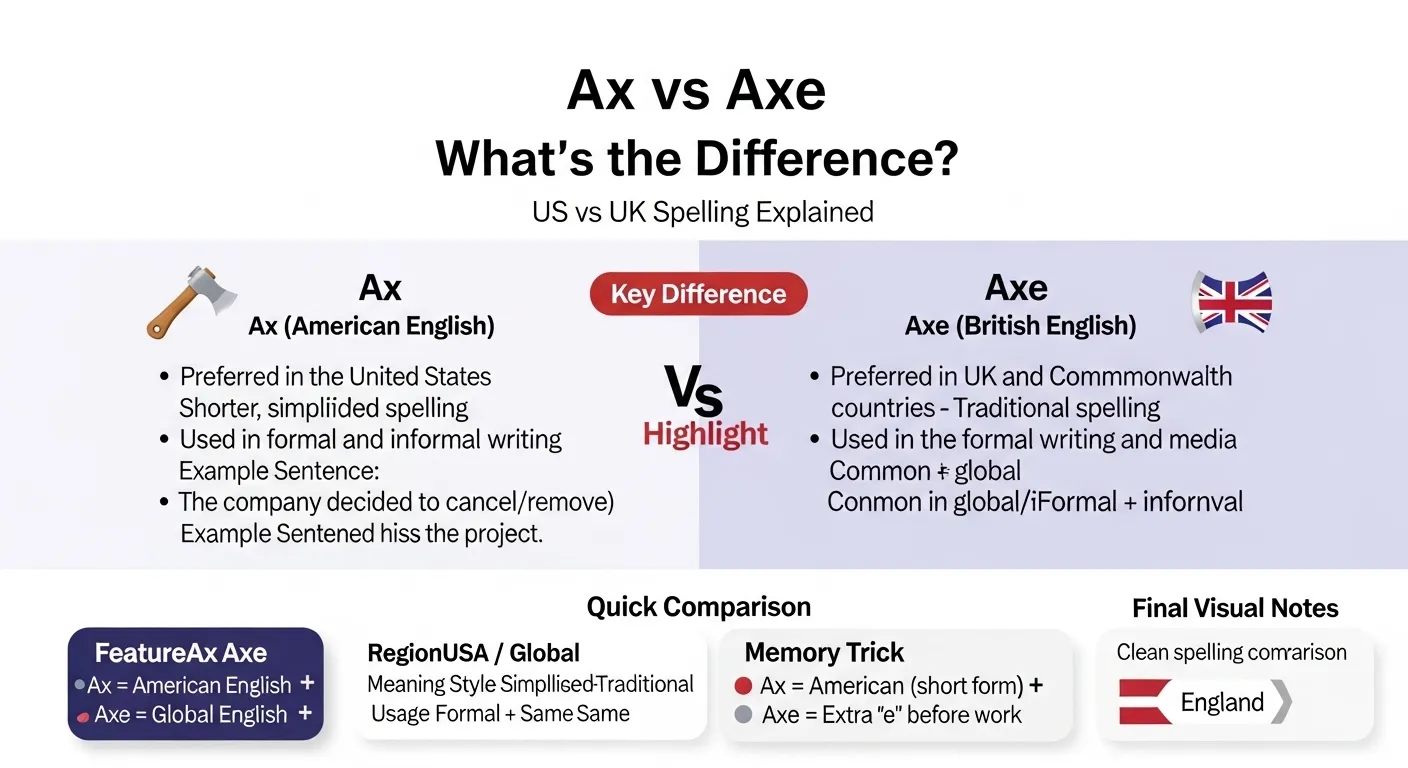
Both “ax” and “axe” are correct spellings the difference is that “ax” is American English, while “axe” is British English.
Many people search for “ax or axe” because they see both forms used in books, news, tools, and even brand names. The confusion grows when
Spell check accepts both spellings and dictionaries list them as correct. Writers want to know which one is right for American English, which one suits British English, and which looks more professional. This article solves that problem clearly. You will learn the exact difference
between ax and axe, their history, spelling rules, common mistakes and expert advice so you can choose the correct spelling with confidence every time.
Ax or Axe: Quick Answer
Ax and axe mean the same thing: a tool with a sharp blade used for cutting wood, or the verb meaning to cut or remove.
- Ax is the preferred spelling in American English.
- Axe is the preferred spelling in British English and most Commonwealth countries.
Examples:
- He used an ax to cut firewood. (American English)
- The worker sharpened his axe before work. (British English)
- The company decided to ax the project. (American English verb)
Simple rule:
US English prefers ax. UK and global English prefer axe.
The Origin of Ax or Axe
Early History of the Word
The word axe comes from Old English æx, which itself came from Proto-Germanic akwisī. This word has ancient roots and appears in many early European languages with similar spellings and meanings. The axe has been one of humanity’s oldest tools, used for survival, hunting, and building.
Why Two Spellings Exist
In Old English, the spelling æx was common. Over time, English spelling evolved, and the form axe became standard in Britain.
Later, when American English began simplifying spellings in the 18th and 19th centuries, ax emerged as a shorter, simplified version.
Influence of American Spelling Reform
American lexicographer Noah Webster supported simpler spellings. Just as colour became color and centre became center, axe often became ax in American usage.
This is why both spellings are correct today, but their usage depends on region.
British English vs American English Spelling
The difference between ax and axe is a classic example of regional spelling variation.
British English
- Standard spelling: axe
- Used in formal, academic, and everyday writing
Examples:
- He bought a new axe for camping.
- The minister faced the axe during reforms.
American English
- Standard spelling: ax
- Widely accepted in dictionaries and style guides
Examples:
- Keep the ax sharp for chopping wood.
- The show got the ax after one season.
Comparison Table
| Feature | British English | American English |
| Preferred spelling | axe | ax |
| Accepted alternative | ax (rare) | axe (less common) |
| Formal writing | axe | ax |
| Idioms | axe | ax |
Which Spelling Should You Use?
For American Audiences
Use ax in all contexts tools, verbs, idioms, and headlines. It looks natural and follows American spelling standards.
For UK & Commonwealth Audiences
Use axe consistently. This includes countries like the UK, Canada, Australia, and New Zealand.
For Global or Professional Writing
If your audience is international, axe is usually the safer and more widely recognized spelling. Many global publications prefer British-based spelling rules.
Professional tip:
Match your spelling to your audience’s English style.
Ax vs Axe: Spelling, Articles, and Common Usage Questions
Many users search questions like “ax vs axe,” “is it ax or axe,” “ax or axe spelling,” and “difference between ax and axe.” These all point to the same idea: both spellings are correct, but usage depends on region.
Correct Articles: “A Axe” or “An Axe”?
A very common confusion is:
- a axe ❌
- an axe ✅
Correct rule:
👉 Use “an axe” because the word starts with a vowel sound.
Examples:
- He picked up an axe.
- She bought an axe for camping.
For American spelling:
- He picked up an ax ✅ (same rule applies)
Spelling Questions Answered
People also search:
- how to spell axe / how do you spell axe
- how to spell ax / how do you spell ax
- spelling of axe / spelling of ax
- correct spelling of ax
👉 Both are correct spellings:
- Ax → American English
- Axe → British English
Simple Clarification
- US → ax
- UK / global → axe
- Canada → mostly axe
Common Mistakes with Ax or Axe
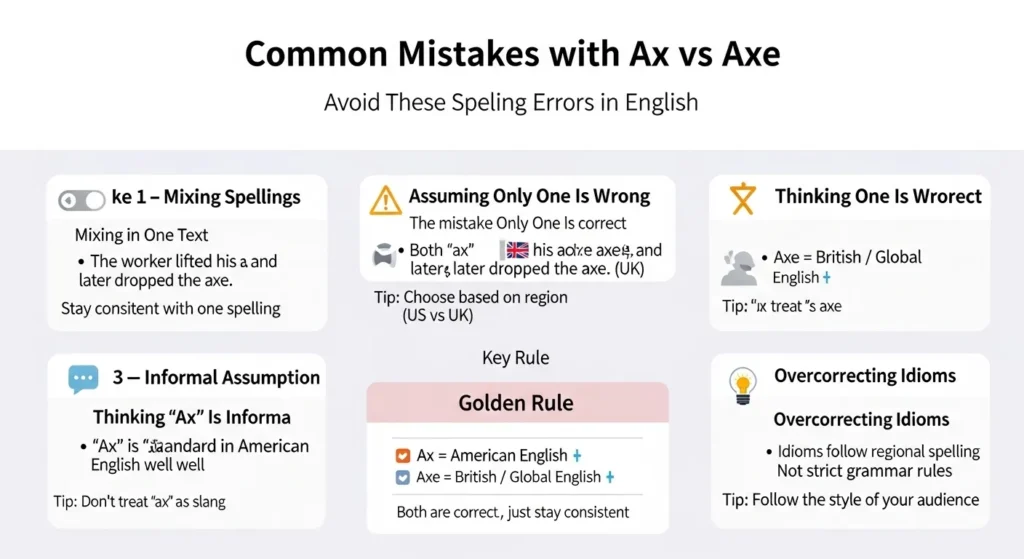
Mistake 1: Mixing Spellings in One Text
❌ The worker lifted his axe and later dropped the ax. ✅ The worker lifted his axe and later dropped the axe. (UK)
Mistake 2: Thinking One Spelling Is Wrong
Both spellings are correct. The mistake is choosing the wrong one for your audience.
Mistake 3: Assuming “Ax” Is Informal
Ax is fully standard in American English, even in formal writing.
Mistake 4: Overcorrecting Idioms
Idioms follow regional spelling rules, not strict logic.
Ax or Axe in Everyday Examples
Emails
- The budget cuts may ax several departments. (US)
- Safety training includes using an axe correctly. (UK)
News Headlines
- Company Plans to Ax 500 Jobs (US media)
- Minister Faces the Axe in Cabinet Reshuffle (UK media)
Social Media
- Time to ax bad habits 💪
- Bought a new camping axe 🪓
Formal Writing
- The proposal was axed due to cost concerns. (US)
- Workers must handle the axe with care. (UK)
Ax or Axe: Google Trends & Usage Data
Search data shows strong interest in “ax or axe”, especially among writers, students, and ESL learners.
Popular Search Regions
- United States (ax dominant)
- United Kingdom (axe dominant)
- Canada (axe dominant)
- Australia (axe dominant)
- India and Pakistan (mixed usage)
Usage by Context
- Ax appears more in American news, business, and verbs
- Axe appears more in tools, history, and British media
The popularity difference is regional, not grammatical.
Comparison Table: Ax vs Axe
| Word | Region | Meaning | Example |
| ax | American English | Tool / remove | The plan got the ax |
| axe | British English | Tool / remove | He sharpened his axe |
Ax or Axe in Grammar, Meaning, and Real Usage
Many learners also search for practical grammar and usage questions like “ax meaning,” “is ax a real word,” “axe vs ax meaning,” and “axing or axeing.”
Is “Ax” a Real Word?
Yes. A very common query is:
👉 “is ax a real word?”
Answer:
✔ Yes, ax is a real and correct word in American English
Meaning of Ax / Axe
Both words have the same meanings:
- A cutting tool
- To remove or cancel (verb)
Example:
- The company decided to ax the project.
- He used an axe to cut wood.
Verb Forms: Axing or Axeing?
Another common confusion:
- axing ✅ (preferred in US)
- axeing ❌ (rare and usually avoided)
Correct forms:
- The company is axing jobs.
- The plan was axed.
Common Search Variations Explained
Users also search:
- ax v axe
- axe vs ax
- ax vs axe spelling
- what is the difference between ax and axe
👉 All these have one answer:
No meaning difference only regional spelling difference
FAQs About Ax or Axe
Is “ax” a real word?
Yes. Ax is the standard American spelling.
Is “axe” more correct than “ax”?
No. Both are correct. Usage depends on region.
Which spelling should I use in exams?
Use the spelling that matches the English variety required.
Can “ax” be used as a verb?
Yes. To ax means to cut or remove.
Is “axe” used as a verb in British English?
Yes. British English uses axe as both noun and verb.
Which spelling is better for ?
Use the one your target audience searches for.
Should I mix ax and axe in one article?
No. Always stay consistent.
Conclusion
The difference between ax or axe is not about right or wrong, but about where and how you are writing.
Both spellings come from the same historical word and carry the same meaning. Over time, English developed regional preferences.
American English simplified the spelling to ax, while British and Commonwealth English kept axe.
Understanding this distinction helps you write clearly and professionally. If you are writing for an American audience, ax will look natural and correct. If your audience is British or
international, axe is usually the better choice. The key is consistency. Choose one spelling based on your audience and use it throughout your writing.
Small spelling choices like this matter more than people think. They affect clarity, trust, and professionalism.
By following the guidance in this article, you can confidently choose the correct spelling every time and avoid common mistakes that confuse readers.
Related posts!
The Origin of Complement or Compliment
Above vs Over: What’s the Difference?In 30 Seconds
By vs With: What’s the Difference and When to Use Each?