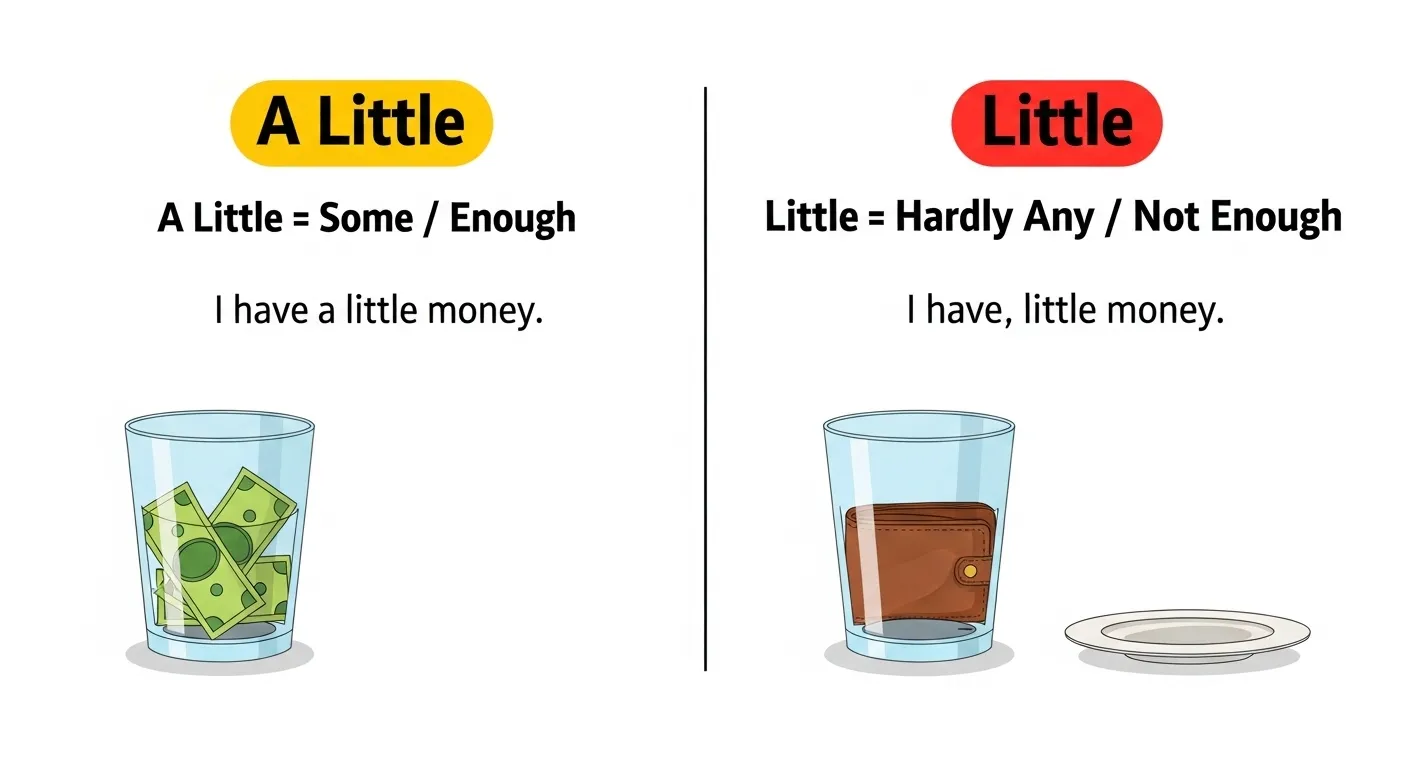
“A little” means some and has a positive meaning, while “little” means not much and has a negative meaning.
Many people search for a little vs little, difference between a little and little, when to use a little or little, a little vs little in English grammar, and a little vs little examples in sentences because both phrases talk about small amounts.
This creates confusion, especially for English learners. At first, both seem similar because they refer to a small quantity.
But the key difference is simple: “a little” means some amount and suggests enough, while “little” means almost none and suggests not enough.
This guide will help you understand the difference clearly and use both correctly in everyday English.
⚡ A Little or Little: Quick Answer
- Use a little to mean some / a small but enough amount
- Use little to mean not much / almost none
✅ Examples:
- I have a little money. (some money)
- I have little money. (almost no money)
- She needs a little help.
- We have little time left.
👉 Simple Rule:
A little = some / enough
Little = hardly any / not enough
📖 Definitions with Examples
🟢 A Little (Definition):
“A little” means a small amount, but enough. It has a positive or neutral meaning.
✅ Examples:
- I have a little sugar left.
- She knows a little English.
- We need a little more time.
- There is a little water in the bottle.
🔵 Little (Definition):
“Little” means not much or almost none. It has a negative meaning.
✅ Examples:
- I have little hope now.
- There is little milk left.
- We have little time to finish.
- He showed little interest.
📜 The Origin of A Little vs Little
People also search history of a little and little.
- Little comes from old English meaning “small in amount”
- It was used to show limited quantity
- Adding “a” changed the tone
- A little developed to mean “some amount” instead of “almost none”
👉 This is why:
- Little = negative feeling
- A little = positive feeling
🌍 British English vs American English Usage
People search a little vs little British vs American English.
Both forms are used the same way in British and American English.
📊 Comparison Table:
| Phrase | British English | American English | Meaning |
| A Little | Same | Same | Some / Enough |
| Little | Same | Same | Hardly Any |
👉 No spelling difference, only meaning difference.
🎯 Which One Should You Use?
People search when to use a little vs little correctly.
🟢 Use A Little when:
- You mean some amount
- The amount is small but enough
- You want a positive/neutral tone
🔵 Use Little when:
- You mean almost none
- The amount is not enough
- You want a negative tone
👉 Pro Tip:
If the amount feels enough, use a little.
❌ Common Mistakes with A Little vs Little
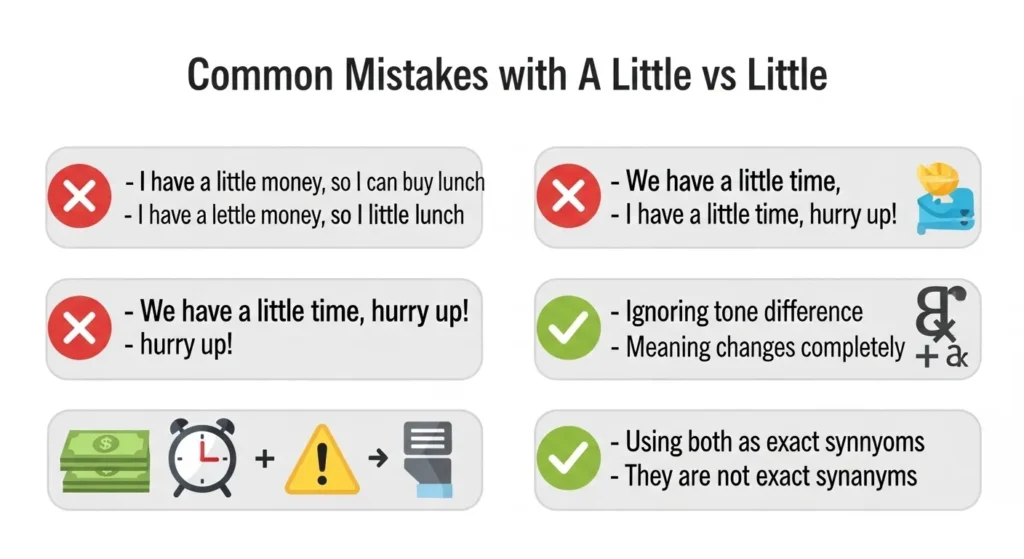
People search common mistakes with a little and little.
❌ Mistake 1:
I have little money, so I can buy lunch
✔ Better: I have a little money, so I can buy lunch
❌ Mistake 2:
We have a little time, hurry up!
✔ Better: We have little time, hurry up!
❌ Mistake 3:
Ignoring tone difference
✔ Remember: Meaning changes completely
❌ Mistake 4:
Using both as exact synonyms
✔ They are not exact synonyms
💬 Little vs A Little in Everyday Examples
People search a little vs little sentence examples.
📧 Emails:
- I need a little more information.
- We have little time before the deadline.
📱 Social Media:
- Feeling a little tired today 😴
- I have little patience left 😅
📰 News:
- The company made little progress this year.
- There is a little improvement in sales.
🧑🏫 Classroom:
- She speaks a little French.
- He showed little effort in class.
🏠 Daily Life:
- Add a little salt.
- There is little food left.
📊 A Little vs Little: Google Trends & Usage Data
People search which is more common a little or little.
🌎 Global Usage:
- Both are common
- “A little” is more common in daily conversation
📍 Popular Search Queries:
- a little vs little grammar
- difference between little and a little
- little and a little examples
- when to use little and a little
- little vs a little exercises
📚 Context:
- Positive amount → A little
- Negative/lacking amount → Little
📋 Comparison Table: A Little vs Little
| Feature | A Little | Little |
| Meaning | Some / Enough | Hardly Any |
| Tone | Positive / Neutral | Negative |
| Suggests Sufficiency | Yes | No |
| Example | A little water | Little water |
📌 Important Grammar Rule
People also search a little and little with countable or uncountable nouns.
Both are used with uncountable nouns only.
✅ Correct:
- A little water
- Little money
- A little time
- Little hope
❌ Incorrect:
- A little books
- Little apples
👉 For countable nouns, use a few / few instead.
❓ FAQs About A Little vs Little
1. What is the difference between little and a little?
“A little” means some; “little” means almost none.
2. Is little negative?
Yes, usually.
3. Is a little positive?
Yes, it suggests enough amount.
4. Can I use them with countable nouns?
No, use them with uncountable nouns.
5. Why do learners confuse them?
Because both refer to small amounts.
6. Which is more common?
“A little” is more common in conversation.
7. How do I remember the rule?
A little = some, Little = hardly any.
📝 Conclusion
The difference between a little vs little is small in form but big in meaning. Both phrases talk about a small amount, but they create very different ideas.
“A little” means some amount and usually suggests that it is enough, while “little” means almost none and suggests the amount is not enough.
For example, saying “I have a little money” means you have some money available. But saying “I have little money” means you almost have none. That tiny word “a” changes the entire feeling of the sentence.
This is why learners often make mistakes with these two forms. The best way to remember the rule is simple:
A little = positive / enough
Little = negative / not enough
Once you understand that tone difference, choosing the correct form becomes much easier. With practice, you will start using a little and little naturally in speaking and writing.
Discover More Articals!
Above vs Over: What’s the Difference?In 30 Seconds
Each vs Every: What’s the Difference and?In 30 Seconds
Unphased or Unfazed: Which Word Is Correct?(2026)