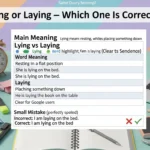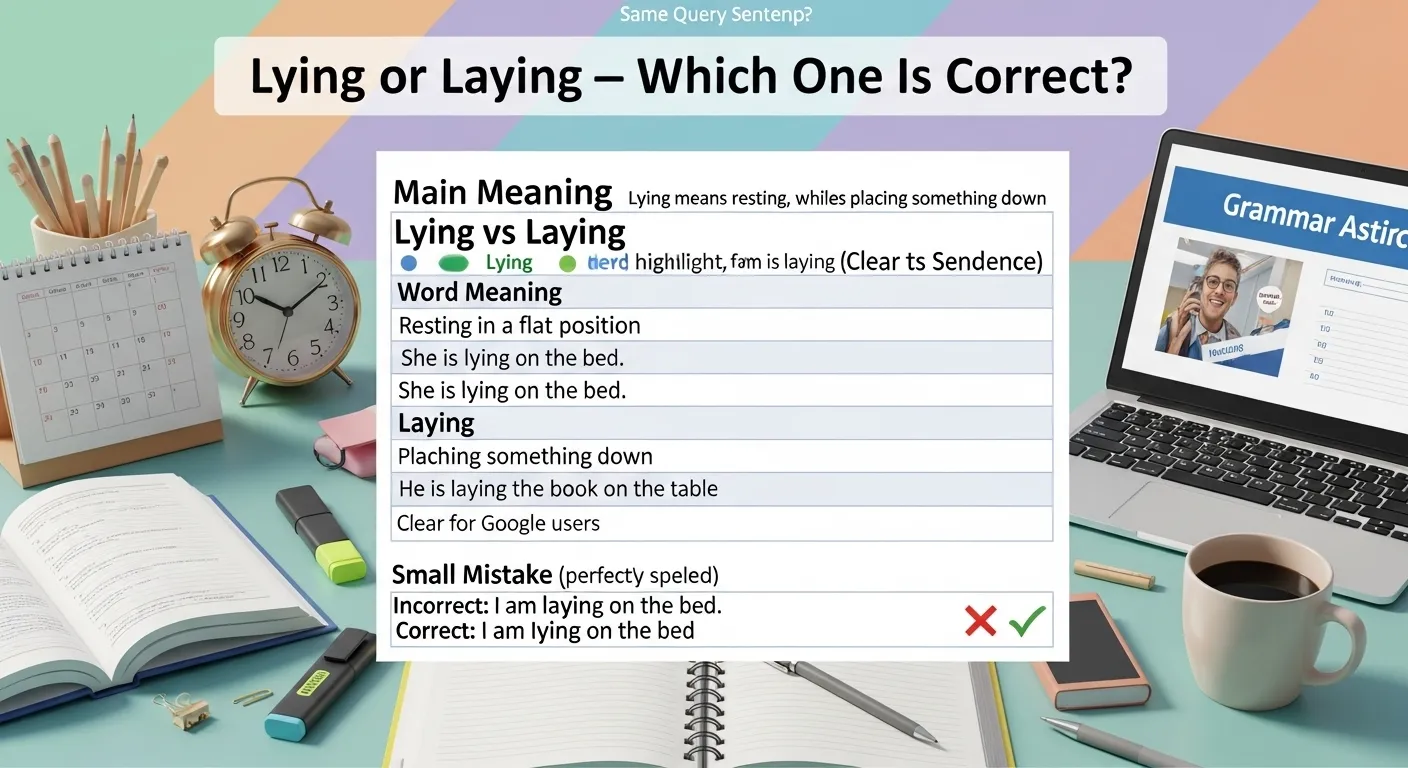
Lying means resting or being in a flat position, while laying means placing something down.
Many people search for “lying or laying” because the words sound very similar. They often appear in everyday conversation, but their grammar rules are different. Students frequently mix them up in essays, emails, and exams.
The confusion happens because both words come from the verb “lie,” yet they follow different patterns. Understanding when to use each form is important for clear and accurate writing.
This guide explains the meanings, origins, grammar rules, examples, common mistakes, and usage trends so you can confidently choose the correct word every time.
⚡ Lying vs Laying : Quick Answer
The difference is simple:
| Word | Meaning | Example |
| Lying | Resting in a flat position | She is lying on the bed. |
| Laying | Placing something down | He is laying the book on the table. |
Simple Rule
- Lying → no object needed
- Laying → needs an object
Example:
- I am lying on the sofa.
- I am laying the blanket on the sofa.
This quick rule solves most confusion.
📜 The Origin of Lying and Laying
The verbs “lie” and “lay” come from Old English.
Origin of “Lie”
“Lie” comes from Old English licgan, meaning “to rest or recline.”
Example:
- The dog lies on the floor.
Origin of “Lay”
“Lay” comes from Old English lecgan, meaning “to place something down.”
Example:
- Please lay the book on the table.
Over time, English kept both verbs, but their forms became confusing because their past tenses overlap.
🇬🇧🇺🇸 British English vs American English Spelling
There is no spelling difference between British and American English for these words.
| Word | British English | American English | Same? |
| Lying | Lying | Lying | Yes |
| Laying | Laying | Laying | Yes |
The grammar rules remain the same everywhere.
🌍 Which Form Should You Use?
Choosing between lying or laying depends on If the sentence has an object.
Use Lying
When someone is resting or reclining.
Example:
- The cat is lying on the sofa.
Use Laying
When someone is placing something somewhere.
Example:
- She is laying the keys on the table.
This rule works in all English-speaking regions.
❌ Common Mistakes with Lying or Laying
These verbs cause many grammar errors.
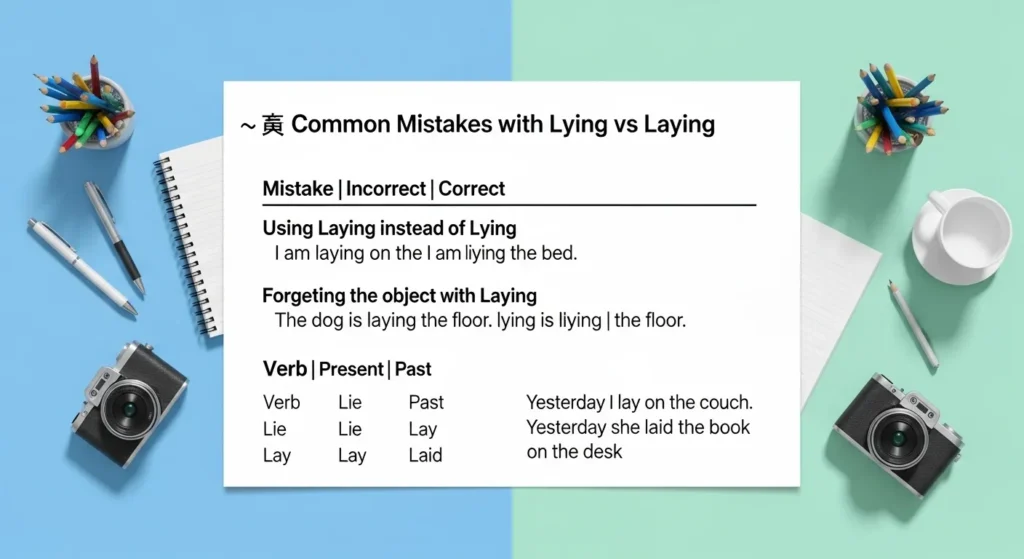
1. Using Laying Instead of Lying
Incorrect:
- I am laying on the bed.
Correct:
- I am lying on the bed.
2. Forgetting the Object with Laying
Incorrect:
- The dog is laying on the floor.
Correct:
- The dog is lying on the floor.
3. Confusing Past Tense Forms
Past tense creates additional confusion.
| Verb | Present | Past |
| Lie | Lie | Lay |
| Lay | Lay | Laid |
Example:
- Yesterday I lay on the couch.
- Yesterday she laid the book on the desk.
📘 Grammar Structure Explained
Understanding sentence structure helps avoid mistakes.
Lying (No Object)
Subject + lying + location
Example:
- He is lying on the grass.
Laying (Object Needed)
Subject + laying + object + location
Example:
- She is laying the towel on the chair.
The presence of an object is the key difference.
✍️ Laying or Lying in Everyday Examples
📧 Email Example
“I am lying down because I feel sick.”
📰 News Example
“The worker was laying bricks for the new building.”
📱 Social Media Example
“I am lying on the beach enjoying the sun.”
📄 Formal Writing Example
“The technician is laying cables across the field.”
Both forms appear in many types of writing.
📊 Lying or Laying: Google Trends & Usage Data
Search data shows that “lying or laying” is one of the most searched grammar topics.
Common search countries include:
- United States
- United Kingdom
- India
- Pakistan
English learners often struggle with these verbs because their forms overlap in the past tense.
Grammar teachers frequently use this example when teaching verb structure.
📋 Comparison Table: Lying vs Laying
| Word | Verb Type | Meaning | Example |
| Lying | Intransitive | Resting | She is lying on the sofa. |
| Laying | Transitive | Placing something | He is laying the book down. |
| Lie | Base verb | Rest | I lie down. |
| Lay | Base verb | Place | Lay the bag here. |
This table clearly shows how the verbs work.
🧠 Memory Tricks to Remember the Difference
Here are easy ways to remember.
Trick 1: Lay Needs an Object
Lay → place something
Example:
- Lay the phone on the table.
Trick 2: Lie Means Recline
Lie → body position
Example:
- I lie on the bed.
Trick 3: Think “Lay = Place”
If you place something somewhere, use “lay.”
📖 Advanced Usage in Sentences
Present Continuous
- She is lying on the couch.
- He is laying the tiles on the floor.
Past Tense
- Yesterday I lay on the beach.
- Yesterday she laid the book on the desk.
Future Tense
- I will lie down later.
- I will lay the documents on your desk.
Understanding verb forms improves accuracy.
🧾 Professional Writing Advice
In business writing:
Correct:
- The technician is laying cables for the network.
Incorrect:
- The technician is lying cables.
In descriptive writing:
Correct:
- The patient is lying on the hospital bed.
Using correct verbs improves clarity and professionalism.
🌎 Why This Confusion Happens
There are several reasons:
- The verbs sound similar.
- Their past tense forms overlap.
- Many speakers use them interchangeably in casual speech.
Because of this, even native English speakers sometimes make mistakes.
Learning the object rule helps solve the confusion.
❓ FAQs About Lying or Laying
1. What is the difference between lying and laying?
Lying means resting. Laying means placing something down.
2. Does laying need an object?
Yes. Laying always requires an object.
3. Can I say “I am laying on the bed”?
No. The correct sentence is “I am lying on the bed.”
4. What is the past tense of lie?
The past tense of lie is “lay.”
5. What is the past tense of lay?
The past tense of lay is “laid.”
6. Is this mistake common?
Yes. Many people confuse these verbs.
7. Is there a UK vs US difference?
No. The rules are the same in both systems.
🏁 Conclusion:
The difference between lying and laying is based on grammar structure. “Lying” means resting or being in a flat position, while “laying” means placing something somewhere.
The key rule is simple: laying always requires an object, while lying does not.This distinction is important for clear communication in both casual and professional writing.
Many learners confuse the words because they sound similar and their past tense forms overlap.
However, remembering the object rule makes the choice much easier.With practice, you can quickly recognize which verb fits your sentence.
Accurate grammar improves writing quality and helps avoid common mistakes. Now you can confidently use lying and laying correctly in everyday communication.
Discover More Articals!
Something to That Effect or Affect: Correct Usage Explained Simply
Used To or Use To: Meaning and Everyday Examples📚
📝That or Which: The Complete Guide to Using Them Correctly in English Writing

**Emily R. Dawson** I am a English language writer and editor i specializes in grammar clarity, sentence structure, and common writing mistakes.I focuses on helping readers write correct, natural-sounding English through simple explanations and practical examples. Emily mainly creates beginner-friendly and intermediate-level language guidesmy writing style is clear, supportive, and easy to follow.