Both spelledand speltare correct spellings.
That simple fact surprises many people. You see one version in books, another in emails, and a different one online.
This is why people search for “spelled or spelt.” They want a clear answer. They want to avoid mistakes.
The confusion happens because English is not one-size-fits-all. British English and American English follow different rules.
What looks wrong in one country is normal in another. Students worry about exams. Writers worry about editors.
Bloggers worry about content. This guide solves all of that. You will get a quick answer, clear rules, examples, tables, and expert advice. By the end, you will know exactly when to use spelled or spelt without guessing.
Spelled or Spelt: Quick Answer
Both spelled and spelt are correct past forms of the verb “spell.”
The difference depends on the type of English you use.
- American English:spelled
- She spelled my name wrong.
- She spelled my name wrong.
- British English:spelt (also spelled is accepted)
- He spelt the word correctly.
- He spelt the word correctly.
Simple Rule to Remember
- Writing for the USA → use spelled
- Writing for the UK → use spelt
- Writing for a global audience → spelled is safer
The Origin of Spelled or Spelt
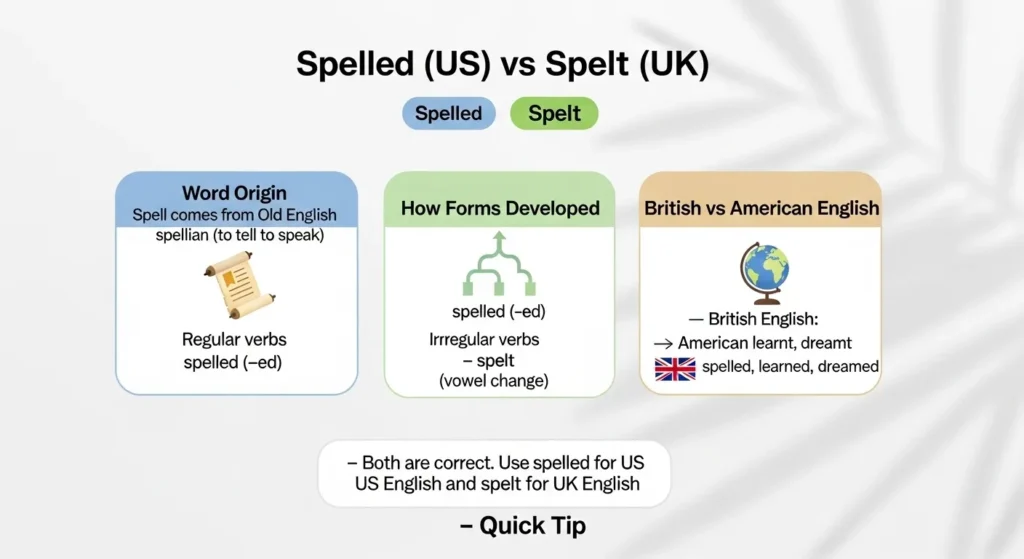
The verb spell comes from Old English spellian, which meant “to tell” or “to speak.” In early English, verbs often had two past forms.
Over time, English verbs changed in two ways:
- Regular verbs added -ed (spelled)
- Irregular verbs changed the vowel (spelt)
British English kept many irregular forms like:
- learnt
- dreamt
- spelt
American English simplified many of them:
- learned
- dreamed
- spelled
This is why both forms exist today. It is not a mistake. It is history.
British English vs American English Spelling
This is where most confusion happens.
Key Difference
- American English prefers regular verbs
- British English keeps older irregular forms
Examples
| Verb | American English | British English |
| spell | spelled | spelt / spelled |
| learn | learned | learnt |
| dream | dreamed | dreamt |
| burn | burned | burnt |
Spelled vs Spelt in Context
| Sentence | US Style | UK Style |
| Past tense | She spelled it wrong. | She spelt it wrong. |
| Past participle | He has spelled it correctly. | He has spelt it correctly. |
👉 Both are grammatically correct. Only the region changes.
Which Spelling Should You Use?
Your audience decides the answer.
1. If Your Audience Is American
Use spelled only.
- School exams
- US blogs
- American clients
✅ Correct: The word was spelled wrong.
2. If Your Audience Is British or Commonwealth
Use spelt or spelled.
But spelt sounds more natural.
- UK
- Australia
- New Zealand
- South Africa
✅ Correct: My name was spelt incorrectly.
3. If Your Audience Is Global
Use spelled.
Why?
- More widely understood
- Preferred by international style guides
🔹 Spelled or Spelt: Common Questions About Usage & Grammar
Many learners ask questions like spelled or spelt UK, spelt vs spelled grammar, should it be spelled or spelt, and is spelled or spelt correct. The answer is simple: both forms are correct, but usage depends on region.
In British English, both spelt and spelled are acceptable, but spelt is more common in everyday writing. In American English, only spelled is widely used.
Some commonly searched examples include:
- My name is spelled or spelt?
✔ US: My name is spelled John
✔ UK: My name is spelt John - Spelled or spelt wrong?
✔ US: You spelled it wrong
✔ UK: You spelt it wrong - Spelled out or spelt out (UK)?
✔ Both are correct, but “spelled out” is more common globally
Grammar tip:
Both forms work as past tense and past participle. The difference is only stylistic, not grammatical.
👉 Quick insight:
Searches like spelled vs spelt grammar, spelt grammar, and difference between spelt and spelled all point to the same rule region decides usage, not correctness.
Common Mistakes with Spelled or Spelt
Even native speakers make these errors.
❌1: Thinking One Is Wrong
- ❌ Spelt is incorrect.
- ✅ Both are correct.
❌ 2: Mixing Styles
- ❌ He spelt the word wrong in an American essay.
- ✅ Use spelled for US writing.
❌3: Using “Spelt” as a Noun
- ❌ I ate spelt bread and spelled rice.
- ✅ Spelt (noun) = a type of grain
- ✅ Spelled/Spelt (verb) = past of spell
❌ Mistake 4: Overthinking in Casual Writing
Emails and messages are flexible. Choose one style and stay consistent.
Spelled or Spelt in Everyday Examples
1. Emails
- You spelled my name wrong in the email. (US)
- You spelt my name wrong in the email. (UK)
2. News Writing
- The minister spelled out the new policy.
(Note: “spell out” almost always uses spelled globally.)
3. Social Media
- Did I spell that right?
- Oops, I spelt it wrong 😅
4. Academic & Formal Writing
- US journal → spelled
- UK journal → spelt
Consistency matters more than the choice.
Spelled or Spelt: Google Trends & Usage Data
Search data shows a clear pattern.
Popularity by Country
- United States: spelled dominates
- United Kingdom: spelt is more common
- India & Pakistan: spelled is more searched
- Australia: spelt slightly higher
Why “Spelled or Spelt” Is Trending
- ESL learners
- Online exams
- Grammarly suggestions
- Global content writing
People want quick clarity. This keyword solves that confusion.
Spelled or Spelt: Comparison Table
| Feature | Spelled | Spelt |
| Correct? | Yes | Yes |
| Used in American English | ✅ Yes | ❌ Rare |
| Used in British English | ✅ Yes | ✅ Common |
| Best for global | ✅ Yes | ⚠️ Limited |
| Formal writing | ✅ Yes | ✅ Yes (UK) |
| Informal writing | ✅ Yes | ✅ Yes |
🔹 Spelt vs Spelled in Different Countries (UK, US, Australia, NZ, Canada)
Search queries such as spelt or spelled UK, spelled or spelt Australia, spelt or spelled NZ, and spelled vs spelt Canada show that users want region-based clarity.
Here’s a simple breakdown:
- United States 🇺🇸
✔ Only spelled is standard - United Kingdom 🇬🇧
✔ Spelt is more common
✔ Spelled is also accepted - Australia 🇦🇺 & New Zealand 🇳🇿
✔ Prefer spelt, but both forms appear - Canada 🇨🇦
✔ Mixed usage (both spelled and spelt are used)
Examples:
- He spelled the word correctly. (US)
- He spelt the word correctly. (UK/AU/NZ)
👉 Important note:
Queries like is it spelt or spelled, spelled or spelt which is correct, and is spelt correct grammar all have the same answer:
✔ Both are correct
✔ Choose based on audience
✔ Stay consistent throughout your writing
FAQs: Spelled or Spelt
1. Is spelt grammatically correct?
Yes. It is correct in British English.
2. Can I use spelt in American English?
You can, but it sounds unusual. Spelled is better.
3. Which is correct: has spelled or has spelt?
Both are correct.
- US: has spelled
- UK: has spelt
4. Is spelt only British?
Mostly yes. It is also used in Australia and New Zealand.
5. Does Grammarly accept both?
Yes. Grammarly adjusts based on language settings.
6. Is spelt a food?
Yes. Spelt is also a type of grain. Context matters.
7. Which one should students use in exams?
Follow the exam board’s English style. US exams prefer spelled. UK exams prefer spelt.
Conclusion
The confusion around spelled or spelt is normal. English is a global language, and it changes by region. The good news is simple: both forms are correct. The key is knowing when and where to use them.
If you write for an American audience, spelled is the clear choice. It sounds natural and professional. If you write for a British or Commonwealth audience, spelt feels more local and familiar. In global writing, blogs,
content, and professional communication, spelled is usually the safest option.
Do not stress about being “wrong.” Focus on being consistent. Pick one style and stick to it. Editors, teachers, and readers care more about clarity than small regional differences.
Once you understand the rule behind spelled or spelt, you will never hesitate again. That confidence is what good English is really about.
Related posts!
Aluminum or Aluminium: Which Spelling Is Correct ?
Lying or Laying : Which One Is Correct?
Speak vs Talk: What’s the Difference?In 30 Seconds