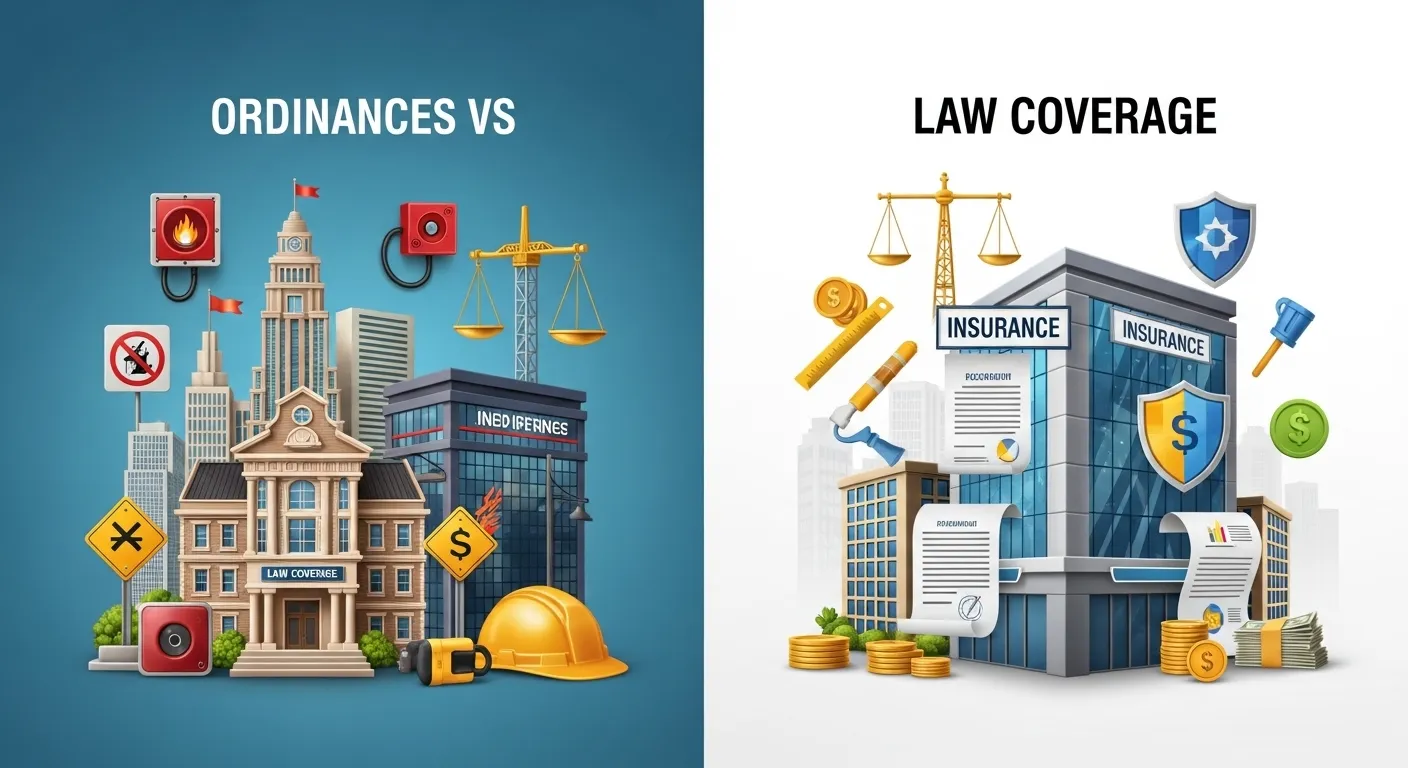
Ordinances are local laws, while law coverage is insurance that pays for costs caused by legal building rules.
Many property owners confuse ordinances or law coverage when reading insurance policies.
The words sound legal. They seem similar. But they are not the same. One is a government rule.
The other is protection inside an insurance plan. This confusion often appears after property damage. Owners discover extra costs they did not expect.
This guide explains the quick answer, clear definitions,common mistakes, and practical advice. By the end, you will clearly understand ordinances and law coverage.
🏛️ Ordinances or Law Coverage: Quick Answer
Ordinances are local government laws.
They control building rules.
They control safety codes.
Example: A city ordinance may require new fire alarms.
Law coverage (often called ordinance or law coverage) is insurance protection.
It helps pay extra costs when laws require upgrades after damage.
Example: If a storm damages your building, new codes may require updates. Law coverage helps pay for that.
One is a rule.
One is financial protection.
📘 Definition of Ordinances or Law Coverage
An ordinance is a law passed by a local government.
Cities and towns create them.
They apply within that area.
For example, the New York City Council passes city ordinances.
These rules may cover:
- Building codes
- Zoning laws
- Fire safety
- Environmental standards
Law coverage is part of property insurance.
It pays costs required by new laws after damage.
It does not create laws.
📖 The Origin of Ordinances and Law Coverage
The word “ordinance” comes from old French roots.
It means an official order or rule.
Local governments have passed ordinances for centuries.
They manage safety and order in communities.
Insurance law coverage developed later.
As building codes became stricter, rebuilding costs increased.
After disasters, owners discovered gaps in coverage.
Insurance companies introduced ordinance or law coverage to solve this issue.
Modern policies now include optional coverage sections.
🏗️ How Ordinances Work
Ordinances are legally binding.
They apply to everyone in the area.
For example:
- A city may require sprinkler systems.
- A town may limit building height.
- A region may require earthquake-resistant materials.
If a building is damaged, it must follow current rules.
Old buildings must upgrade to new standards.
That upgrade can be expensive.
🛡️ How Law Coverage Works
Law coverage helps pay extra costs.
It usually has three parts.
A: Pays for undamaged parts that must be demolished.
B: Pays demolition costs.
C: Pays increased construction costs due to new codes.
Without this coverage, insurance may only pay to restore old standards.
Example:
If your building was built in 1980 and damaged today, new codes may require upgrades.
Law coverage helps pay that difference.
📊 Ordinances vs Law Coverage: Comparison Table
| Feature | Ordinances | Law Coverage |
| Type | Local Law | Insurance Protection |
| Created By | Government | Insurance Company |
| Purpose | Regulate safety and construction | Pay extra rebuild costs |
| Applies To | Everyone in area | Policyholders only |
| Example | Fire safety rule | Pays cost of new sprinkler system |
This table shows the core difference clearly.
🏢 Real-Life Example
Imagine a building in Los Angeles.
A fire damages half the property.
Local ordinances require full electrical upgrades.
Insurance may cover fire damage only.
It may not cover the required upgrades.
If the owner has law coverage, the policy helps pay for code upgrades.
If not, the owner pays out of pocket.
This difference can mean thousands of dollars.
❌ Common Mistakes About Ordinances or Law Coverage
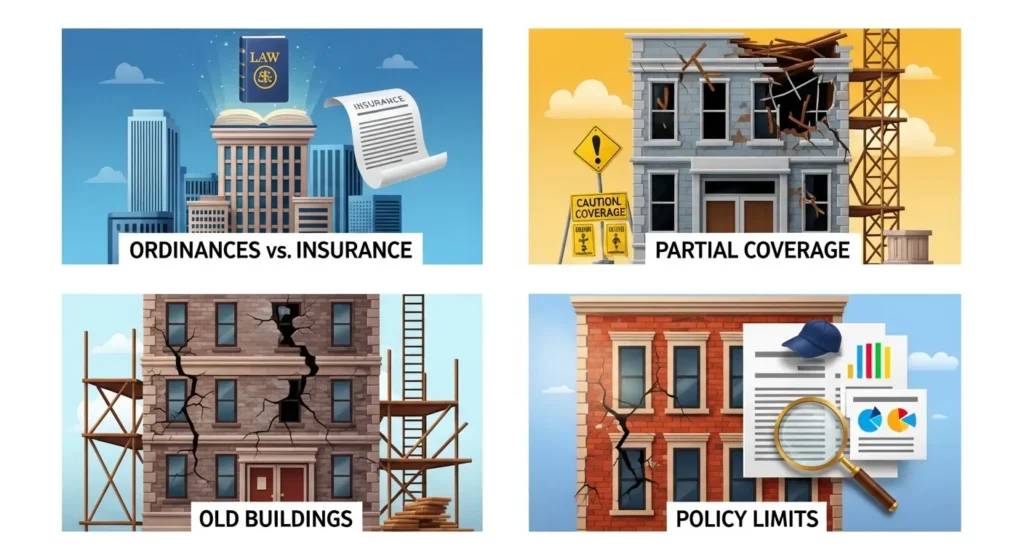
Mistake 1: Thinking ordinances are insurance policies.
Truth: They are government rules.
Mistake 2: Thinking standard insurance covers all code upgrades.
Truth: Many policies exclude upgrade costs.
Mistake 3: Ignoring older buildings.
Truth: Older buildings face higher upgrade risks.
Mistake 4: Not reading policy limits.
Law coverage often has limits.
Understanding policy details is critical.
🏠 Who Needs Law Coverage?
Property owners need it most.
This includes:
- Homeowners
- Landlords
- Commercial building owners
Older properties face higher risk.
Stricter codes increase upgrade costs.
Businesses in major cities may face higher ordinance demands.
Coverage reduces financial shock after disasters.
🌍 Why Ordinances Matter
Ordinances protect communities.
They improve safety.
They improve environmental standards.
Cities like Chicago update building codes often.
These updates save lives.
But they increase rebuilding costs.
That is why insurance protection matters.
💡 Key Differences in Simple Words
Ordinances tell you what you must do.
Law coverage helps you pay for it.
One creates obligation.
One reduces financial burden.
One is legal authority.
One is financial support.
Both connect after property damage.
❓ FAQs About Ordinances or Law Coverage
1. Are ordinances the same as laws?
Yes.
They are local laws.
2. Is law coverage mandatory?
Not always.
It depends on policy type and lender requirements.
3. Does homeowners insurance include it automatically?
Sometimes limited coverage is included.
Extra protection may cost more.
4. Why is it important for old buildings?
Old buildings may not meet modern codes.
Upgrades can be expensive.
5. Can businesses skip this coverage?
They can.
But risk increases without it.
6. Does law coverage apply without damage?
No.
It applies after covered damage occurs.
7. Who enforces ordinances?
Local government authorities enforce them.
🏁 Conclusion
Ordinances or law coverage may sound similar, but they are very different. Ordinances are local government laws.
They control how buildings are constructed, repaired, and maintained. Law coverage is insurance protection.
It helps pay extra costs when those laws require upgrades after damage. Without law coverage, property owners may face high out-of-pocket expenses.
This is especially true for older buildings. Ordinances improve safety and protect communities.
Law coverage protects your finances. Both become important after disasters like fire, storms, or earthquakes.
Understanding the difference helps you make smarter insurance decisions. Always review your policy carefully and ask about ordinance or law coverage before you need it.
Discover More Articals!
Tieing or Tying: Which Spelling Is Correct?

englifiy.com is my English grammar comparison website where I simplify confusing words, spelling differences, and usage rules through clear explanations and examples. My goal is to help learners, writers, and students understand English easily and use correct grammar with confidence.