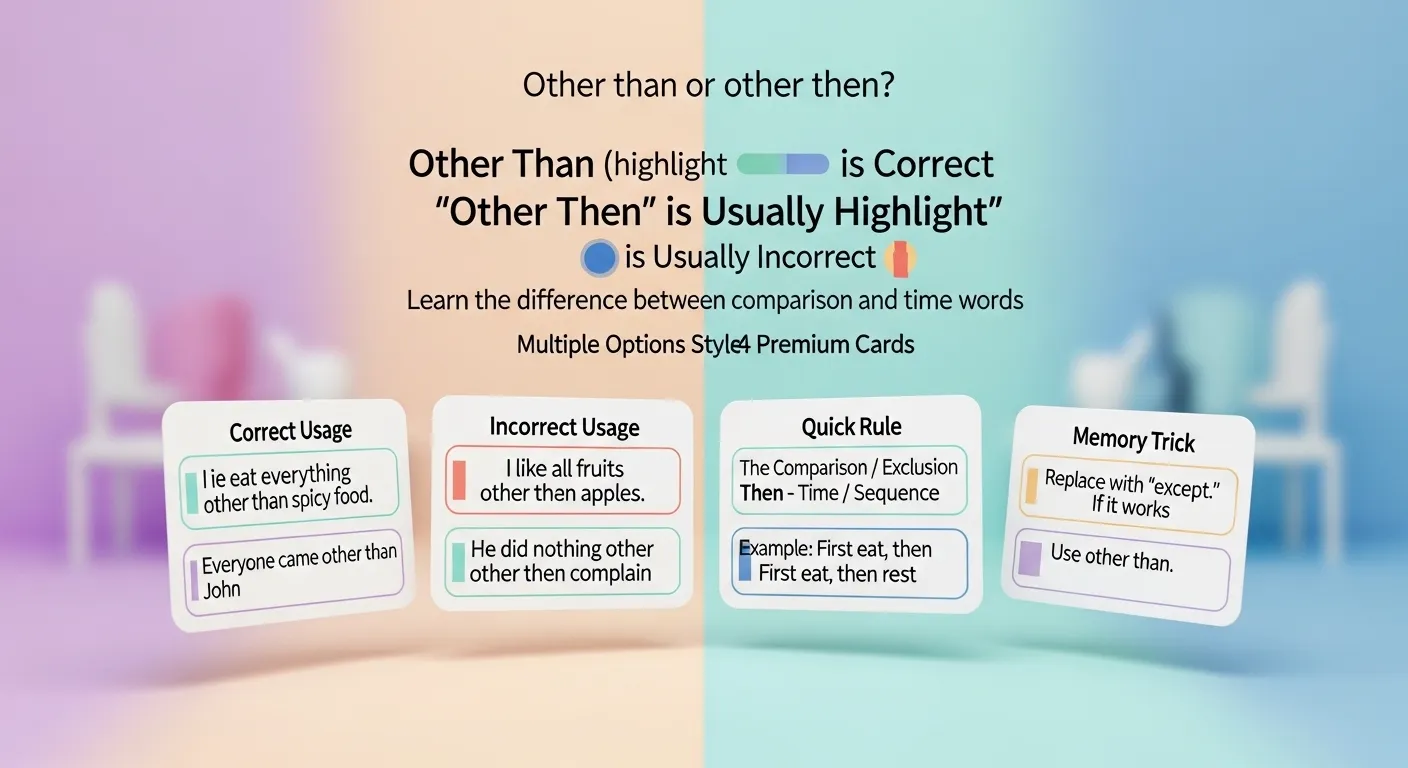
The correct phrase is “other than,” while “other then” is usually a mistake. Many writers feel confused when choosing between these two phrases because they look very similar and sound almost the same when spoken quickly.
This confusion appears often in emails, school writing, blogs, and social media posts. English has many words that differ by just one letter, and that small difference can change the meaning completely.
People search for this topic to avoid grammar mistakes and to write clearly and correctly. Understanding the difference between these phrases helps improve clarity, prevents misunderstandings, and makes your writing look more natural and professional in everyday communication.
Other Than or Other Then: Quick Answer
The quick rule is simple:
- ✅ Other than = correct phrase used for exceptions, comparisons, or exclusions.
- ❌ Other then = usually incorrect and considered a spelling or grammar mistake.
Examples:
- I eat everything other than spicy food.
- She visits every day other than Sunday.
- There was nothing to do other than wait.
In all these cases, “other than” means “except,” “apart from,” or “besides.”
Now look at incorrect examples:
- ❌ I like all fruits other then apples.
- ❌ He did nothing other then complain.
These should use “other than.”
The confusion happens because “then” is also a real word, but it has a different meaning. “Then” usually refers to time or sequence:
- First we ate dinner, then we watched a movie.
Remember this simple idea:
👉 Than = comparison or exclusion
👉 Then = time or sequence
The Origin of Other Than or Other Then
To understand the difference fully, it helps to look at the history of these words.
The word “than” comes from Old English and was used to compare things or show differences. Over time, it became a standard comparison word in English grammar.
Phrases like “more than,” “less than,” and “other than” became common because they clearly show contrast or exception.
The word “then,” on the other hand, also comes from Old English but relates to time. It means “at that moment,” “after that,” or “next.” Because both words sound similar when spoken quickly, writers sometimes confuse them while typing.
The phrase “other than” developed naturally as a way to express exclusion. For example:
- Everyone came other than John.
Here, it clearly shows that John is excluded.
Why do spelling differences happen? English evolved from many languages, including Germanic and Latin roots.
Some words kept similar sounds but developed different meanings. This is why “than” and “then” look alike but function differently.
Today, “other than” is fixed as the correct phrase for exceptions, while “other then” appears mostly as an error caused by sound similarity.
British English vs American English Spelling
Unlike many English words that change spelling between regions, “other than” does not change between British and American usage. Both regions use the same form.
Here is a simple comparison:
| Aspect | British English | American English |
| Correct phrase | Other than | Other than |
| Meaning | Exception or exclusion | Exception or exclusion |
| “Other then” usage | Considered incorrect | Considered incorrect |
| Spoken pronunciation | Similar | Similar |
Even though pronunciation differences exist across regions, the written form remains the same. This makes the rule easier to remember because you do not need to adjust spelling based on location.
Some learners assume “other then” might be accepted somewhere because many English words vary across regions.
However, this phrase does not follow that pattern. Across academic writing, journalism, and daily communication, “other than” is the accepted form.
Which Spelling Should You Use?
Choosing the correct phrase depends less on geography and more on grammar rules.
For readers in the United States
Use “other than” in all contexts involving comparison or exclusion. American writing guides treat “other then” as incorrect.
For readers in the United Kingdom and Commonwealth countries
The same rule applies. British style guides also accept only “other than.”
For global communication
Using “other than” ensures clarity across audiences. Since English is used worldwide, sticking to the standard form prevents confusion.
Simple advice:
- Writing emails → use “other than.”
- Writing school assignments → use “other than.”
- Posting on social media → use “other than.”
- Professional or formal writing → always use “other than.”
When in doubt, replace the phrase with “except.” If the sentence still makes sense, “other than” is the correct choice.
Example:
- Everyone joined other than Sarah.
- Everyone joined except Sarah.
Both mean the same thing.
Common Mistakes with Other Than or Other Then
Many errors come from mixing up sound and spelling.
1. Using “then” instead of “than”
❌ I enjoy all sports other then football.
✅ I enjoy all sports other than football.
2. Confusing time with comparison
Remember:
- “Then” = time or order
- “Than” = comparison or exclusion
3. Autocorrect mistakes
Sometimes typing quickly leads to the wrong word. Always double-check before sending important messages.
4. Spoken language influence
When people speak quickly, the difference between “than” and “then” may sound small. This leads to incorrect spelling in writing.
5. Overthinking grammar rules
Some learners believe both are acceptable options, but only one works in this context.
Other Than or Other Then in Everyday Examples
Understanding real-life examples makes learning easier.
Emails
- Please contact me on any day other than Friday.
- I have no questions other than one small detail.
News writing
- The policy affects all regions other than coastal areas.
- No candidates other than the current leader applied.
Social media
- I listen to every genre other than heavy metal.
- Nothing changed other than the color scheme.
Formal writing
- No method other than testing produced accurate results.
- The committee accepted all proposals other than two.
Casual conversation
- I eat everything other than mushrooms.
- She reads every genre other than horror.
These examples show how common the phrase is in daily language.
Other Than or Other Then: Google Trends & Usage Data
Usage patterns show that “other than” is widely used across English-speaking countries. It appears frequently in online searches because learners want confirmation about correct grammar.
Countries with high usage include:
- United States
- United Kingdom
- Canada
- Australia
- India and Pakistan
In academic writing and news sources, “other than” appears consistently. Meanwhile, “other then” shows up mostly in informal posts or typing mistakes.
Common contexts where people search for this topic:
- Writing emails or assignments
- Editing professional documents
- Preparing exams
- Improving language skills
This shows that many learners actively look for clear guidance on this topic.
Comparison Table: Keyword Variations
| Phrase | Correctness | Meaning | Example |
| Other than | ✅ Correct | Exception or exclusion | Everyone came other than Alex |
| Other then | ❌ Incorrect | Grammar mistake | Not recommended |
| Than | ✅ Correct | Comparison word | Taller than me |
| Then | ✅ Correct | Time or sequence | First eat, then rest |
FAQs
1. Is “other then” ever correct?
In standard English, it is treated as an error when used instead of “other than.”
2. Why do people confuse these phrases?
They sound similar when spoken quickly, which causes spelling mistakes.
3. Can “other than” mean “except”?
Yes. It often works as a replacement for “except.”
4. Is this difference important in formal writing?
Yes. Using the wrong word can make writing look careless.
5. Do British and American writers use different forms?
No. Both use “other than.”
6. How can I remember the rule easily?
Think: comparison uses “than.” Time uses “then.”
7. Can I replace “other than” with “besides”?
Sometimes, but check the meaning carefully because tone may change.
Conclusion
Understanding the difference between “other than” and “other then” is simple once you learn the core rule.
“Other than” is the correct phrase used to show exception, exclusion, or comparison, while “other then” is usually a mistake caused by sound similarity.
English includes many words that look alike but serve different roles, so focusing on meaning helps avoid confusion.
A good strategy is to replace the phrase with “except” and see if the sentence still works. If it does, “other than” is the right choice.
This rule applies across different regions and writing styles, making it easy to follow in daily communication.
Paying attention to small details like this improves clarity, builds confidence, and makes your writing easier to understand.
With regular practice and careful proofreading, choosing the correct form becomes natural and automatic, helping you communicate clearly in both casual and formal situations.
Related More Posts!
Addendums or Addenda: Which One Is Correct?
Highschool or High School: Meaning, Examples, and Complete Guide✨
Til or Till: Meaning, and Simple Guide✨

I am Oliver H. Grant. I am a English language writer and editor my focuses on grammar, word usage, and common English mistakes.
I specializes in explaining the differences between British and American English in a clear and practical way.
my writing style is simple, learner-friendly, and designed to help readers understand English with ease.
My work is also SEO-focused, making it especially useful for online learners and readers.