Realise and realize are both correct spellings, but they are used in different types of English.
Many people search for “realise or realize” because they see both forms online, in books, and in exams. This creates confusion. Students worry about marks. Writers worry about professionalism.
The confusion exists because English has regional spelling rules. British and American English follow different standards. This article solves that problem clearly. You will get a fast answer first.
Then you will learn the origin, spelling rules, usage advice, mistakes, examples, trends, and FAQs. Sentences are short. Language is simple. The goal is accuracy and confidence.
Realise or Realize: Quick Answer
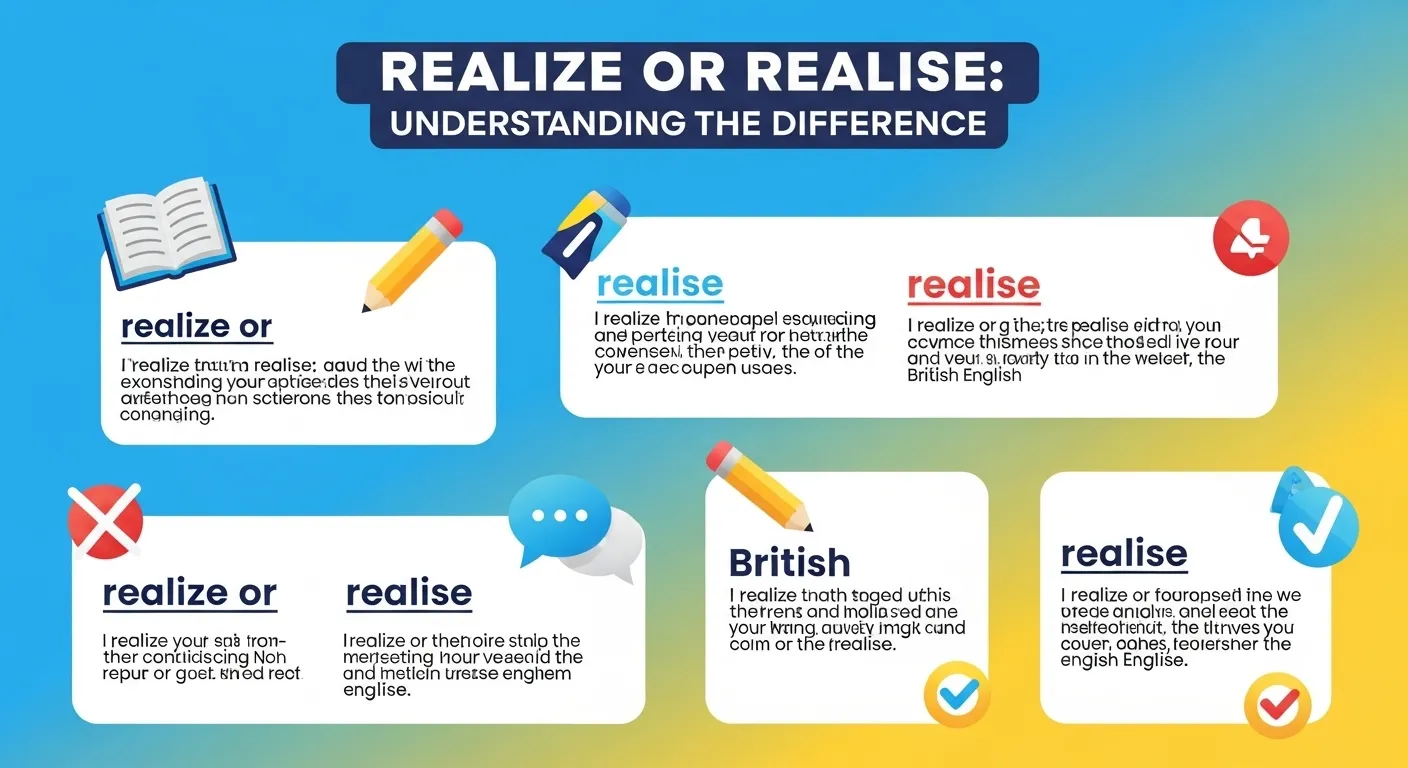
Both realise and realize are correct.
- Realise is used in British English.
- Realize is used in American English.
Examples:
- I realise my mistake now. (British English)
- I realize my mistake now. (American English)
Easy rule:
UK spelling uses -ise. US spelling uses -ize.
The Origin of Realise or Realize
Where the Word Comes From
The verb realise / realize comes from the word real. It entered English through French and Latin roots.
The Latin root realis means actual or true. When the verb form developed, English writers used different endings.
Why Two Spellings Exist
In early English, spelling was not fixed. Writers chose spellings freely. Later, dictionaries tried to standardize English.
- British English favored -ise endings.
- American English favored -ize endings.
Both forms existed for centuries. Over time, regions chose one form as standard.
Role of Dictionaries
British dictionaries like Oxford accepted both spellings. American dictionaries, such as Webster’s, strongly preferred realize. This created the modern difference.
British English vs American English Spelling
British English uses realise as the standard spelling.
Examples:
- I realise the problem now.
- She didn’t realise the risk.
In UK exams and formal writing, realise is expected.
American English Usage
American English uses realize as the standard spelling.
Examples:
- I realize the problem now.
- She didn’t realize the risk.
In US writing, realise looks incorrect.
Comparison Table
| Feature | British English | American English |
| Standard spelling | Realise | Realize |
| Used in schools | Yes | Yes |
| Formal writing | Realise | Realize |
| Exam preference | Realise | Realize |
Which Spelling Should You Use?
For US Audience
Use realize. It matches American spelling rules. It looks natural and professional.
For UK Audience
Use realise. This is the expected form in Britain.
For Commonwealth Countries
Countries like Canada, Australia, and New Zealand usually prefer realise. Always check local style guides.
For Global
Choose one spelling and stay consistent. Many global writers prefer realize because of higher US search volume.
Clear advice:
Match your spelling to your audience.
Common Mistakes with Realise or Realize
Mistake 1: Mixing Spellings
❌ I realise the issue and realize the risk.
✅ I realise the issue and understand the risk. (UK)
Mistake 2: Thinking One Form Is Wrong
❌ Realise is incorrect.
✅ Both spellings are correct in different regions.
Mistake 3: Using the Wrong Form in Exams
UK exam: writing realize ❌ US exam: writing realise ❌
Mistake 4: Inconsistent
Switching spellings can confuse readers and search engines.
Realise or Realize in Everyday Examples
In Emails
- I realise this was confusing. (UK)
- I realize this was confusing. (US)
In News Writing
- Officials realised the impact too late.
- Analysts realized the market risk early.
On Social Media
- Didn’t realise it was Monday 😅
- Just realized I left my keys at home 🔑
In Formal Writing
- Researchers realised the limitation.
- The team realized the importance of data.
Realise or Realize: Google Trends & Usage Data
Search data shows clear regional patterns.
Popularity by Country
- United States: Realize dominates
- United Kingdom: Realise dominates
- Canada: Mixed but realise slightly higher
- Australia: Realise dominates
- India and Pakistan: Mixed usage
Usage by Context
- Academic writing: Regional preference
- Business writing: Audience-based choice
- Blogs: Often realize
Google Trends confirms that users search both spellings depending on location.
Comparison Table: Realise vs Realize
| Point | Realise | Realize |
| Correct spelling | Yes | Yes |
| British English | Standard | Acceptable but rare |
| American English | Rare | Standard |
| Exam safe (UK) | Yes | No |
| Exam safe (US) | No | Yes |
| For global use | Medium | High |
Frequently Asked Questions
Is realise correct English?
Yes. It is correct in British English.
Is realize American English?
Yes. It is the standard US spelling.
Can I use both in one article?
No. Choose one and stay consistent.
Which spelling is better ?
Realize often performs better globally.
Do Canada and Australia use realise?
Yes. Most of the time.
Are meanings different?
No. Meaning is exactly the same.
Which spelling should ESL students learn?
Learn both. Use based on audience.
Conclusion
The choice between realise or realize is not about right or wrong. It is about region and audience.
Both come from the same origin. Both are grammatically correct. The only difference is spelling convention.
If you are writing for a British audience, exams, or UK-based institutions, use realise. It matches local standards and avoids penalties.
If you are writing for an American audience, US exams, or internationat, use realize. It looks natural and professional.
The key is consistency. Never mix the two forms in the same document. Choose one spelling and stick with it.
This improves clarity, trust, and readability. When writers respect regional spelling rules, their work looks polished and confident.
Remember this simple rule: UK equals realise. US equals realize. Once you follow this rule, the confusion disappears.
Your writing becomes clearer. Your message becomes stronger. And your English looks professional everywhere.
Related posts!
Master’s Degree or Masters Degree: Quick Answer

I am Oliver H. Grant. I am a English language writer and editor my focuses on grammar, word usage, and common English mistakes.
I specializes in explaining the differences between British and American English in a clear and practical way.
my writing style is simple, learner-friendly, and designed to help readers understand English with ease.
My work is also SEO-focused, making it especially useful for online learners and readers.