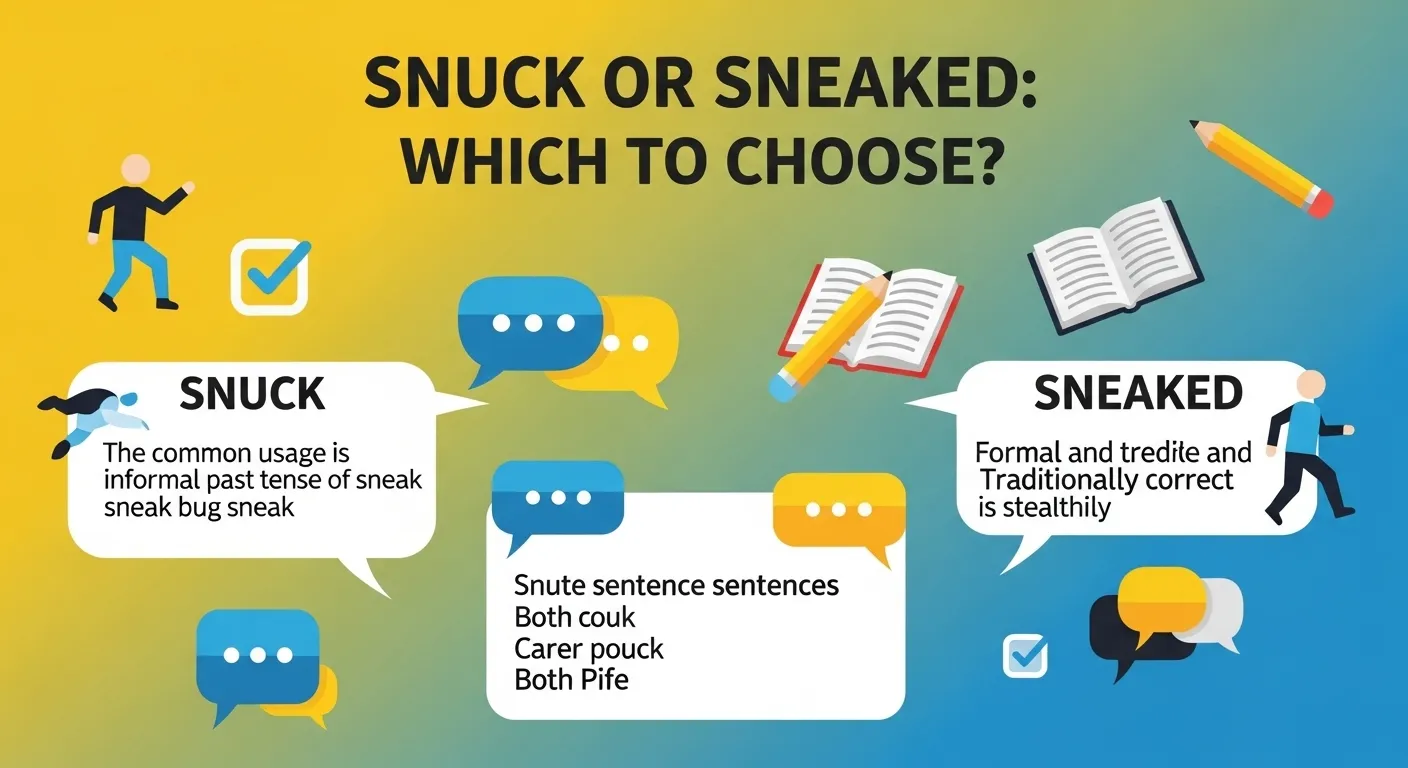
Both snuck and sneaked are correct past tense forms of sneak.
Many people search for “snuck or sneaked” because they are unsure which to use in speaking, writing, emails, or exams. The confusion comes from the irregular nature of English verbs.
Some verbs have standard past tense forms, others have alternative forms. Sneak is one of those verbs.
Over time, English speakers developed snuck in informal speech, while sneaked remained standard in formal contexts.
This article explains the difference, origin, regional usage, examples, mistakes, trends, and clear guidance. By the end, you will confidently know when to use snuck and when to use sneaked.
Snuck or Sneaked – Quick Answer
- Sneaked is the traditional past tense and past participle ✅
- Snuck is informal but widely accepted in modern English ✅
Examples:
- He sneaked out of the room quietly. (formal)
- She snuck into the party without anyone noticing. (informal)
Simple rule:
Use sneaked for formal writing. Snuck is common in spoken English and informal writing.
The Origin of Snuck or Sneaked
Word History
The verb sneak comes from Old English snīcan, meaning “to creep” or “move quietly.” Over centuries, its forms evolved.
Development of Snuck
Snuck first appeared in American English in the late 19th century. It spread quickly in informal speech. Literature and journalism gradually adopted it, though formal writing still prefers sneaked.
Reason for Confusion
English has many irregular verbs with alternative forms. Snuck feels irregular compared to regular verbs like walked or jumped.
Writers often hesitate because snuck sounds informal, even though it is widely understood.
British English vs American English Usage
British English
- Sneaked is preferred
- Formal contexts: reports, essays, newspapers
Example:
- He sneaked past the teacher without being noticed.
American English
- Snuck is widely used in informal speech
- Sneaked still preferred in formal writing
Example:
- The dog snuck into the kitchen while no one was watching.
Comparison Table
| Feature | British English | American English |
| Preferred Past Tense | Sneaked | Sneaked (formal), Snuck (informal) |
| Common Usage | Newspapers, essays | Speech, casual writing |
| Meaning | Same | Same |
Which Form Should You Use?
- Formal Writing: Always use sneaked
- Informal Writing / Speech: snuck is acceptable
- Exams: Use sneaked unless the context allows informal English
Tip:
Consistency is key. Stick to one form per document.
Common Mistakes with Snuck or Sneaked
Mistake 1: Mixing Forms
❌ He sneaked in and snuck out. ✅ Use one consistent form
Mistake 2: Using Snuck in Formal Writing
❌ The committee snuck in a vote. ✅ The committee sneaked in a vote.
Mistake 3: Assuming Snuck is Wrong
❌ Snuck is incorrect. ✅ Snuck is widely accepted in informal English.
Mistake 4: Overgeneralization
❌ Snuck is correct for all verbs. ✅ Only for sneak.
Snuck or Sneaked in Everyday Examples
Emails
- He sneaked out of the office early. (formal)
- She snuck in without anyone noticing. (informal)
News Writing
- The cat sneaked past the dog. (formal)
Social Media
- I snuck a cookie from the jar. (informal)
Formal Writing
- The inspector sneaked a glance at the report.
Snuck or Sneaked – Google Trends & Usage Data
Popularity
- Snuck has grown in American informal writing
- Sneaked dominates in formal writing and UK English
Usage Context
- Literature: mostly sneaked
- Journalism: sneaked preferred
- Social media and blogs: snuck common
Comparison Table
| Aspect | Sneaked | Snuck |
| Correct | Yes | Yes (informal) |
| Region | UK & US formal | US informal |
| Usage | Formal | Informal / Speech |
| Acceptance | High | Growing |
FAQs
Is snuck correct?
Yes. It is accepted in informal English.
Is sneaked correct?
Yes. It is the traditional past tense, especially for formal writing.
Which form should I use in essays?
Use sneaked unless informal style is allowed.
Is snuck only American English?
Mostly, but it is understood worldwide.
Do both forms have the same meaning?
Yes. Both indicate past action of sneaking.
Can I use snuck in exams?
Depends on rules; formal writing usually requires sneaked.
Is snuck a modern invention?
It appeared in the 19th century and became common in informal speech.
Extended Usage Notes
Learning to use snuck and sneaked correctly requires understanding context. Sneaked remains the safe choice for all formal writing, academic work, and professional reports. It is the preferred form in the UK and for exams.
Snuck appears often in casual speech, social media, blogs, and informal emails, particularly in the US.
While some people still consider snuck nonstandard, it has gained acceptance over the years. Writers should remember that pronunciation is the same, but spelling changes based on formality and region.
To avoid mistakes, pick one form and use it consistently throughout a document. Practicing with sentences, reading English texts from your target region, and noting examples of usage helps learners internalize the rules.
Over time, choosing the correct form becomes automatic, and the confusion between snuck and sneaked diminishes.
This attention to detail improves both confidence and credibility in writing. Understanding these patterns allows English learners and native speakers alike to communicate clearly and professionally, If in formal writing or casual conversation.
Conclusion
The choice between snuck or sneaked depends on formality and audience. Sneaked is traditional and preferred in formal and UK English. Snuck is widely accepted in American informal speech.
Both forms mean the same. Consistency is important in writing. Use sneaked in reports, essays, and exams.
Use snuck in casual conversation, emails, or social media. Understanding the context ensures proper usage. Once the rule is clear, choosing between snuck and sneaked becomes easy and natural.
Discovers more posts!