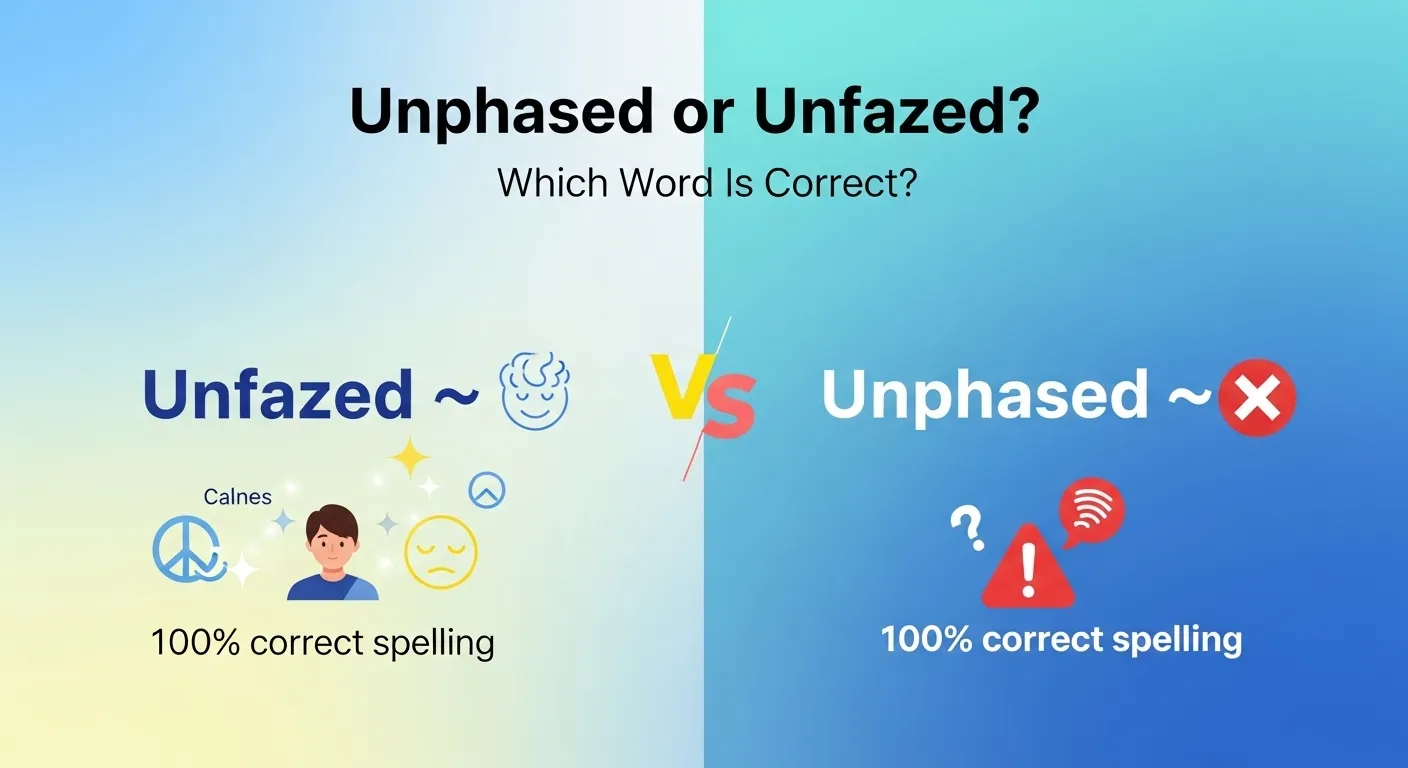
Unfazed is correct. Unphased is incorrect in most situations.
Many people search for “unphased or unfazed” because both spellings look similar. The words sound the same when spoken.
This creates confusion in writing. Social media posts often use the wrong spelling. Students also mix them in essays.
The mistake is common in professional emails too. This article explains the difference clearly.
You will learn the correct spelling, meaning, origin, common mistakes, and usage examples. By the end, you will confidently use unfazed the right way.
⚡ Unphased vs Unfazed: Quick Answer
✅ What Does Unfazed Mean?
Unfazed means not disturbed.
It means not worried.
It means not affected.
Examples:
- She was unfazed by criticism.
- He remained unfazed during the storm.
- The athlete stayed unfazed under pressure.
Unfazed describes calm behavior.
❌ What About Unphased?
Unphased is usually incorrect.
It is a spelling mistake.
Some people think it relates to the word “phase.”
But in this case, that is wrong.
In almost all situations, you should use unfazed.
🧠 Simple Memory Trick
Fazed comes from “faze.”
Faze means to disturb.
Unfazed means not disturbed.
If someone is calm, they are unfazed.
📜 The Origin of Unfazed
📖 Where Does Faze Come From?
The word “faze” appeared in English in the 1800s.
It means to disturb or upset.
Example:
Nothing fazes her.
Add “un” to show the opposite.
Unfazed means not disturbed.
🔤 Why People Write Unphased
People connect the sound to “phase.”
Phase means stage or step.
Example:
The project entered a new phase.
Because unfazed sounds like “unphased,” writers add “ph” by mistake.
It is a spelling error.
🇬🇧 British English vs American English
🌍 Is There a Spelling Difference?
No.
Both British and American English use unfazed.
Unphased is incorrect in both.
📊 Comparison Table
| Word | Correct? | Meaning | Example |
| Unfazed | ✅ Yes | Not disturbed | She was unfazed. |
| Unphased | ❌ No | Incorrect spelling | Incorrect usage |
| Phase | ✅ Yes | Stage or step | New project phase |
| Faze | ✅ Yes | To disturb | Nothing fazes him |
The rule is the same worldwide.
📝 Which Spelling Should You Use?
🎯 Always Use Unfazed
Use unfazed in:
- Essays
- Emails
- Reports
- Social media
- News writing
Do not use unphased unless you are actually talking about phases.
📧 Business Example
Correct: She remained unfazed during the meeting.
Wrong: She remained unphased during the meeting.
Professional writing requires accuracy.
🎓 Academic Writing
Correct grammar improves grades.
Unfazed is the only correct spelling.
Spell check tools sometimes miss context.
Always double-check manually.
⚠️ Common Mistakes with Unphased or Unfazed
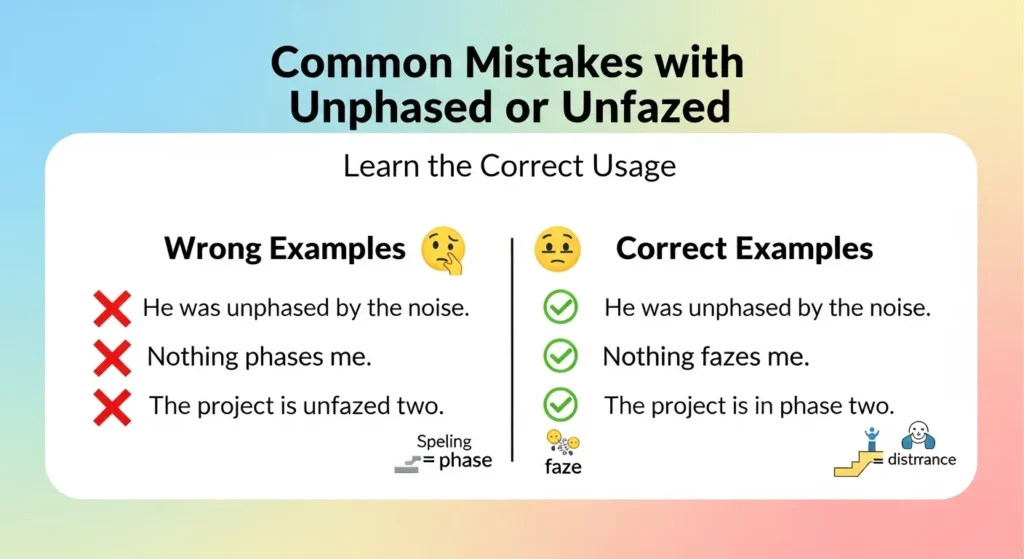
❌ Mistake 1: Adding “ph”
Wrong: He was unphased by the noise.
Correct: He was unfazed by the noise.
❌ Mistake 2: Confusing Phase and Faze
Wrong: Nothing phases me.
Correct: Nothing fazes me.
Phase = stage.
Faze = disturb.
❌ Mistake 3: Using It in Wrong Context
Wrong: The project is unfazed two.
Correct: The project is in phase two.
Understand meaning before writing.
🖊️ Unphased and Unfazed in Everyday Examples
📱 Social Media
“She stayed unfazed by negative comments.”
📰 News Writing
“The leader appeared unfazed by criticism.”
📄 Formal Writing
“The company remained unfazed despite losses.”
💬 Conversation
Friend: Aren’t you nervous?
You: No, I’m unfazed.
Context clearly shows calmness.
📊 Unfazed or Unphased: Search Trends & Popularity
Many people search this keyword monthly.
It is a common spelling mistake.
Popular searches include:
- unphased meaning
- unfazed definition
- is unphased correct
- unfazed sentence example
Top countries searching:
- United States
- United Kingdom
- Canada
- Australia
- India
Most confusion happens in online writing.
📊 Side-by-Side Comparison Table
| Feature | Unfazed | Unphased |
| Correct spelling | Yes | No |
| Meaning | Not disturbed | Spelling mistake |
| Related word | Faze | Phase |
| Used in formal writing | Yes | No |
| Common online error | Rare | Very common |
This table makes the difference clear.
🧠 Extra Memory Tricks
🔹 Trick 1: Faze Means Fear
Faze = disturb.
Unfazed = not disturbed.
🔹 Trick 2: Phase Has “PH”
Phase relates to stage.
Project phase.
Life phase.
If you mean calmness, never use PH.
🔹 Trick 3: Replace Test
Replace unfazed with “calm.”
If it fits, use unfazed.
Example:
She was calm during pressure.
She was unfazed during pressure.
Correct.
❓ FAQs: Unphased or Unfazed
1️⃣ Is unphased a real word?
No.
It is a spelling mistake.
2️⃣ What does unfazed mean?
It means not disturbed or not affected.
3️⃣ Why do people write unphased?
Because it sounds like phase.
4️⃣ Is there a regional difference?
No.
Both UK and US use unfazed.
5️⃣ How do you pronounce unfazed?
It sounds like “un-fayzd.”
6️⃣ Can spell check catch unphased?
Not always.
Manual proofreading is important.
7️⃣ Which is correct: Nothing phases me or Nothing fazes me?
Correct: Nothing fazes me.
🎯 Why Correct Spelling Matters
Small spelling errors reduce credibility.
Professional writing requires accuracy.
Academic writing demands precision.
Online readers notice mistakes.
Correct spelling builds trust.
It improves clarity.
It strengthens communication.
Using unfazed correctly shows attention to detail.
✅ Conclusion
In conclusion, unfazed is the correct spelling. It means not disturbed or not affected. Unphased is usually a spelling mistake.
The confusion happens because unfazed sounds like phase. However, faze means to disturb.
When someone remains calm, they are unfazed. The spelling does not change in British or American English. The rule is simple and universal.
Always check meaning before writing. If you mean calm or not worried, use unfazed. If you mean stage or step, use phase.
Small spelling accuracy improves professional writing. It strengthens academic work and online content.
With practice, the correct form becomes natural. Understanding this difference ensures confident and error-free communication every time.
Discover More Posts!
Worshipping or Worshiping: Spelling Difference.In(2026)
May vs Might: What Is the Difference?In 30 Seconds

**Emily R. Dawson** I am a English language writer and editor i specializes in grammar clarity, sentence structure, and common writing mistakes.I focuses on helping readers write correct, natural-sounding English through simple explanations and practical examples. Emily mainly creates beginner-friendly and intermediate-level language guidesmy writing style is clear, supportive, and easy to follow.