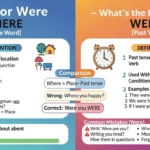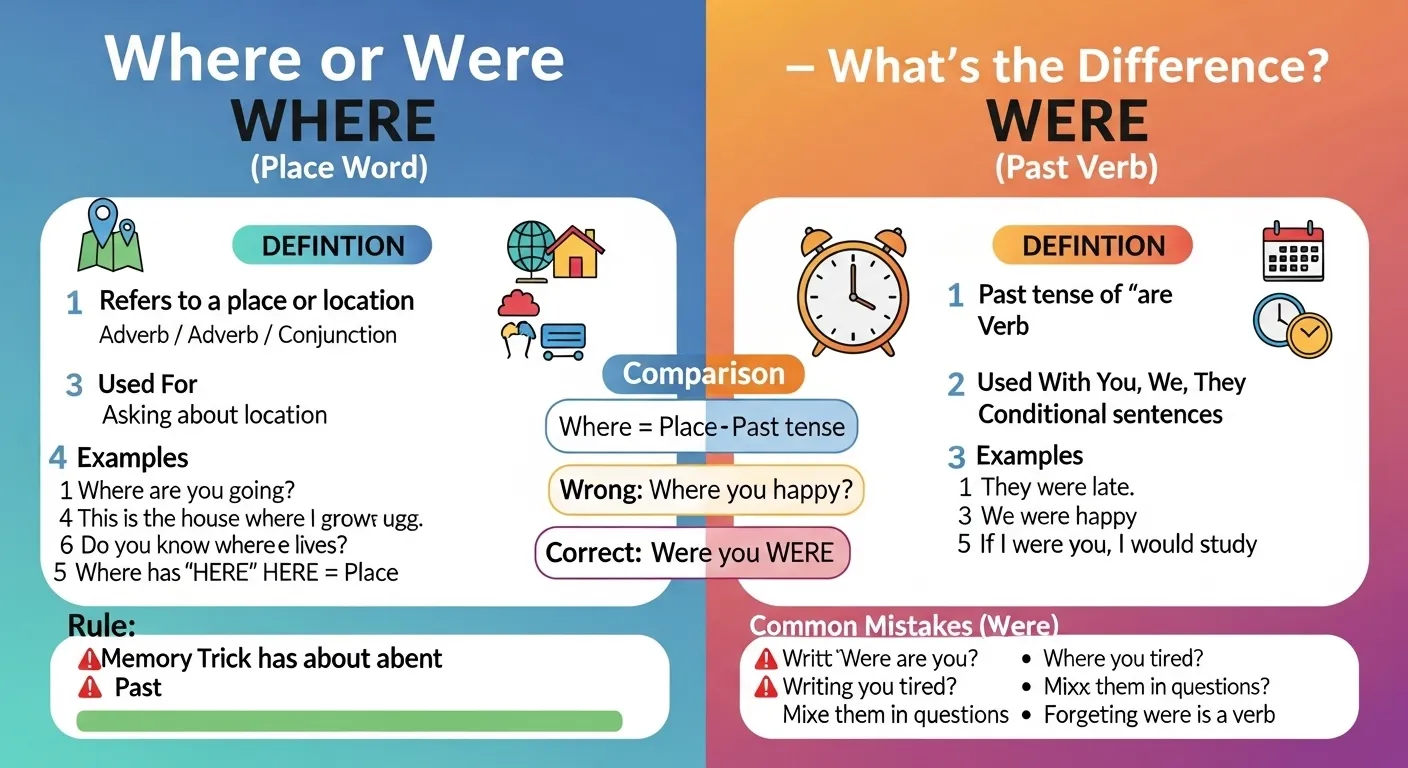
“Where” is about place. “Were” is a past tense verb.
Many people confuse these two words because they sound similar. This mistake is common in texts, emails, exams, and social media posts.
You may have seen sentences like “Where you at the party?” or “I don’t know were she lives.” These errors look small, but they change meaning. This article solves that confusion.
You will learn the quick answer, the origin of both words, grammar rules, usage examples, common mistakes, and writing tips. By the end, you will never mix up where and were again.
📍 Where: Quick Answer
Where is a question word. It talks about a place or location.
It asks about position.
Examples:
- Where are you going?
- Where is my phone?
- Do you know where she lives?
“Where” often starts a question.
It can also join two clauses.
Example:
- This is the house where I grew up.
Here, “where” connects ideas.
It still shows location.
Simple rule:
If you can replace the word with “at what place,” use where.
🕰️ where or were: Quick Answer
Were is a verb.
It is the past tense of “are.”
It is used with plural subjects.
Examples:
- They were happy.
- We were late.
- You were right.
“Were” also appears in unreal situations.
Example:
- If I were rich, I would travel the world.
This is called the subjunctive form.
It shows imagination or a wish.
Simple rule:
If the word shows past action or state, use were.
📖 Definition of Where and Were
Where is an adverb or conjunction.
It refers to place or position.
It answers the question “at what place?”
It connects clauses about location.
Were is a verb.
It is the past tense of “are.”
It agrees with plural subjects and “you.”
One word shows place.
The other shows past time.
They are not interchangeable.
🏛️ The Origin of Where and Were
Where comes from Old English “hwær.”
It meant “in what place.”
It has always related to location.
Over time, spelling changed slightly.
But the meaning stayed the same.
It always focused on place.
Were comes from Old English “wǣron.”
It was the past form of “be.”
It described a state in the past.
English grammar changed over centuries.
But “were” stayed as a past plural form.
It is still linked to the verb “to be.”
Both words are old.
Both are important in English.
But their roots are different.
🇬🇧 British English vs American English Usage
There is no spelling difference between British and American English for these words.
Both use where the same way.
Both use were the same way.
Grammar rules do not change by region.
Here is a comparison table:
| Word | Type | Meaning | US Usage | UK Usage |
| Where | Adverb/Conjunction | Refers to place | Same | Same |
| Were | Verb (Past of “are”) | Past state | Same | Same |
So no regional confusion exists.
The mistake is purely grammatical.
🧭 Which Word Should You Use?
Ask yourself a simple question.
Are you talking about a place?
Use where.
Are you talking about the past?
Use were.
Try replacing the word in your sentence.
If “at what place” fits, choose where.
If “are” in the past fits, choose were.
Examples:
Wrong: Were are you going?
Correct: Where are you going?
Wrong: We where tired yesterday.
Correct: We were tired yesterday.
Always check meaning.
Meaning decides the correct word.
❌ Common Mistakes with Where or Were
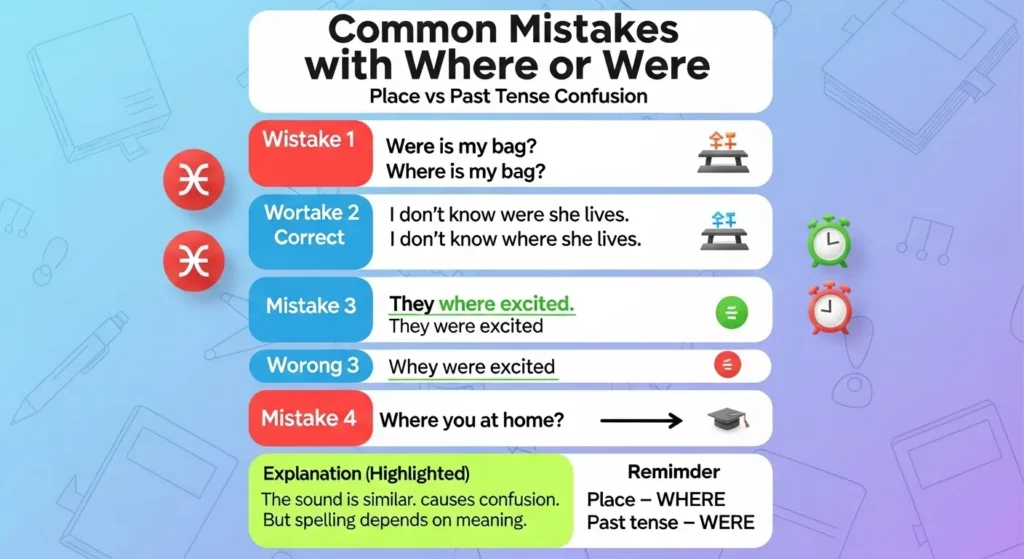
Many writers mix these words in questions.
Mistake 1:
Wrong: Were is my bag?
Correct: Where is my bag?
Mistake 2:
Wrong: I don’t know were she lives.
Correct: I don’t know where she lives.
Mistake 3:
Wrong: They where excited.
Correct: They were excited.
Mistake 4:
Wrong: Where you at home?
Correct: Were you at home?
The sound is similar.
That causes confusion.
But spelling depends on meaning.
✍️ Where or Were in Everyday Writing
These words appear everywhere.
📧 In Emails
Correct: Where did you save the file?
Correct: We were in a meeting.
Professional writing must be clear.
A small mistake looks careless.
📰 In News Writing
News uses “where” to describe places.
Example:
The accident happened where the roads meet.
News uses “were” for past facts.
Example:
The victims were treated at a hospital.
Accuracy matters in journalism.
📱 On Social Media
Mistakes are common online.
People type fast.
They ignore grammar.
Example mistake:
Were are you now?
Correct form:
Where are you now?
Short posts still need correct words.
📚 In School Essays
Teachers mark grammar errors.
Example:
Wrong: The park were we met.
Correct: The park where we met.
Wrong: The students where tired.
Correct: The students were tired.
Using correct words improves grades.
📊 Where or Were: Usage Data and Popularity
Search data shows many people confuse these words.
Students search the difference often.
Non-native speakers search it more.
“Where” is used more frequently overall.
It appears in many questions.
“Were” appears often in stories.
It is common in past tense writing.
Common confusion happens in typing.
Auto-correct sometimes fixes it.
Sometimes it makes it worse.
Usage depends on sentence purpose.
📋 Comparison Table: Where vs Were
| Feature | Where | Were |
| Part of Speech | Adverb / Conjunction | Verb |
| Talks About | Place | Past State |
| Example | Where is she? | They were happy. |
| Replacement Test | At what place | Past form of “are” |
| Time Reference | Present or general | Past |
This table makes it clear.
Place vs past.
That is the core difference.
❓ FAQs About Where or Were
1. Why do people confuse where and were?
They sound alike.
Fast typing causes mistakes.
Pronunciation is similar.
2. Is “where” ever a verb?
No.
It is never a verb.
It shows place only.
3. Can “were” start a question?
Yes.
Example:
Were you at school?
It forms past tense questions.
4. What is the trick to remember?
Where = Here.
Both talk about place.
Were = Past of are.
Think “we were.”
5. Is it “where you” or “were you”?
It depends on meaning.
Question about place:
Where are you?
Past question:
Were you there?
6. Is “if I were” correct?
Yes.
It is grammatically correct.
Example:
If I were you, I would study.
This shows imagination.
7. Can both appear in one sentence?
Yes.
Example:
We were at the café where we first met.
Both are correct.
Both have different roles.
🏁 Conclusion
Where and were look similar. They sound similar. But they have completely different meanings. “Where” talks about place.
It asks about location. It connects ideas about position. “Were” is a verb. It shows a past state. It is the past form of “are.” The easiest way to choose is to check meaning.
If the sentence asks about place, use “where.” If it describes something in the past, use “were.” Always read your sentence carefully. Small grammar mistakes can change meaning.
They can also affect clarity in school, work, and online writing. Practice simple sentences daily.
Over time, the difference will feel natural. Once you understand place versus past, you will never confuse where and were again.
Discover More posts!
Realise or Realize: Grammar Guide for Writers 📘✍️
Benefitting or Benefiting: Meaning, Usage, and Examples
In To or Into: Which One Is Correct? With In 30 Seconds
📜Traveling or Travelling:Meaning, Usage, and Examples
🎓Any Time or Anytime: Meaning, Usage and Examples

**Emily R. Dawson** I am a English language writer and editor i specializes in grammar clarity, sentence structure, and common writing mistakes.I focuses on helping readers write correct, natural-sounding English through simple explanations and practical examples. Emily mainly creates beginner-friendly and intermediate-level language guidesmy writing style is clear, supportive, and easy to follow.