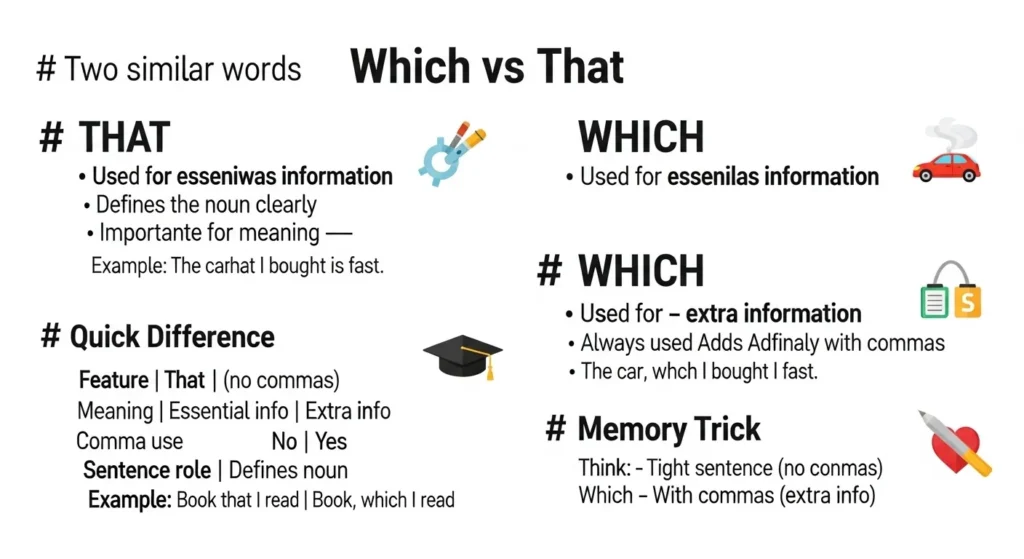
That is used for essential information, while which is used for extra, non essential information.
Many people search for which vs that because both words are used to connect clauses in sentences.
They look simple, but the choice between them can change meaning and clarity. Students, writers, and professionals often get confused when writing essays, emails, or reports.
The confusion happens because both words introduce relative clauses, yet they follow different rules in formal writing. Understanding when to use each one helps make your sentences clear and correct.
This guide explains the quick answer, origin, grammar rules, common mistakes, examples, and usage patterns so you can confidently use which and that.
⚡ Which vs That: Quick Answer
The main rule is:
- That = essential information (no commas)
- Which = extra information (with commas)
Examples
- The book that I borrowed is interesting.
- The book, which I borrowed yesterday, is interesting.
Simple Explanation
- Use that when the information is necessary.
- Use which when the information is additional.
📜 The Origin of Which and That
Both words come from Old English but have different uses.
Origin of That
“That” comes from Old English þæt, meaning a specific thing.
It has always been used to point to something important or specific.
Example:
- The car that he bought is new.
Origin of Which
“Which” comes from Old English hwilc, meaning what kind or which one.
Example:
- The car, which is new, belongs to him.
Over time, English grammar separated their roles for clarity.
🇬🇧🇺🇸 British English vs American English Spelling
There is no spelling difference, but usage can vary slightly.
| Word | British English | American English | Usage |
| That | That | That | Essential clauses |
| Which | Which | Which | Non essential clauses |
In American English, the rule is followed more strictly.
British English sometimes uses “which” in both cases, but formal writing still prefers the distinction.
🌍 Which Word Should You Use?
Your choice depends onIf the information is essential.
Use That for Essential Information
Example:
- The phone that I bought is expensive.
Meaning:
You are talking about a specific phone. The clause is necessary.
Use Which for Extra Information
Example:
- The phone, which I bought yesterday, is expensive.
Meaning:
You already know which phone. The extra detail is not necessary.
❌ Common Mistakes with Which vs That
These mistakes are very common.
1. Using Which Without Commas
Incorrect:
- The car which I bought is fast.
Correct:
- The car that I bought is fast.
2. Using That with Commas
Incorrect:
- The car, that I bought, is fast.
Correct:
- The car, which I bought, is fast.
3. Mixing Up Meaning
Incorrect:
- The students which study hard pass exams.
Correct:
- The students that study hard pass exams.
📘 Understanding the Grammar Rule
Here is a clear comparison.
| Word | Clause Type | Commas | Example |
| That | Restrictive | No | The book that I read was good. |
| Which | Non restrictive | Yes | The book, which I read, was good. |
Key Idea
- Restrictive clause → necessary → use that
- Non restrictive clause → extra → use which
✍️ Which vs That in Everyday Examples
📧 Email Example
“The report that you sent is helpful.”
📰 News Example
“The policy, which was announced yesterday, will start soon.”
📱 Social Media Example
“The movie that I watched was amazing.”
📄 Formal Writing Example
“The data, which was collected over five years, shows clear trends.”
These examples show how both words are used in daily writing.
📊 Which vs That: Google Trends & Usage Data
Search data shows that which vs that is a popular grammar query.
Common related searches include:
- which vs that difference
- when to use which or that
- which vs that examples
- which vs that grammar rule
- which vs that comma rule
Countries where this topic is widely searched:
- United States
- United Kingdom
- India
- Pakistan
Students and professionals often check this rule for formal writing.
📋 Comparison Table: Which vs That
| Feature | That | Which |
| Use | Essential info | Extra info |
| Clause type | Restrictive | Non restrictive |
| Commas | No | Yes |
| Example | The car that I bought | The car, which I bought |
This table summarizes the difference clearly.
🧠 Easy Memory Tricks
Simple tricks make it easier to remember.
Trick 1: That = Important
If the information is necessary, use that.
Example:
- The book that I need is missing.
Trick 2: Which = Extra
If the information can be removed, use which.
Example:
- The book, which is old, is valuable.
Trick 3: Comma Rule
- Comma → use which
- No comma → use that
📖 Advanced Usage Examples
Using That
- The house that we built is strong.
- The student that studies hard will succeed.
Using Which
- The house, which we built last year, is strong.
- The student, which is incorrect here, should be “who” for people.
Note:
Use who for people, not which or that in formal writing.
🧾 Which vs That in Professional Writing
Right usage improves clarity.
Correct:
- The system that we installed works well.
Correct:
- The system, which we installed last year, works well.
Incorrect:
- The system, that we installed, works well.
Using the wrong word can make writing unclear or less professional.
🌎 Why This Confusion Happens
This confusion occurs because:
- Both words connect clauses.
- They are often used interchangeably in speech.
- Grammar rules are not always taught clearly.
Understanding clause types helps solve the problem.
❓ FAQs About Which vs That
1. What is the difference between which and that?
That is used for essential information, while which is used for extra information.
2. When should I use commas?
Use commas with “which,” not with “that.”
3. Can I use which instead of that?
In informal speech, yes. In formal writing, it is better to follow the rule.
4. Is this rule strict in all English?
It is stricter in American English than in British English.
5. What is a restrictive clause?
A clause that is necessary to understand the sentence.
6. What is a non restrictive clause?
A clause that adds extra information and can be removed.
7. Is this mistake common?
Yes. Many writers confuse which and that.
🏁 Conclusion:
The difference between which and that becomes clear when you understand how they function in a sentence. “That” is used for essential information that defines the subject.
Without it, the sentence may lose its meaning. “Which,” on the other hand, is used for extra information that adds detail but is not necessary. It is usually separated by commas.
This distinction is important in formal writing because it improves clarity and precision. While casual speech may mix these words, professional writing benefits from using them correctly. Remember the simple rule: use “that” for important information and “which” for additional details.
With practice, you will quickly recognize when each word is needed. Mastering this difference helps you write clearer and more professional English in emails, essays, and reports.
Discover More Articals!
Family’s or Families: What’s the Difference 👨👩👧👦
To Many or Too Many: When Should You Use Each?
Their vs There vs They’re: What Is the Difference?

englifiy.com is my English grammar comparison website where I simplify confusing words, spelling differences, and usage rules through clear explanations and examples. My goal is to help learners, writers, and students understand English easily and use correct grammar with confidence.