“You’re welcome” is the correct polite reply to “thank you,” while “your welcome” is usually incorrect because “your” shows possession.
Many English learners and even native speakers search for “your welcome or you’re welcome” because these two forms look similar but mean different things. This confusion is
very common in emails, text messages, social media, and professional writing. People often type “your welcome” quickly, without realizing it can be grammatically incorrect.
The main confusion comes from the apostrophe in “you’re,” which is a short form of you are. When someone says thank you, the correct reply is “you’re welcome.” This guide clearly explains the difference and helps you use the correct form with confidence.
Your Welcome or You’re Welcome:Quick Answer

You’re welcome is the correct phrase used to respond politely when someone says thank you.
Your welcome is usually incorrect in this context because your shows possession.
Examples:
- “Thank you for your help.” → “You’re welcome.” ✅
- “This gift is your welcome to the team.” ✅ (rare, specific meaning)
❌ Thanks for the help! → Your welcome. (Incorrect)
Simple rule:
If you can replace it with “you are welcome,” then you’re welcome is correct.
The Origin of Your Welcome or You’re Welcome

To understand the difference, we must look at the origin of both words.
Origin of “You’re Welcome”
You’re is a contraction of “you are.” Contractions became popular in spoken and written English to make communication faster and more natural.
The phrase “you are welcome” has been used for centuries as a polite response meaning you are gladly received or you are not a burden.
Over time, “you are welcome” was shortened to “you’re welcome,” especially in everyday speech and informal writing. The apostrophe replaces the missing letter a in are.
Origin of “Your”
Your comes from Old English ēower, meaning belonging to you. It is a possessive adjective and always shows ownership.
The confusion exists because your and you’re sound exactly the same when spoken. English kept both spellings even though pronunciation merged, which is why mistakes are so common today.
British English vs American English Spelling
There is no spelling difference between British English and American English when it comes to your welcome or you’re welcome. Both varieties follow the same grammar rules.
The phrase “you’re welcome” is standard and correct in:
- British English
- American English
- Australian English
- Canadian English
- International English
Examples
- British English: “Thank you very much.” → “You’re welcome.”
- American English: “Thanks for your support.” → “You’re welcome.”
Comparison Table
| Feature | British English | American English |
| Correct response to thanks | You’re welcome | You’re welcome |
| Use of “your welcome” | Rare, literal | Rare, literal |
| Grammar rule | Same | Same |
Which Spelling Should You Use?
The correct choice depends on meaning and audience, not region.
General Advice
- US audience: Use you’re welcome when replying to thanks.
- UK/Commonwealth audience: Same rule applies.
- Global audience: Always prefer you’re welcome for clarity and correctness.
When “Your Welcome” Is Correct
“Your welcome” is only correct when welcome is a noun and belongs to someone.
Examples:
- This note is your welcome to the company.
- Please accept your welcome gift.
These cases are rare and formal.
Common Mistakes with Your Welcome or You’re Welcome
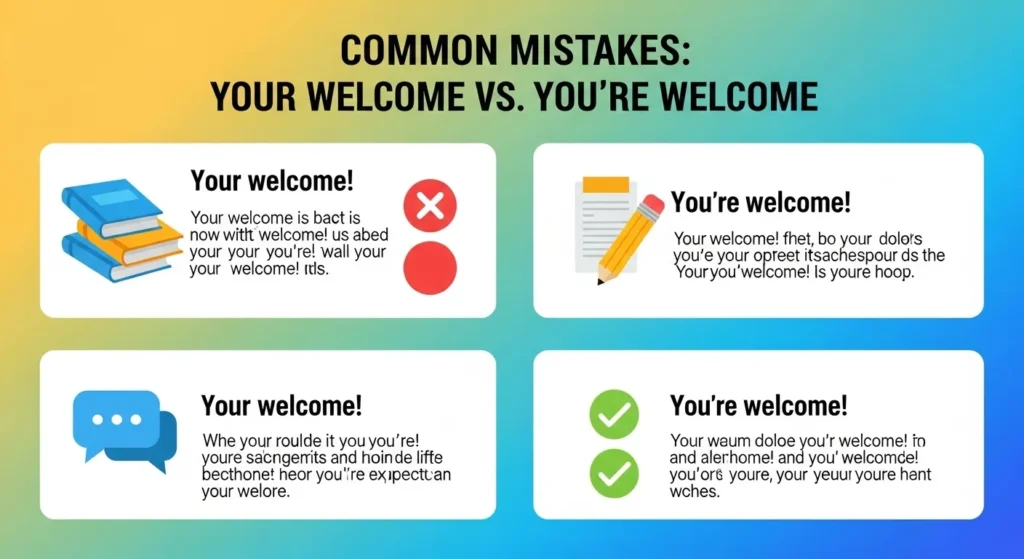
Mistake 1: Using “Your” Instead of “You’re”
❌ Your welcome for your help. ✅ You’re welcome for your help.
Mistake 2: Forgetting the Apostrophe
❌ Youre welcome. ✅ You’re welcome.
Mistake 3: Assuming Both Are Interchangeable
❌ Thanks! → Your welcome. ✅ Thanks! → You’re welcome.
Your Welcome Grammar and Spelling Rules
Many people search questions like your welcome grammar, your welcome spelling, or your welcome correct grammar because they want to confirm which form is correct.
In standard English grammar, the phrase used after someone says thank you is you’re welcome, not your welcome. The reason is simple: you’re is a contraction of you are, while your shows possession.
For example:
Thank you for helping me. → You’re welcome.
Thank you for the information. → You’re welcome.
Because both phrases sound the same when spoken, learners often search questions like youre or your welcome, your and you’re welcome, or is it your or youre welcome when checking their grammar.
To avoid mistakes, remember this simple test: if the phrase can be replaced with you are welcome, then you’re welcome is the correct spelling.
Your Welcome or You’re Welcome in Everyday Examples
Emails
- Thank you for the quick reply. → You’re welcome. Happy to help.
News
- The spokesperson replied, “You’re welcome to attend the meeting.”
Social Media
- Thanks for the info! → You’re welcome 😊
Formal Writing
- Guests are informed that they’re welcome to use the facilities.
Your Welcome or You’re Welcome:Google Trends & Usage Data
Search data shows that “your welcome or you’re welcome” is a highly searched phrase, especially in:
- South Asia
- Southeast Asia
- Africa
- ESL-learning countries
Most searches come from:
- Students
- Content writers
- Job seekers
- Social media users
You’re welcome dominates usage in:
- Professional writing
- Academic texts
- Business emails
Your welcome appears mostly in:
- Grammar questions
- Error examples
- Rare formal noun usage
This shows strong user intent for quick correction and confidence in writing.
How to Spell and Use “You’re Welcome” Correctly
Another common search involves spelling questions such as how do you spell you’re welcome, how to spell your welcome, or how to write your welcom.
The correct spelling used when replying to thanks is you’re welcome, which comes from the phrase you are welcome meaning you are gladly received or it was no trouble to help.
Example:
Thanks for your help today. → You’re welcome.
Some learners also search phrases like you welcome meaning or simply you welcome when trying to understand the polite response. In everyday English, however, the full and correct phrase remains you’re welcome.
Occasionally you may see searches like your wel or your welcome.or you’re welcome when users are quickly checking spelling. In all these cases, the correct and professional form is you’re welcome.
Using the correct spelling ensures that your emails, messages, and professional communication appear clear and grammatically accurate.
Comparison Table:Your Welcome vs You’re Welcome
| Phrase | Grammar Type | Correct Usage | Example |
| You’re welcome | Contraction | Reply to thanks | You’re welcome! |
| Your welcome | Possessive | Rare, noun form | Your welcome gift |
Frequently Asked Questions
Is “your welcome” ever correct?
Yes, but only when welcome is a noun that belongs to someone.
Is “you’re welcome” formal or informal?
It works in both formal and informal English.
Can I say “you are welcome” instead?
Yes, it is fully correct but less common in casual writing.
Why do people confuse your and you’re?
Because they sound the same when spoken.
Is “your welcome” wrong on social media?
Yes, in most cases it is grammatically incorrect.
Which one should I use in exams?
Always use you’re welcome.
Is “you’re welcome” used worldwide?
Yes, it is globally accepted English.
read more about!British English vs American English Spelling
Conclusion
The confusion between your welcome or you’re welcome is small but very important. In everyday English, you’re welcome is the correct and polite response when someone thanks you.
It is a contraction of you are welcome and works in all types of English formal, informal, British, American, and global.
On the other hand, your welcome is rarely correct and only works when welcome is used as a noun showing possession. Because both phrases sound the same, mistakes happen often,
especially in fast typing and casual messages. However, once you remember the simple rule if it means “you are,” use you’re the confusion disappears.
Using the correct form improves your grammar, professionalism, and confidence. If you are writing an email, or answering an exam question, choosing you’re welcome shows strong language skills.
With this complete guide, examples, tables, FAQs, and usage advice, you can now use your welcome or you’re welcome correctly every time.
Related posts!
Aluminum or Aluminium: Quick Answer
Formal vs Informal Usage of Themself and Themselves 🎯
💬 Free Rein or Free Reign in Everyday Writing and Speech

**Emily R. Dawson** I am a English language writer and editor i specializes in grammar clarity, sentence structure, and common writing mistakes.I focuses on helping readers write correct, natural-sounding English through simple explanations and practical examples. Emily mainly creates beginner-friendly and intermediate-level language guidesmy writing style is clear, supportive, and easy to follow.