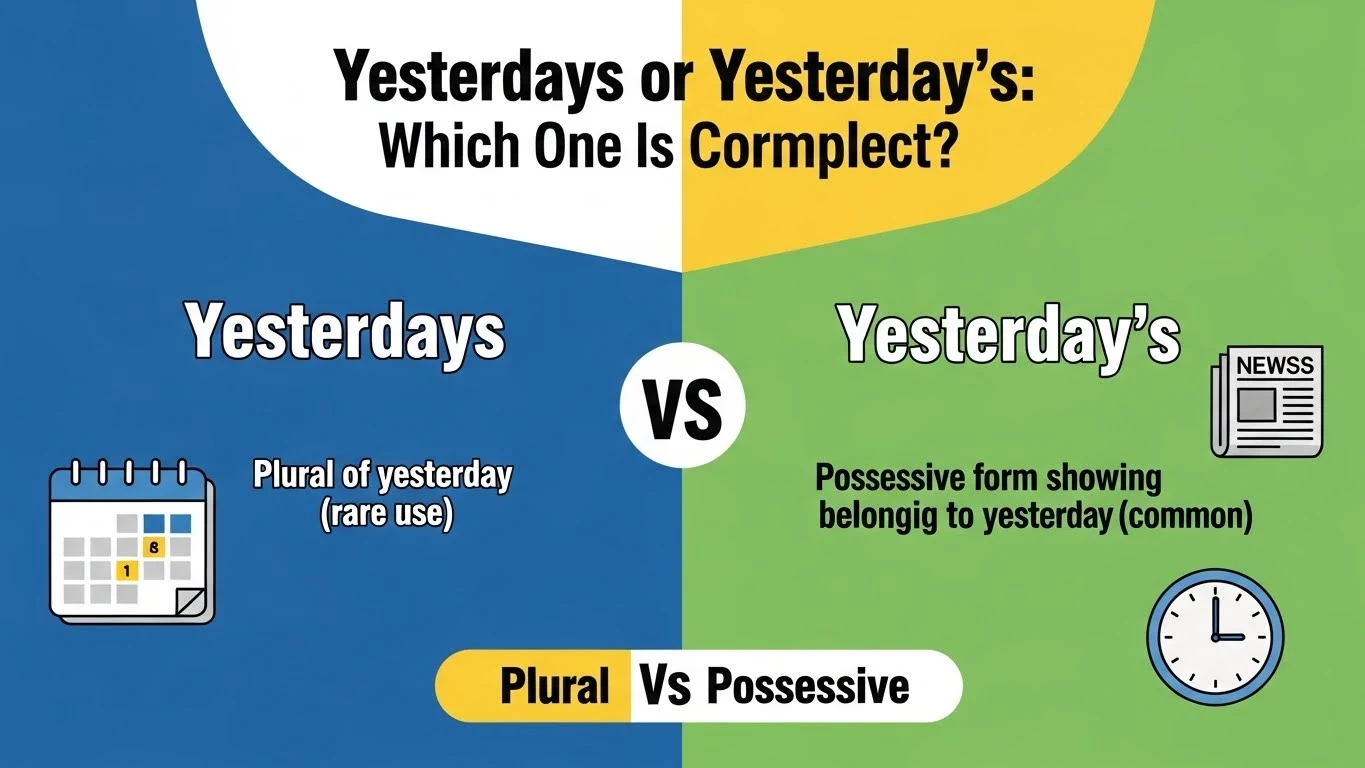
Many people feel confused when they see yesterdays and yesterday’s in writing. The words look almost the same, but the meaning changes because of one small apostrophe.
This is why thousands of users search for “yesterdays or yesterday’s” every month. They want a clear answer: which one is correct, and when should each form be used?
This confusion usually happens because English uses apostrophes for possession, while adding -s can also show plural form
. When these two rules mix, even confident writers can make mistakes. In emails, blog posts, news articles, and social media captions, using the wrong form can make your sentence look unprofessional or unclear.
This article solves that problem completely. You will get a quick answer, detailed explanations, easy examples, tables, and real-life usage.
By the end, you will clearly understand the difference between yesterdays and yesterday’s, know which one native speakers use most, and feel confident using the correct form in any situation.
Yesterdays vs Yesterday’s ;Quick Answer
Yesterday’s is the correct and commonly used form.
It shows possession, meaning something belongs to yesterday.
Examples:
- Yesterday’s weather was cold.
- I missed yesterday’s class.
- She shared yesterday’s news.
Yesterdays (without an apostrophe) is the plural form of yesterday.
It is grammatically correct, but very rare in modern English.
Example:
- Yesterdays like this make me nostalgic.
👉 Simple rule:
If something belongs to yesterday, use yesterday’s.
The Origin of Yesterdays or Yesterday’s
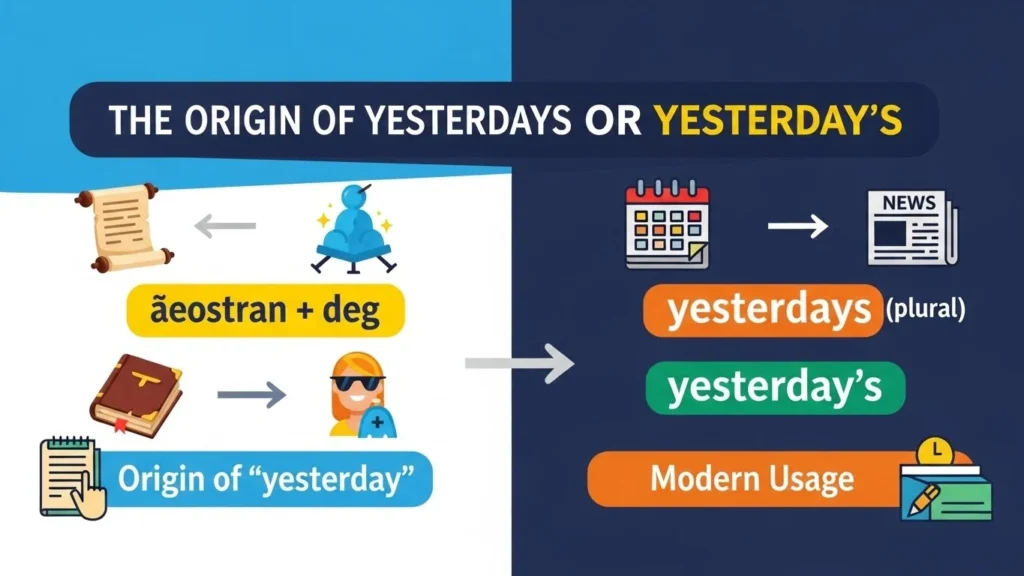
The word yesterday comes from Old English.
It was formed from:
- “ġeostran” meaning of yesterday
- “dæg” meaning day
Over time, these words merged into yesterday, meaning the day before today.
The apostrophe ’s came later when English grammar rules developed to show ownership or possession. That is why yesterday’s means belonging to yesterday.
The plural form yesterdays follows the normal English rule of adding -s to make something plural. However, since we rarely talk about many “yesterdays” at once, this form is uncommon.
So, the spelling difference exists because:
- ’s = possession
- s = plural
Yesterday’s Meaning, Grammar, and Apostrophe Explained
Many English learners also search for yesterday’s meaning, yesterday’s grammar, and yesterday’s apostrophe to better understand how the word works in sentences.
The base word yesterday simply means the day before today.
Examples:
- Yesterday was very busy.
- I finished my project yesterday.
When we add an apostrophe and ’s, the word becomes yesterday’s, which shows possession.
Examples:
- Yesterday’s meeting was productive.
- Yesterday’s event attracted many visitors.
- Yesterday’s report helped us understand the situation.
This is why people often search questions like is yesterday’s correct, yesterday’s or yesterdays, and yesterdays or yesterday’s which is correct.
The simple rule is:
Use yesterday’s when something belongs to yesterday.
Examples:
- Yesterday’s work is already finished.
- Yesterday’s results surprised everyone.
Many writers also wonder about yesterday’s event or yesterday event.
Correct usage:
✅ Yesterday’s event was successful.
❌ Yesterday event was successful.
The apostrophe is necessary because it shows possession or connection with the previous day.
British English vs American English Spelling
There is no spelling difference between British and American English for yesterday’s or yesterdays. Both follow the same grammar rules.
The difference is only in usage frequency, not spelling.
Examples
American English:
- Yesterday’s game was exciting.
British English:
- Yesterday’s meeting lasted two hours.
Comparison Table
| Form | British English | American English | Meaning |
|---|---|---|---|
| yesterday’s | ✅ Common | ✅ Common | Possessive |
| yesterdays | ✅ Rare | ✅ Rare | Plural |
👉 Both varieties prefer yesterday’s.
Which Spelling Should You Use?
For US Audience
Use yesterday’s.
It sounds natural and correct to American readers.
For UK & Commonwealth Audience
Use yesterday’s.
It matches standard British grammar rules.
For Global Audience
Always use yesterday’s unless you clearly mean multiple past days.
👉 Professional advice:
In blogs, articles, SEO content, emails, and academic writing, yesterday’s is almost always the right choice.
Common Mistakes with Yesterdays and Yesterday’s
Many writers make the same mistakes again and again.
❌ Mistake 1: Missing apostrophe
- ❌ Yesterday meeting was long.
- ✅ Yesterday’s meeting was long.
❌ Mistake 2: Using plural instead of possessive
- ❌ I read yesterdays news.
- ✅ I read yesterday’s news.
3: Apostrophe misuse
- ❌ Yesterdays’ news was shocking.
- ✅ Yesterday’s news was shocking.
Mistake 4: Overusing plural
- ❌ Yesterdays event was great.
- ✅ Yesterday’s event was great.
Common Spelling Confusion: Yesterday, Yeasterday, and Yesturday
Another common issue is the spelling of yesterday. Many learners accidentally write incorrect forms such as yeasterday or yesturday.
Correct spelling:
✅ yesterday
Incorrect spellings:
❌ yeasterday
❌ yesturday
Because of this confusion, many users search queries like yesterday vs yesturday, is it yesterday or yesturday, spell yesterday, and yesterday correct spelling.
A simple way to remember the correct spelling is:
yes + ter + day = yesterday
Example sentences:
- Yesterday I visited my cousin.
- Yesterday we completed an important task.
Some people also search yesterday vs yesterday’s to understand the difference.
| Word | Meaning |
|---|---|
| yesterday | the day before today |
| yesterday’s | something belonging to yesterday |
Examples:
- Yesterday was sunny.
- Yesterday’s weather was pleasant.
Understanding this difference helps writers avoid mistakes in emails, articles, and everyday writing.
Yesterdays or Yesterday’s in Everyday Examples
Emails
- Yesterday’s email was not clear.
- Please review yesterday’s report.
News
- Yesterday’s headline shocked the nation.
- Markets reacted to yesterday’s decision.
Social Media
- Yesterday’s vibes were amazing 😊
- Missing yesterday’s memories already.
Formal Writing
- Yesterday’s data confirms the trend.
- The study builds on yesterday’s findings.
Spoken English
Native speakers almost always say yesterday’s, not yesterdays.
Yesterdays or Yesterday’s ; Google Trends & Usage Data
Search data shows that “yesterday’s” is far more popular than “yesterdays.”
Usage by Country
- United States: Yesterday’s (very high usage)
- United Kingdom: Yesterday’s (very high usage)
- Canada & Australia: Yesterday’s dominates
- Global English learners: Confusion exists, but possessive form is preferred
Context of Use
- News articles → Yesterday’s
- Blogs & SEO content → Yesterday’s
- Academic writing → Yesterday’s
- Poetry or storytelling → Sometimes yesterdays
👉 This proves that yesterday’s is the practical and safe choice.
Comparison Table: Yesterdays vs Yesterday’s
| Feature | Yesterdays | Yesterday’s |
|---|---|---|
| Grammar | Plural noun | Possessive noun |
| Usage | Rare | Very common |
| Meaning | Many past days | Belonging to yesterday |
| Professional writing | ❌ Avoid | ✅ Recommended |
| SEO-friendly | ❌ Low | ✅ High |
Frequently Asked Questions (FAQs)
1. Is yesterdays ever correct?
Yes, but only when talking about multiple past days.
2. Which one should I use in exams?
Use yesterday’s.
3. Can yesterdays be used in modern English?
Yes, but it is rare and mostly literary.
4. Is yesterday’s informal?
No. It is correct in both formal and informal writing.
5. Why does yesterday’s need an apostrophe?
Because it shows possession.
6. Can I say yesterdays news?
No. Correct form is yesterday’s news.
7. Which form is better for SEO?
Yesterday’s performs better and matches user intent.
Read more about!
Which Spelling Should You Use?
Conclusion
The confusion between yesterdays or yesterday’s is common, but the solution is simple once you understand the rule. Yesterday’s is the possessive form
, and it is the version used in daily conversation, professional writing, news, emails, and online content. If you are talking about something that belongs to yesterday, this is the correct choice almost every time.
The plural form yesterdays does exist, but it is rarely needed. It usually appears in poetry, storytelling,
or very specific contexts where someone is talking about many past days together. For most writers, learners, and content creators, this form can safely be avoided.
By remembering one simple rule apostrophe means possession you can avoid mistakes and write with confidence.
Whether you are writing for an American, British, or global audience, yesterday’s is the safe, clear, and professional option.
Mastering this small detail can greatly improve the clarity and credibility of your English writing.
Discover More Posts!
To Many or Too Many: When Should You Use Each?
📚Defense or Defence: Which Spelling Is Correct?
⚡ Clearer or More Clear: Quick Rules for Correct Usage

**Emily R. Dawson** I am a English language writer and editor i specializes in grammar clarity, sentence structure, and common writing mistakes.I focuses on helping readers write correct, natural-sounding English through simple explanations and practical examples. Emily mainly creates beginner-friendly and intermediate-level language guidesmy writing style is clear, supportive, and easy to follow.