The transition into university life is often viewed as a series of academic hurdles—passing exams, finishing lab reports, and staying on top of reading lists. However, beneath these technical requirements lies a more fundamental skill set: the ability to communicate who you are and what you value. Whether you are vying for financial support or standing in front of a new seminar group, your success depends on how effectively you can translate your thoughts into compelling narratives. For undergraduate students globally, mastering this dual art of written and verbal self-presentation is the ultimate competitive advantage.
Navigating the competitive world of higher education requires more than just high grades; it demands the ability to tell a story that resonates with decision-makers. One of the first major challenges students face is the funding gap. Crafting a narrative that highlights your achievements while maintaining humility is a delicate balance. Many students find that consulting a professional scholarship essay writer allows them to refine their personal statements, ensuring their unique voice remains intact while meeting the rigorous standards of selection committees. This written foundation serves as the first “handshake” between a student and their future institution.
The Architecture of a Winning Scholarship Essay
Writing a scholarship essay is fundamentally different from writing a standard academic paper. In a history or science essay, the focus is on external data and analysis. In a scholarship essay, you are the subject.
1. Finding Your “Hook”
The first paragraph must do more than introduce the topic; it must grab the reader’s attention. Most committees read hundreds of essays. If yours starts with “I want this scholarship because I need the money,” it will likely be forgotten. Instead, start in the middle of a moment—a challenge you overcame, a spark of curiosity in a library, or a community project that changed your perspective.
2. The Power of “Show, Don’t Tell”
Instead of saying you are “hardworking,” describe the sixteen-hour days you spent balancing a part-time job with a coding project. Instead of saying you are “passionate about biology,” describe the first time you looked through a microscope and realized how much was happening in a single drop of water. Specificity builds credibility.
3. Aligning with the Donor’s Mission
Every scholarship has a “personality.” Some value leadership; others value community service or technical innovation. Research the organization providing the funds and weave their core values into your narrative. This isn’t about being fake; it’s about highlighting the parts of your experience that align with their goals.
Transitioning from the Page to the Podium
Once the written word has opened the door, the next challenge is the verbal introduction. Communication in a global academic setting isn’t just about what you write on a screen; it’s about how you carry yourself in a room full of strangers. The “Self-Introduction” is perhaps the most frequent and most underrated speech you will ever give.
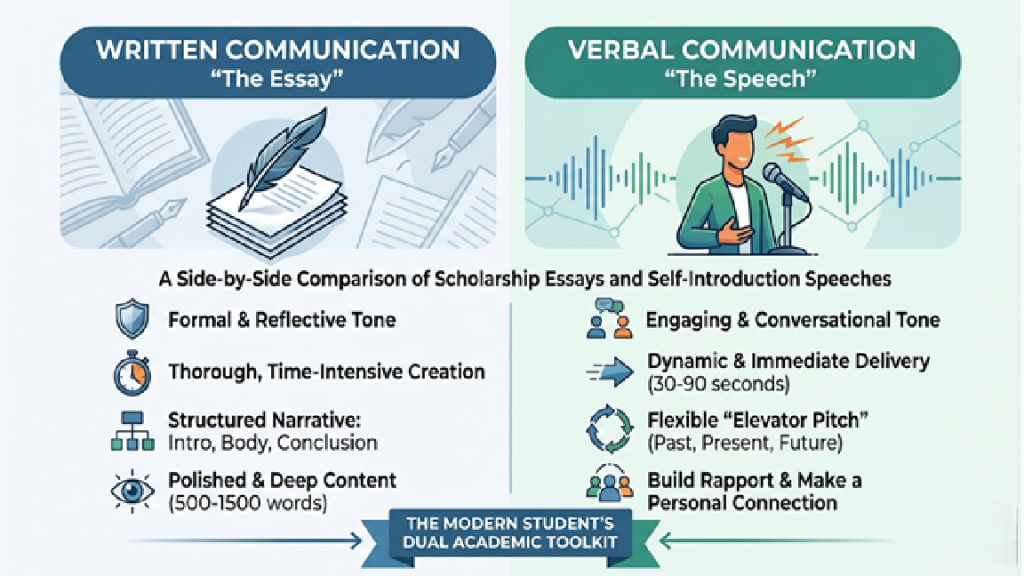
| Feature | Scholarship Essay (Written) | Intro Speech (Verbal) |
| Primary Goal | Secure funding/admission | Build rapport/professional network |
| Tone | Formal, reflective, and polished | Engaging, conversational, and energetic |
| Duration | 500 – 1,500 words | 30 – 90 seconds |
| Structure | Linear: Intro, Body, Conclusion | “Elevator Pitch” style: Past, Present, Future |
As you move through your degree, you will find that these two forms of communication constantly overlap. A well-written essay gives you the confidence to speak, and a confident speech helps you clarify your thoughts for your next writing project.
Crafting the Perfect Self-Introduction Speech
The “tell me about yourself” prompt is notorious for causing mental blocks. Whether it’s in a classroom icebreaker, a club interview, or a professional networking event, having a pre-planned structure is vital.
To deliver a truly impactful self-introduction speech, one should focus on the “Past-Present-Future” framework. This method allows you to briefly mention where you came from, what you are currently studying, and what you hope to achieve. If you find yourself struggling to organize these thoughts into a cohesive script, experts at MyAssignmentHelp can provide structured templates and speech-writing guidance to help you find your professional rhythm. The goal is to sound prepared but not rehearsed, ensuring your personality shines through the professional exterior.
Breaking Down the Framework:
- The Past (The Hook): Start with a brief “origin story” related to your field of study. “I grew up in a coastal town where I saw the direct impact of climate change on our local economy…”
- The Present (The Action): State what you are doing now. “Currently, I am a sophomore at [University Name] focusing on Environmental Economics…”
- The Future (The Goal): Connect your current work to a larger purpose. “I’m looking to apply these insights to help sustainable startups scale their operations.”
Overcoming Common Communication Barriers
For undergraduate students, especially those in a global or multicultural environment, certain barriers can hinder effective communication.
- Public Speaking Anxiety: It is estimated that 75% of people experience some form of speech anxiety. The key is to view the speech as a conversation, not a performance. Practice in front of a mirror or record yourself on your phone to identify filler words like “um” or “like.”
- The “Imposter Syndrome” in Writing: Many students feel they haven’t done enough to “deserve” a scholarship. Remember that scholarships are often based on potential as much as past performance. Write with the future version of yourself in mind.
- Cultural Nuances: In a global academic setting, what counts as “confident” in one culture might be seen as “arrogant” in another. Aim for a “global tone”—be direct, respectful, and focus on shared academic goals rather than personal bravado.
Why Authenticity Trumps Perfection
Google’s search algorithms and university professors have one thing in common: they are both getting better at spotting “robotic” or “spammy” content. In an age of automation, your most valuable asset is your unique human perspective.
When you write or speak, don’t try to use the biggest words in the dictionary. Instead, use the most accurate words. Avoid clichés like “thinking outside the box” or “hardworking student.” These phrases have lost their meaning through over-use. Instead, provide data, anecdotes, and specific goals.
Final Checklist for Academic Communication Success
To ensure your efforts rank high in the eyes of a selection committee (and search engines), keep these technical tips in mind:
- Structure: Use clear headings and bullet points to make your content “scannable.”
- Relevance: Always ask, “Does this sentence add value to the reader?” If not, cut it.
- Clarity: Read your essays and speeches out loud. If you run out of breath before finishing a sentence, the sentence is too long.
- Engagement: Use a mix of short, punchy sentences and longer, descriptive ones to create a natural “flow.”
Frequently Asked Questions (FAQ)
Q1: How long should a self-introduction speech be?
Ans: For most academic and networking settings, aim for 60 to 90 seconds. Anything longer risks losing the audience’s attention; anything shorter may feel rushed or incomplete.
Q2: Can I use the same essay for different scholarship applications?
Ans: You can use the same core stories, but you must tailor the introduction and conclusion to match each specific donor’s mission. A “copy-paste” approach is often obvious to committees.
Q3: What is the most important part of a scholarship essay?
Ans: The “Why.” Why do you want to study this subject? Why does this scholarship matter to your future? Why should the committee invest in you specifically?
Q4: How do I handle nerves before a speech?
Ans: Focus on your breathing and remember that the audience wants you to succeed. Most people won’t notice minor stumbles if your overall message is clear and enthusiastic.
Q5: Is it okay to mention my weaknesses in an essay?
Ans: Yes, but only if you frame them through the lens of growth. Discussing a failure and how you learned from it shows a high level of maturity and “E-E-A-T” (Experience and Trustworthiness).
About The Author
Hello! I am Alice Anderson, a dedicated professional at MyAssignmentHelp. With a strong background as a digital content strategist and SEO specialist, I focus on developing high-impact educational resources that bridge the gap between academic theory and practical application.